Stores
Material issue slip format for construction site stores, with a filled example
Material that leaves the store without a slip is material nobody can account for. One numbered line per item, naming who took it and for which work, turns the store's balance into something you can check.
Part of the guide to construction material tracking
On this page · 8 sections
Key takeaways
- A material issue slip records material leaving the store for the work: what, how much, to whom, for which phase, and against which request.
- The requisition asks for material; the issue slip proves it left the store. Number both and write the requisition number on the slip.
- Write the slip at the store counter when the material goes out, signed by the storekeeper and the person collecting it.
- Charge every issue to a phase or task, so material cost lands on the work that used it.
- Check issues against work done each week: what was issued, minus what came back, against what the work should have used.
What a material issue slip is
A material issue slip is the store's record that material left it for the work. It names the item and quantity, the person or subcontractor who collected it, the phase or task it is for, and the request it answers. Sites also call it a store issue slip, a material issue note (MIN), an issue voucher or simply a store slip.
It is one of three documents that move material through a site store, and they are easy to mix up:
| Document | Direction | Written by | What it proves |
|---|---|---|---|
| Material requisition | A request, nothing moves yet | Site engineer or foreman | Who asked for what, for which work, by when |
| Goods received note | Into the store from a supplier | Storekeeper | What arrived against the order, short or damaged |
| Material issue slip | Out of the store to the work | Storekeeper, signed by the collector | What left, who took it and which work it is charged to |
| Return note | Back into the store from the work | Storekeeper | What came back unused, and from which work |
A material requisition form can be filled from the store or by buying. When it is filled from the store, the issue slip is the record that closes it.
Material issue slip format: the fields to include
| Field | Example | Why it's there |
|---|---|---|
| Slip number | MIS-0457 | Every slip is accounted for; a missing number is a question |
| Date and time | 12 Nov, 8:10 | Matches the slip to the day's work |
| Project and store | Two-storey house · site store | Which store's balance goes down |
| Issued to | Plaster subcontractor (foreman's name) | A person, not 'site', so someone answers for it |
| Against requisition | MR-0121 | Links the issue to an approved request |
| Phase or task | Ground floor · internal plaster | Charges the cost to the work that uses it |
| Item and specification | Cement, 50 kg bag | The same item names as the store register |
| Unit | bag, m³, kg, m | Counted the same way as the register |
| Quantity requested / issued | 10 / 10 | Shows a part-issue when stock is short |
| Batch or heat number | Cement batch, steel heat no. | Traces a quality problem back to a delivery |
| Rate and amount | Filled in by the office | Values the issue at the store's average cost |
| Signatures | Storekeeper · collector | Proof of hand-over at the counter |
Keep the rate off the storekeeper's copy if you like. The store counts quantities; the office values them. What matters is that the slip carries the phase, so the cost can be posted without asking anyone later.
A filled material issue slip
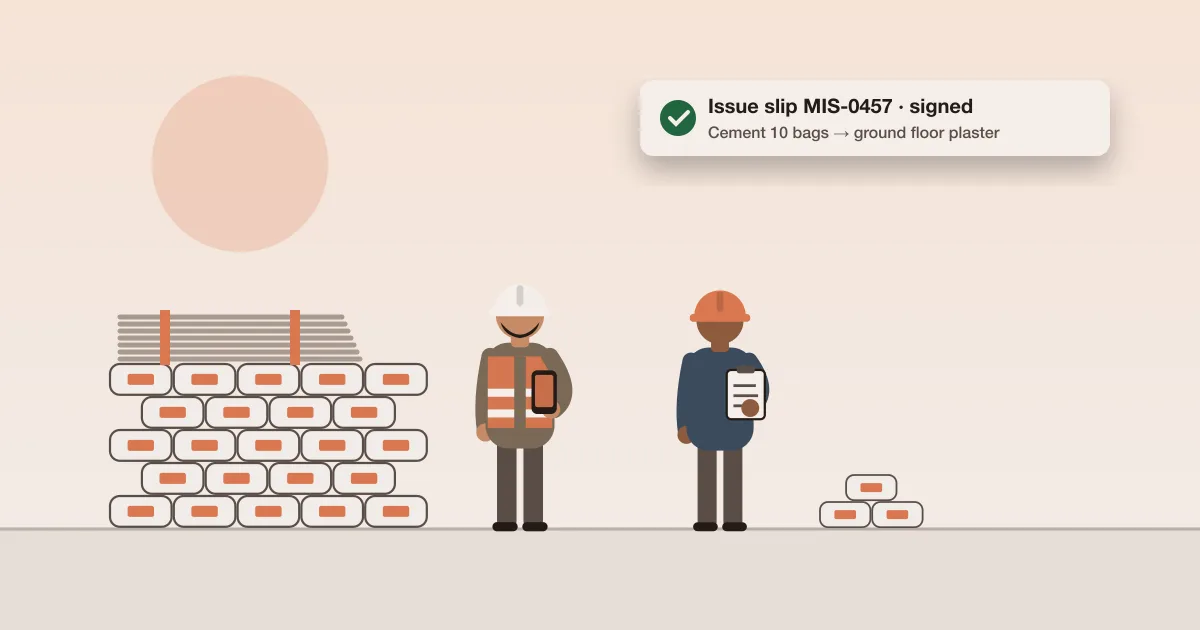
The plaster subcontractor starts the ground-floor rooms on Monday. Their foreman raised requisition MR-0121 for the week's cement and sand, and the project manager approved it. At 8:10 the storekeeper issues it. The rates are the store's average cost; all figures are samples.
| Item | Unit | Requested | Issued | Rate | Amount |
|---|---|---|---|---|---|
| Cement, 50 kg bag | bag | 10 | 10 | $9.50 | $95.00 |
| Plaster sand | m³ | 2 | 2 | $38.00 | $76.00 |
| Total | $171.00 |
Signed by the storekeeper and the plaster foreman. Sand is issued from the stockpile by the measured box or the loader bucket, not guessed, so its quantity on the slip means something.
Download the free material issue slip format (Excel). It has this slip with formulas for amounts and the total, and a register for numbering every slip.
The material issue register and the stock balance
Each slip becomes a line in the material issue register, and the register feeds the store's balance for every item:
Balance = opening stock + received − issued + returned − transferred out.
If a count finds less than the balance, the first place to look is a missing slip: a bag taken without paperwork, or an issue written on the wrong item. Counting site inventory covers how to count and reconcile without blaming anyone first. Stock reconciliation is a search for the record that explains the difference (Cleverence).
Check issues against the work done
The register also answers a question the count can't: was the material used well? By Friday the plaster subcontractor has done 120 m² of 12 mm plaster in a 1:6 mix and returned 1 bag. Net use is 9 bags. The plaster calculator puts that area at 7.9 bags with no allowance for wastage, so 1.1 bags, about 14%, went beyond the theoretical quantity. Sand is the same check: 2 m³ issued against 1.64 m³ theoretical.
| Cement (bags) | Sand (m³) | |
|---|---|---|
| Issued (MIS-0457) | 10 | 2 |
| Returned | 1 | 0 |
| Net used | 9 | 2 |
| Theoretical for 120 m², 12 mm, 1:6 | 7.9 | 1.64 |
| Above theoretical | 1.1 (14%) | 0.36 (22%) |
Material issue procedure on site
- 1The foreman or engineer raises a requisition for the work, and it is approved within the limits you've set.
- 2The storekeeper checks stock.
If there is not enough, they issue what there is, mark the slip as a part-issue and tell the buyer the shortfall. - 3The storekeeper writes the next numbered slip at the counter, with the phase and the requisition number, and counts the material out in front of the collector.
- 4Both sign.
On paper, the collector keeps one copy and the store keeps the other; in an app, the record is made at once. - 5The slip posts to the issue register the same day, and the store balance goes down.
- 6Unused material comes back on a return note against the same phase, so the net use is right.
- 7Once a week, compare net issues with work done for the main materials, and follow up anything well above the allowance.
Keep duties apart: the person who approves a requisition, the person who issues material and the person who writes off a stock difference should not be the same. Segregation of duties is a basic internal control (GAO Green Book). The construction storekeeper guide covers the rest of the store's daily routine.
Mistakes that make issue slips useless
- Writing the day's slips at closing time from memory. Write them at the counter, when the material goes out.
- Issuing to 'site' or 'labour'. Name a person or a subcontractor, or nobody is responsible for the material.
- Leaving the phase blank. The issue reduces the stock but its cost never reaches the job that used it.
- Skipping bulk material. Sand, aggregate and bricks are issued the most and slipped the least; measure them by the box, bucket or count.
- Unnumbered slip pads, or several pads in use at once. Gaps in the numbers can't be found.
- Never checking issues against work done, so heavy wastage only shows when the store runs out.
Questions people ask
What is a material issue slip?
The store's record that material left it for the work: the item, quantity, who collected it, the phase or task it is for and the requisition it answers, signed by the storekeeper and the collector.
What is the difference between a material issue slip and a requisition?
A requisition is a request for material and moves nothing. An issue slip records material actually leaving the store. Write the requisition number on the slip so each issue traces back to an approved request.
Who signs a material issue slip?
The storekeeper who issues the material and the person who collects it. The requisition it answers carries the approval.
Should material given free to subcontractors go on issue slips?
Yes, always. Free-issue material is the easiest to waste. Slip it to the subcontractor by name and phase, net off returns, and compare it with the work they bill for, using the wastage allowance in their subcontract.
How is issued material valued?
Usually at the store's average cost for the item, so each issue charges its phase with what the material really cost, not the latest price.