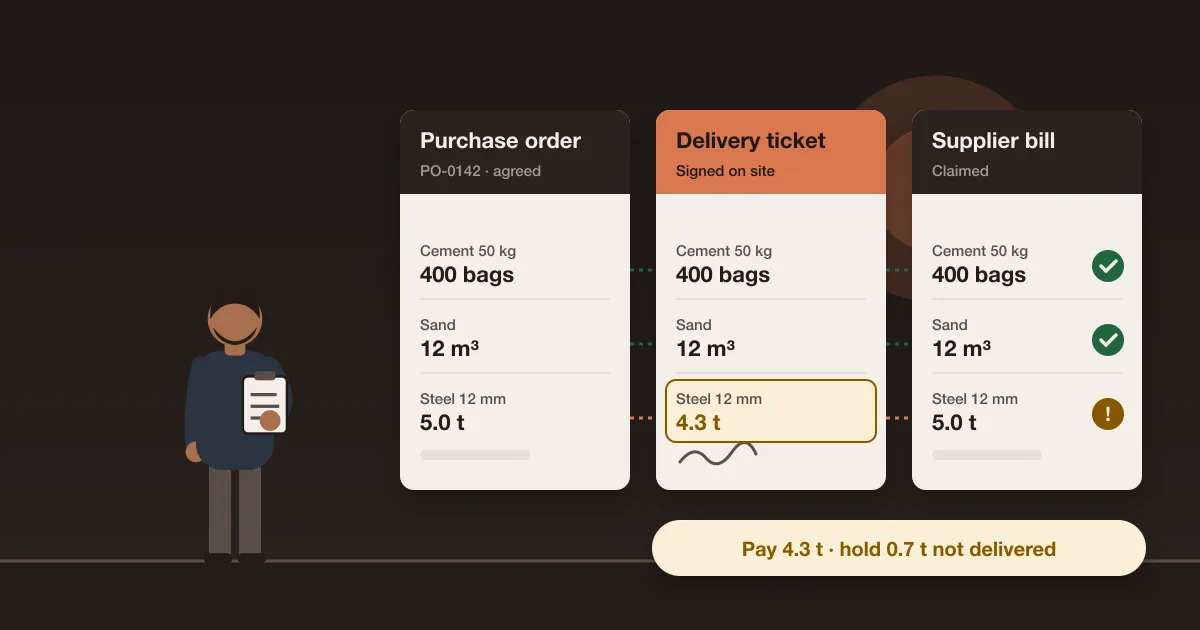
Purchasing
Material requisition form for construction: fields, approvals and a filled example
A material requisition is the moment a site says 'we need this'. If it's a phone call, the order that follows can't be checked against anything. Written down, with a quantity, a date and the stock already on site, it is the first and cheapest control in the whole buying process.
Part of the guide to construction material procurement process
On this page · 10 sections
- What a material requisition form is
- Where the requisition fits in site buying
- What to include on a material requisition form
- A filled example
- Who approves a material requisition
- Material requisition vs purchase order (and indent, and issue slip)
- Common mistakes with material requisitions
- Paper book, spreadsheet or software
- Questions people ask
- Sources
Key takeaways
- A material requisition form is the site's written request for material: what, how much, for which work, and by when. It commits no money. The purchase order does that.
- Check the site store and open orders first. Many requisitions can be filled from stock already on site, and only the shortfall should be bought.
- Write the date the material is needed on site, not just 'urgent'. The buyer works back from it to quotes, ordering and delivery.
- Set approval limits by amount: for example, the project manager approves up to a set value and the owner approves above it. Write the limits down.
- Number every requisition and carry the number onto the purchase order, the delivery note and the bill, so each step can be traced back to a request.
What a material requisition form is
A material requisition form is the written request from a site (or a department) for material it needs, sent to whoever buys or holds stock. On construction sites it's also called a material request, a site requisition, an indent or, in some apps, a demand. It says what is needed, how much, for which part of the work, and the date it must be on site.
'Material requisition' is used for two different requests, and a good form handles both:
- 1A request to buy.
The material isn't on site or in the central store, so it has to be purchased. The requisition goes for approval, then to quotes and a purchase order. - 2A request to issue from the store.
The material is already in stock. The requisition, sometimes called a material issue slip or store requisition, tells the storekeeper to hand it over and charge it to the right work.
The useful habit is to treat every requisition as a request to issue first and to buy only what the store can't supply. That one check stops the most common waste in site buying: ordering cement that is already sitting under a tarpaulin at the back of the site.
Where the requisition fits in site buying
The requisition is the first of seven checkpoints between a site needing material and the supplier being paid. The full path is covered in the construction material tracking guide. In short:
- 1Requisition.
The site writes down what it needs and by when. - 2Store check.
What can be issued from stock? - 3Approval.
For what has to be bought, by someone with the authority for that amount. - 4Quotations.
From more than one supplier for anything significant (how to compare supplier quotations). - 5Purchase order.
The binding order to the chosen supplier (construction purchase order template). - 6Receiving.
Counted against the order on site. - 7Bill and payment.
Matched against the order and what was received (three-way match).
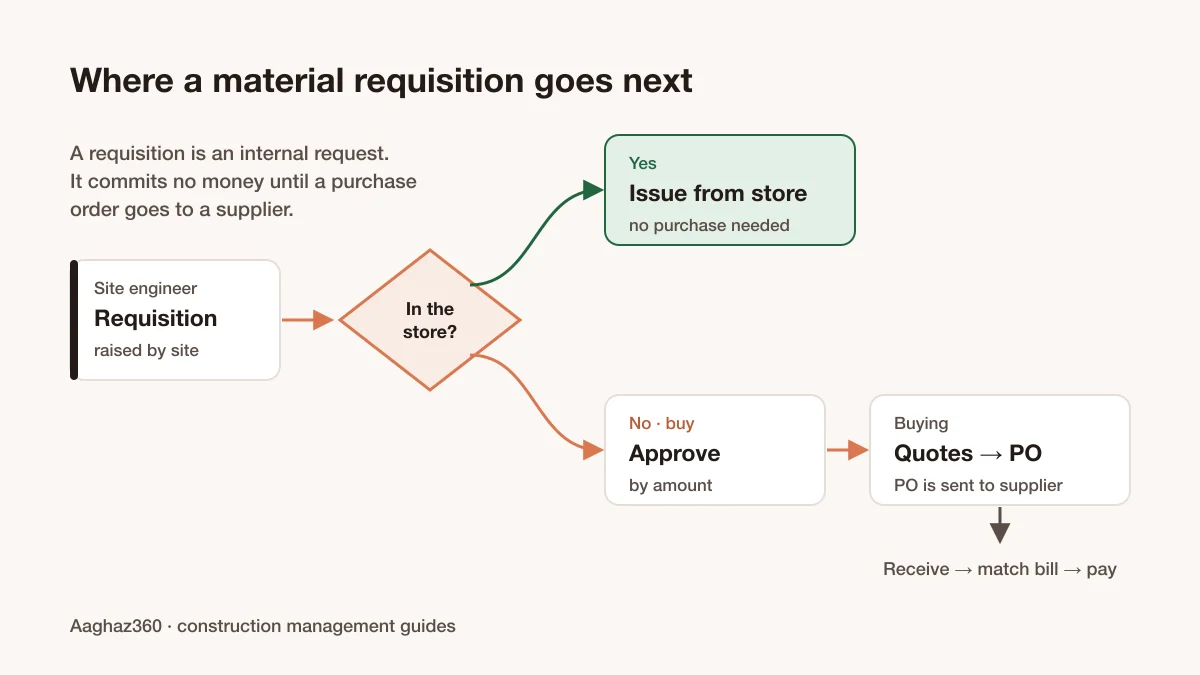
The requisition is internal, and nothing is owed to anyone because of it. That's why it's the right place to stop a bad purchase: changing a requisition costs nothing, while cancelling a purchase order may not be free.
What to include on a material requisition form
| Field | Example | Why it matters |
|---|---|---|
| Requisition number | MR-0118 | Lets the order, delivery note and bill point back to the request. Without it, nobody can prove what the site asked for. |
| Project and site | Two-storey house, plot 42 | The cost lands on the right job |
| Phase or work item | First-floor slab and beams | The cost lands on the right phase, so budget vs actual stays meaningful |
| Requested by, date raised | Site engineer, Mon 13 Oct | Who is accountable for the quantity |
| Needed on site by | Thu 16 Oct, 7 am | The buyer works back from this to quotes and delivery. 'Urgent' isn't a date. |
| Item and specification | Steel bar 12 mm, grade per drawing S-04 | Size, grade, brand or standard. A vague spec gets the cheapest substitute. |
| Unit | t, bag, m³, piece | Must be the unit the supplier will bill in, or the bill can't be matched later |
| Quantity needed | 1.8 t | From the drawings or BOQ for that work, not a round guess |
| In site store now | 0.3 t | Checked by the storekeeper, not remembered |
| Already on order | 0 t | Stops two engineers ordering the same steel |
| To issue / to buy | Issue 0.3 t, buy 1.5 t | Buy only the shortfall |
| Estimated rate and amount | $780/t, $1,170 | Tells the approver what this costs before quotes come in |
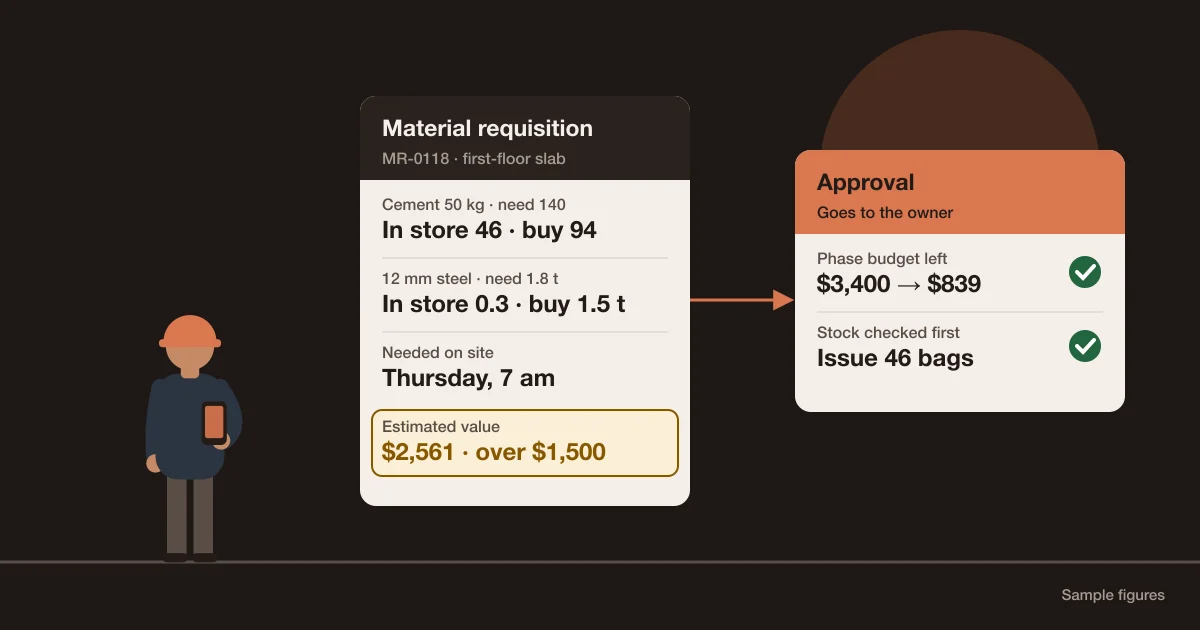
| Phase budget left | $3,400 before, $839 after | The approver sees the effect on the budget, not just the request |
| Reason or reference | Slab pour planned Saturday; BOQ item 4.2 | Lets the approver check the quantity against the plan |
| Deliver to, receiver | Site store, storekeeper | Who signs for it when it arrives |
| Decision and approver | Approved by owner, Mon 13 Oct, 6:10 pm | Name and time, not 'OK on phone' |
A filled example
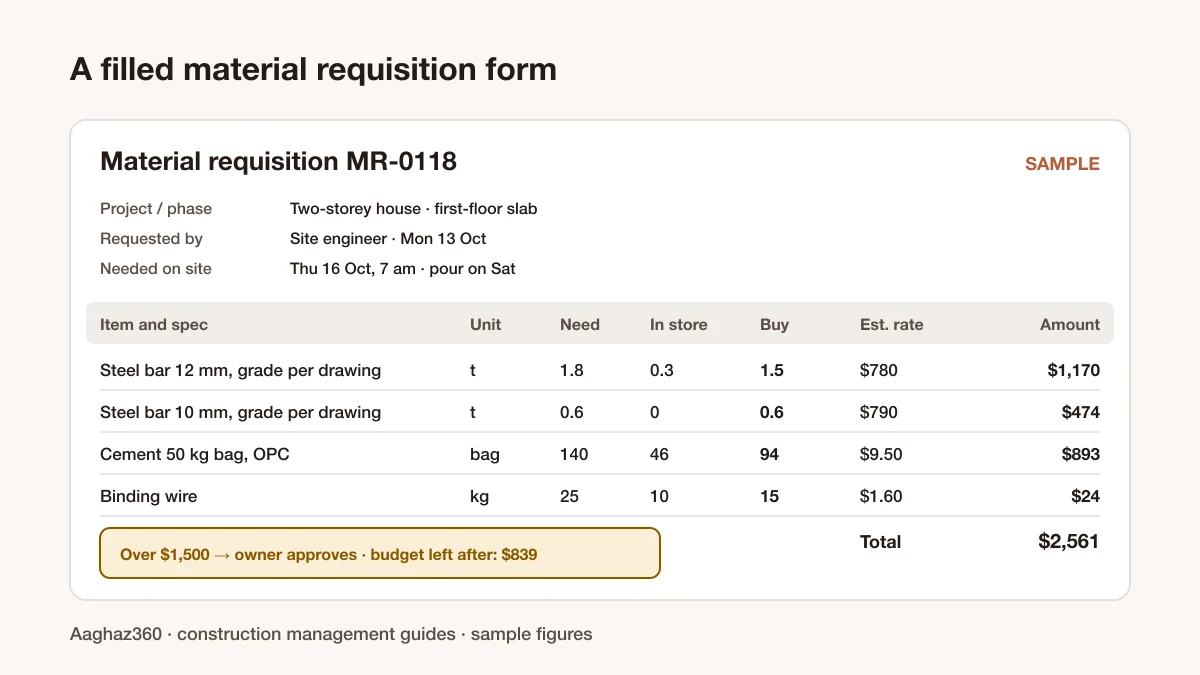
Here is a real-looking requisition for the first-floor slab of a two-storey house. All quantities and rates are sample figures, not market prices or a quantity take-off for any specific slab.
| Item and specification | Unit | Needed | In store | Issue | Buy | Est. rate | Est. amount |
|---|---|---|---|---|---|---|---|
| Steel bar 12 mm, grade per drawing | t | 1.8 | 0.3 | 0.3 | 1.5 | $780 | $1,170 |
| Steel bar 10 mm, grade per drawing | t | 0.6 | 0 | 0 | 0.6 | $790 | $474 |
| Cement, 50 kg bag | bag | 140 | 46 | 46 | 94 | $9.50 | $893 |
| Binding wire | kg | 25 | 10 | 10 | 15 | $1.60 | $24 |
| Total to buy | $2,561 |
- The store check saved buying 46 bags of cement, 0.3 t of steel and 10 kg of wire. At the sample rates that's about $437 + $234 + $16 = $687 of material that's already paid for and sitting on site.
- The value to buy is $2,561. The company rule is that the project manager approves up to $1,500, so this one goes to the owner.
- The phase budget for material had $3,400 left and will have $839 after this. The owner can see the slab is within budget, and that very little is left for the rest of the phase.
- The slab pour is on Saturday and material is needed by Thursday 7 am. If the steel supplier's lead time is two days, the order has to go out by Monday evening, so the approval can't wait until Wednesday.
Without the store column, this site would have bought $3,248 of material instead of $2,561, and the 46 bags in the store would have aged until someone found them. Download the free material requisition form (Excel): it works out issue, buy, value, budget left and who approves, and has a register for numbering every request.
Who approves a material requisition
Approvals protect cash, but each one also adds a delay. Set them up so routine requests move fast and unusual ones get a second look:
- Set limits by amount, in writing. For example, the project manager approves requisitions up to a set value per request and the owner approves anything above it. Choose numbers that send roughly the top fifth of requests by value to the owner, and adjust after a month.
- Give the approver five questions, not a feeling: Is it for work in the current plan? Does the quantity match the drawings or BOQ? Has the store been checked? Is there budget left in the phase? Is the date realistic for the supplier?
- Agree a response time, for example the same working day. An approval that takes three days turns every requisition into an emergency.
- Allow emergencies, then regularise them. If a pour is at risk, the site can buy against a phone approval, but the requisition is written up within 24 hours with the same fields. If this happens every week, the planning is the problem, not the form.
- Don't let a requisition be split to stay under the limit. Two requests for 70 bags on the same day are one request for 140.
- Keep duties separate. The person who requests, the person who approves and the person who pays shouldn't be the same person. Segregation of duties is a basic internal control (GAO Green Book). On a small team, the owner can approve and pay while the site requests and receives.
How to manage multiple construction sites covers setting approval limits across several projects.
Material requisition vs purchase order (and indent, and issue slip)
| Material requisition | Purchase order | Material issue slip | |
|---|---|---|---|
| What it is | Internal request for material | Order to a supplier to deliver at agreed prices and terms | Internal record that material left the store for a job |
| Who raises it | Site engineer, foreman, storekeeper | Purchaser or project manager, after approval | Storekeeper |
| Sent to | Approver, buyer or store | The supplier | Stays inside the company |
| Commits money? | No | Yes, once the supplier accepts it | No (the material is already paid for) |
| Key numbers | Quantity needed, date needed, estimate | Quantity, unit, agreed rate, delivery terms | Quantity issued, phase charged |
| Also called | Material request, indent, demand | PO, order | Store issue note, store requisition |
A purchase order is a document a buyer issues to a seller to show the intention to buy specific goods at agreed prices and terms. It becomes a contract once the supplier accepts it (Designing Buildings Wiki). The requisition comes before it and doesn't bind anyone. One requisition can become several orders (steel from one supplier, cement from another), and one order can cover several requisitions from the same site.
Common mistakes with material requisitions
- Vague specifications. 'Steel 12 mm' without the grade, or 'cement' without the type, invites substitution. Write the spec the drawing calls for.
- No date needed. Every request becomes 'urgent', which means 'whenever'. Write the day and time.
- Ignoring the store. Ordering what's already on site, or already on order from a colleague's requisition last week.
- Round guesses. 'Get 200 bags' when the work needs 140 leaves 60 bags to harden or walk away. Quantities should come from the drawings or BOQ, plus a stated waste allowance.
- Wrong unit. Requesting steel as bars when the supplier bills by the tonne makes the later bill check much harder. Use the billing unit and note the conversion.
- Verbal requisitions. A phone call is fine for speed, but it isn't a record. Write it the same day.
- No phase. Material bought 'for the site' can't be compared with the budget for any piece of work.
Paper book, spreadsheet or software
A numbered carbon book works for a single site: one copy for the site, one for the office. Photograph each page the day it's written, or the office won't see it until Friday.
A spreadsheet adds the arithmetic (stock, shortfall, value, approver) and a register of every requisition with its status. It needs one person to keep the register current, and approvals still happen by phone.
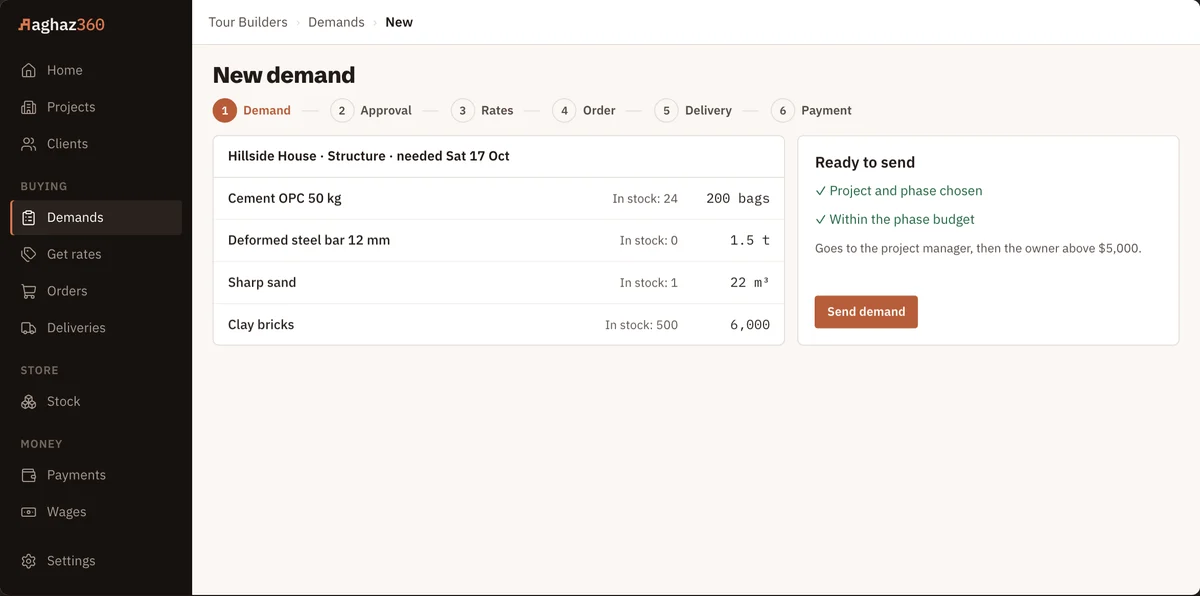
Software is worth it once requests come from several sites, approvals need a record, and the stock check should happen automatically. In Aaghaz360, a site engineer raises a demand from a phone with the project, phase and date needed. The demand suggests materials for the phase and checks what's already in stock and what the budget allows. Approvals follow limits by amount that the owner sets in one screen, and approved demands go on to supplier quotations by private link. Projects that don't need approvals can skip that step. When stock is issued from a site store, it's charged to the phase at that moment. To see a demand go from site to approval to quotes with your own materials, book a walkthrough.
Before you approve a material requisition
0 of 9 in placeTick what is already in place on your site.
Questions people ask
What is a material requisition form in construction?
It's the written request from a site for material: the item and specification, quantity, unit, the work it's for, and the date it's needed on site. It goes to an approver and then to the store or the buyer. It doesn't commit the company to any purchase; the purchase order does that.
Who prepares and who approves a material requisition?
The site engineer, foreman or storekeeper usually prepares it, because they know what the work needs. A project manager approves routine requests up to a set amount, and the owner or a named manager approves larger ones. Write the limits down so everyone knows them.
What is the difference between a material requisition and a purchase order?
A requisition is an internal request; a purchase order is sent to a supplier and becomes binding once the supplier accepts it. The requisition comes first, gets approved, and then becomes one or more purchase orders for the part that has to be bought.
What is an indent in construction?
An indent is another name for a material requisition, used by many contractors and public works departments: the site's written request for material. The same fields apply: item, specification, quantity, unit, the work it's for and the date it's needed.
How far in advance should a site raise a material requisition?
At least the supplier's lead time, plus the time for approval and quotes, plus a margin for a late delivery. Ask your main suppliers for their usual lead times on steel, cement, blocks and finishes, and plan requests back from the date of the work.
Should a requisition be raised for material that's already in stock?
Yes. Raise it the same way and issue it from the store. The requisition records which work the material went to, so the cost is charged to the right phase and the stock figures stay correct.