
Site management
Daily site report format for construction: what to record every day
A daily report only works if it takes minutes, not an hour. Record less, but record it every day.
Part of the guide to construction progress tracking
On this page · 7 sections
Key takeaways
- Record seven things: date and project, work done, labour, material used, machines and services, issues and photos.
- Keep it short enough to finish before the site closes, or it will not be filled in.
- Names and headcounts in the report become the wage sheet, so they settle labour disputes.
- Dated photos from the same spots each day prove progress to clients.
- The person on site records; the project manager reviews and approves labour.
What a daily site report is for
A daily site report format is a fixed set of things the site records at the end of every working day: what was done, who worked, what material was used, and what went wrong. It is the day's record of progress and, when a delay or dispute comes up later, the evidence of what actually happened (Autodesk).
It also feeds everything else. Labour in the report becomes the wage sheet, material used becomes the store's issues, and progress photos become the client's update.
What to include in a construction daily report
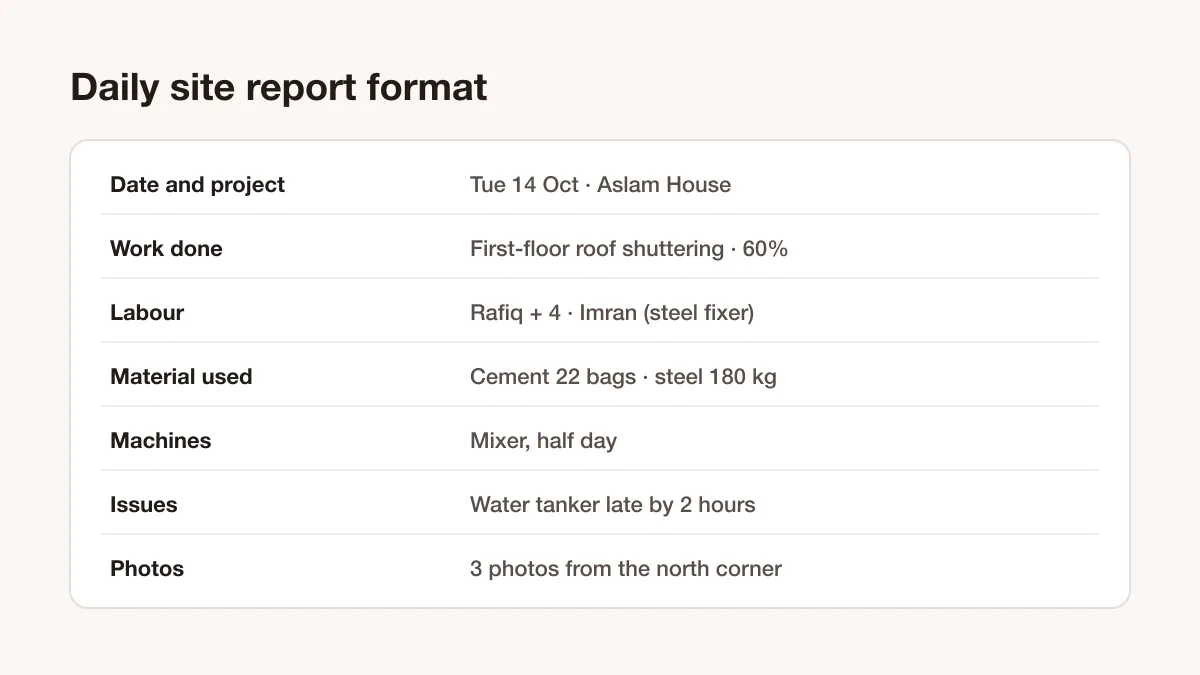
| Section | What to write | Why it matters |
|---|---|---|
| Date and project | Date, day, project and site | Makes every report findable later |
| Work done | Which part of the building and how far (e.g. first-floor roof shuttering, 60%) | Progress against plan |
| Labour | Names or groups, how many in each, extra hours | Becomes the wage sheet |
| Material used | Main items only, in site units | Checks store stock against progress |
| Machines and services | Mixer, excavator, water tanker, hours or days | Hire cost on the right phase |
| Issues and delays | What stopped or slowed work, and why | Evidence if a delay is disputed |
| Photos | Two or three, from the same spots daily | Proof of progress for the client |
International templates add weather, visitors and safety incidents (ProjectManager). Add them when they matter on your site, such as rain stopping concrete work, but keep the core short.
What to leave out of the daily report
Long written descriptions, weather nobody reads and every small consumable. If a field doesn't change a decision or a payment, leave it out. Engineers stop filling in reports that feel like homework, and a half-filled report is worse than a short complete one.
Who prepares the daily site report and who checks it
The site engineer, supervisor or time keeper prepares it; the project manager reviews it and approves the labour before it becomes wages owed. Splitting recording from approving keeps the report quick on site and still gives payments a second look.
How to make your engineers actually fill it in
- 1Fix a time, such as before the site closes, and make it part of the day.
- 2Use a phone, not a register that has to be carried to the office.
A construction management app that installs from the browser is one less thing for site staff to set up. - 3Read the reports yourself for the first two weeks and reply to them.
People keep doing what gets noticed. - 4Use the report for something visible: the wage sheet, the client update. Then it stops being paperwork.
Labour recorded in the report connects directly to budget against actual by phase, and material used to your site stock. If you run several sites, the daily report is also how you manage multiple construction sites without visiting each one.
Questions people ask
What should a daily site report include?
Date and project, work done with location and progress, labour by name or group, main material used, machines and services, issues or delays, and two or three progress photos.
Who prepares the daily report on a construction site?
Usually the site engineer, supervisor or time keeper prepares it at the end of the day, and the project manager reviews it and approves the labour.
Is a daily site report a legal document?
It is often used as evidence in disputes and claims because it records what happened on the day it happened, which is why it should be completed daily and not rewritten later.
Should daily reports be on paper or on a phone?
A phone is better: the report is filled in on site, photos attach to it directly, and the office sees it the same evening instead of when the register arrives.