Site management
Construction labour attendance register: format, wage sheet and weekly pay run
Most wage arguments on a building site aren't about the rate. They're about the days: who came, for how long, and what was already paid. A register filled in on site every day settles those questions before pay day does.
Part of the guide to construction progress tracking
On this page · 10 sections
- What a construction labour attendance register is
- The register format: columns that hold up on pay day
- Workers paid through a labour head
- Worked example: one week's pay run
- How to calculate labour cost per day and per unit of work
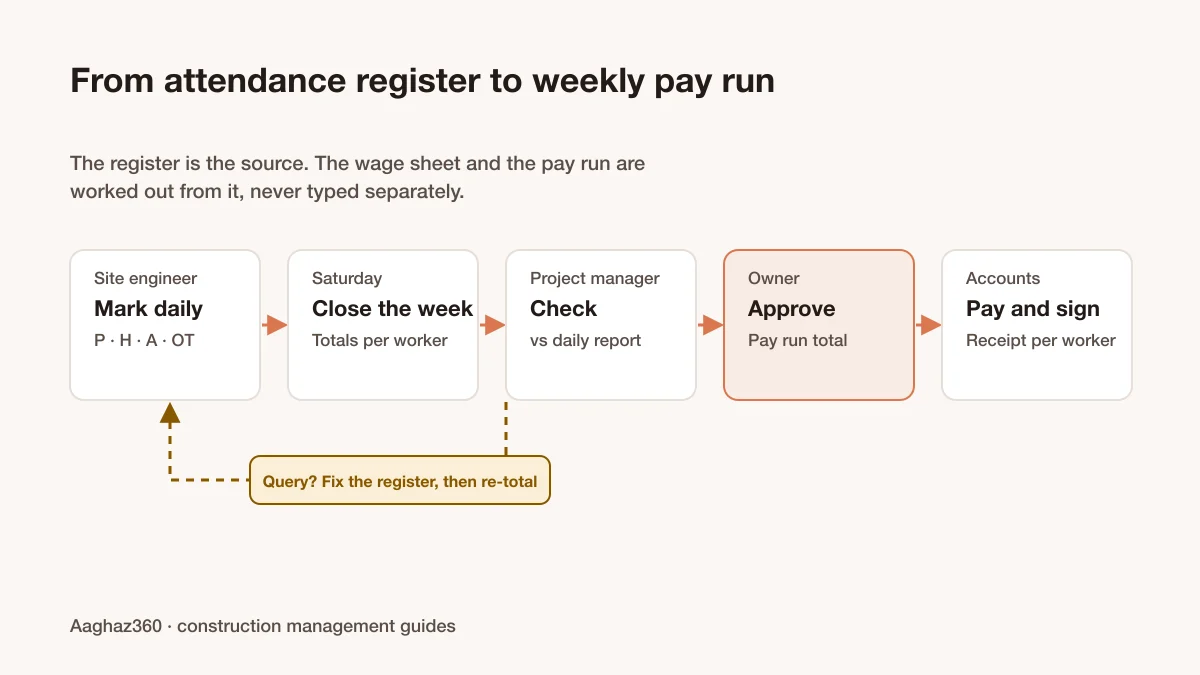
- From register to pay run in five steps
- Where pay-day disputes come from, and the control for each
- Paper, spreadsheet or app?
- Questions people ask
- Sources
Key takeaways
- A construction labour attendance register (also called a muster roll) records who worked on which site each day. The weekly wage sheet and pay run should be worked out from it, never typed separately.
- Mark attendance on site before work ends, with one code per day: present, half day, absent or site stopped. Write your rule for paying half days and stopped days down once.
- For a group paid through a labour head, record the headcount each day and, where you can, the names. Don't record a lump sum.
- Record every advance on the day it's given. Most pay-day disputes are about advances nobody wrote down.
- Labour cost per unit of work (per m² of blockwork, say) is the week's labour cost for that work divided by the quantity done. Compare it with your estimate every week.
What a construction labour attendance register is
A construction labour attendance register is the daily record of who worked on a site, for how long, and at what rate. Depending on the country it's called a muster roll, a crew sheet, a labour log or a site timesheet. At the end of the pay period it becomes the wage sheet: days worked × day rate, plus overtime, minus advances, gives what each worker is owed.
Three documents are involved, and confusing them causes most of the trouble:
| Document | What it records | Who fills it | When |
|---|---|---|---|
| Attendance register (muster roll) | Who was on site each day, half days, overtime hours | Site engineer or time keeper | Every day, on site |
| Wage sheet | Days × rate, overtime pay, advances and deductions, net owed | Worked out from the register | End of the pay period |
| Pay run | Which wage sheet is approved and paid, how and when, with each worker's signature or receipt | Project manager records it, owner approves | Pay day |
Keep the register as the single source. If the wage sheet is typed up separately from memory or from a WhatsApp message, the two will disagree and the worker will believe whichever number is higher.
The rules on what records to keep, how often wages must be paid and what may be deducted depend on where you work. In the United States, the Department of Labor lists the records employers must keep for non-exempt workers, including the hours worked each day, total hours each workweek, the regular rate, overtime earnings, additions and deductions, and wages paid each pay period (US DOL Fact Sheet #21). Internationally, the ILO's Protection of Wages Convention says wages must be paid regularly, deductions are allowed only as national law or an agreement permits, and workers should be told the particulars of their wages at each payment (ILO Convention 95). Check your own country's labour law before you rely on any format, including the one below.
The register format: columns that hold up on pay day
One sheet per site per week works for most builders. These are the columns, and why each one is there:
| Column | Example | Why it's there |
|---|---|---|
| Worker ID | W-01 | Two workers with the same name are two people. The ID stops them being paid as one, or one being paid twice. |
| Name | As on ID card | Matches the signature or thumb impression on pay day |
| Trade | Mason, helper, steel fixer | Rates differ by trade; labour cost is analysed by trade |
| Group / head | Masonry crew (5) | Blank for individual workers. Filled for workers who come and are paid through a labour head. |
| Day rate | $25.00 | The agreed rate for a full day. A change starts on a date, written in the notes. |
| Overtime rate per hour | $4.00 | Agreed in advance, not on pay day |
| Mon to Sun | P, H, A, R or a headcount | One mark per day, made on site |
| Days | 5.5 | Worked out from the marks |
| Overtime hours | 3 | Only hours approved before they were worked |
| Wages, overtime pay, gross | Worked out | |
| Advances | $40.00 | Every advance on the day it's given, with the date |
| Other deductions | Only what the law and the agreement allow | |
| Net payable | Gross minus advances and deductions | |
| Paid on, signature or thumb, checked by | Proof of payment and who checked the sheet |
Use the same marking codes on every site:
| Code | Meaning | Counts as | Note |
|---|---|---|---|
| P | Present, full day | 1 day | |
| H | Half day | 0.5 day | Define 'half': arrived after a set time or left before one |
| A | Absent | 0 | |
| R | Site stopped (rain, no material, an inspection hold) | Your rule | Decide once whether a stopped day is paid in full, half or not at all, and write it down |
| A number | Headcount for a group under a head | That many person-days | Write the names on the back or in the daily report if you can |
Workers paid through a labour head
On many sites a labour head (a foreman, gang leader, mate or labour subcontractor) brings a group, is paid for the group, and pays the workers. It's convenient. The risk is that you pay for heads you never counted. A head who works on a contract with an advance is really a subcontractor, and subcontractor management software tracks the contract value, advance and retention instead of days.
- 1Record the headcount each day.
Put it in the register and in the daily site report, at the same time each morning. A headcount taken at 4 pm is not the headcount at 8 am. - 2Write the names when you can.
Even if you pay the head, names let you notice a 'group of 6' that is really 4 regulars and two people you have never seen. - 3Take a photo of the group.
Do it at the start of work. It costs nothing and ends the argument about Wednesday. - 4Agree the basis in writing.
Per person-day, or a lump sum for a measured quantity of work. Don't mix both in one week. - 5Get the head's signature.
The head signs the week's total before payment, and you keep the receipt.
If you pay workers in a group individually instead, record each of them as an individual worker with the head's name in the 'Group / head' column. The register then shows both who worked and through whom.
Worked example: one week's pay run
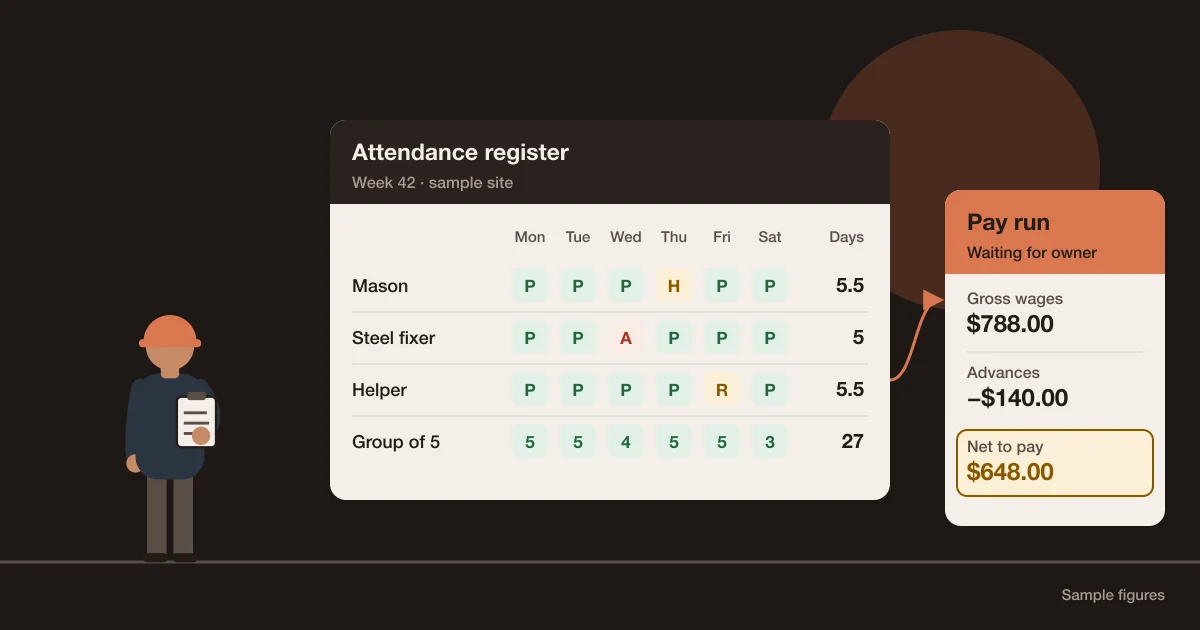
Here is one week on a small site, with three individual workers and one group of five paid through its head. The figures are sample numbers, not market rates. The rule for this site is that a day stopped by rain after work has started is paid as half a day.
| Worker | Day rate | Mon–Sat | Days | Overtime | Gross | Advance | Net |
|---|---|---|---|---|---|---|---|
| Mason | $25.00 | P P P H P P | 5.5 | 3 h × $4.00 | $149.50 | $40.00 | $109.50 |
| Steel fixer | $22.00 | P P A P P P | 5 | 4 h × $3.50 | $124.00 | $124.00 | |
| Helper | $15.00 | P P P P R P | 5.5 | $82.50 | $82.50 | ||
| Group of 5 (per person-day) | $16.00 | 5 5 4 5 5 3 | 27 | $432.00 | $100.00 | $332.00 | |
| Total | $788.00 | $140.00 | $648.00 |
- Mason: 5 full days + 1 half day = 5.5 days × $25 = $137.50, plus 3 overtime hours × $4 = $12, so gross is $149.50. The mason took a $40 advance on Wednesday, so net is $109.50.
- Steel fixer: 5 days × $22 = $110, plus 4 hours × $3.50 = $14, so gross and net are $124.
- Helper: Friday was stopped by rain, paid as half a day under the site rule. 5.5 days × $15 = $82.50.
- Group: the headcount over the week is 5 + 5 + 4 + 5 + 5 + 3 = 27 person-days × $16 = $432. The head took a $100 advance on Tuesday, so net is $332.
The owner approves a net pay run of $648.00, but the cost to the project is the gross $788.00. The advances were cash already spent earlier in the week and should already be in the books. Many site cash books count the advance as an expense on the day and then count the full wage again on pay day. That doubles the labour cost in your construction budget vs actual report.
How to calculate labour cost per day and per unit of work
The same sheet answers two questions owners ask every week:
- Labour cost per working day on this site: $788 ÷ 6 working days = $131.33 a day.
- Labour cost per unit of work: suppose the mason and the group built 120 m² of blockwork this week. Their labour cost was $149.50 + $432.00 = $581.50, so $581.50 ÷ 120 m² = $4.85 per m². If your estimate allowed $4.20 per m², blockwork labour is running about 15% over the estimate, and you know it in week one, not at handover.
Use the quantity actually completed and measured, not the quantity planned. Per-unit labour cost falls when work is well planned and supplied, and rises when crews wait for material, drawings or instructions. A 2018 Aarhus University study of four Danish construction sites, observed for more than 1,000 hours across fifteen trades, found that only about one-third of working hours added value, and named a lack of planning and coordination as a main cause (Aarhus University). That's one study in one country, not a benchmark for your site. But it is a reason to look at waiting time before you look at rates.
From register to pay run in five steps
- 1Mark daily, on site.
The site engineer or time keeper marks the register before the crew leaves and records the headcount for each group. Overtime is written only if it was approved before it was worked. - 2Close the week on a fixed day.
Saturday afternoon, for example. Totals are worked out from the marks. Nobody edits a closed week; a correction is a new, dated line with a reason. - 3Check against the daily site report.
The project manager compares days and headcounts with the daily site report and the work actually done. Twenty bricklayers can't have built two square metres of wall. - 4Owner approves the pay run.
The approval covers the total and any line that changed since last week: a new worker, a rate change, a large advance. - 5Pay, get a signature, file.
Each worker or the group head signs or gives a thumb impression against the amount received, or you keep the bank or mobile-wallet transfer receipt. File the signed sheet with the week's daily reports.
The person who marks attendance, the person who approves the pay run and the person who hands over cash shouldn't all be the same person. On a small site the owner can approve and pay. Just don't let the person who marks the register also pay out the cash.
Where pay-day disputes come from, and the control for each
| What goes wrong | Usual cause | Control |
|---|---|---|
| 'I worked a full day on Thursday' | Half days not defined; register filled from memory | Write the half-day rule once; mark the register before the crew leaves |
| Overtime claimed but nobody remembers approving it | Overtime agreed verbally | Record approved overtime the same day, with the approver's name |
| Advance forgotten or disputed | Cash handed over without a record | Advance written in the register on the day, signed by the worker |
| A group of 6 that was really 4 | Headcount taken late or not at all | Morning headcount, names when possible, a photo of the group |
| The same worker paid on two sites the same day | Separate registers per site that nobody compares | Worker IDs; check IDs across sites when you have more than one |
| Rate changed mid-week | New rate agreed but not dated | Rate changes start on a date written in the register |
| Rain day paid on one site and not another | No company rule | One written rule for stopped days, used on every site |
| Wage sheet and register disagree | Wage sheet typed separately | Work the wage sheet out from the register; never retype |
Paper, spreadsheet or app?
Paper works on a single site with one person keeping it, as long as it's filled daily and photographed every evening. It fails when the register gets wet, lost or 'corrected' after the fact.
A spreadsheet adds the arithmetic and makes the wage sheet automatic. Download the free labour attendance register (Excel): it uses the exact format above. Type P, H, A or R for individuals, or a headcount for a group, and it works out the days, gross, net and labour cost per unit. It works for one or two sites with one disciplined person. It struggles when several engineers keep their own copies, when the office needs today's headcount from three sites, or when the owner approves pay runs by phone with no record.
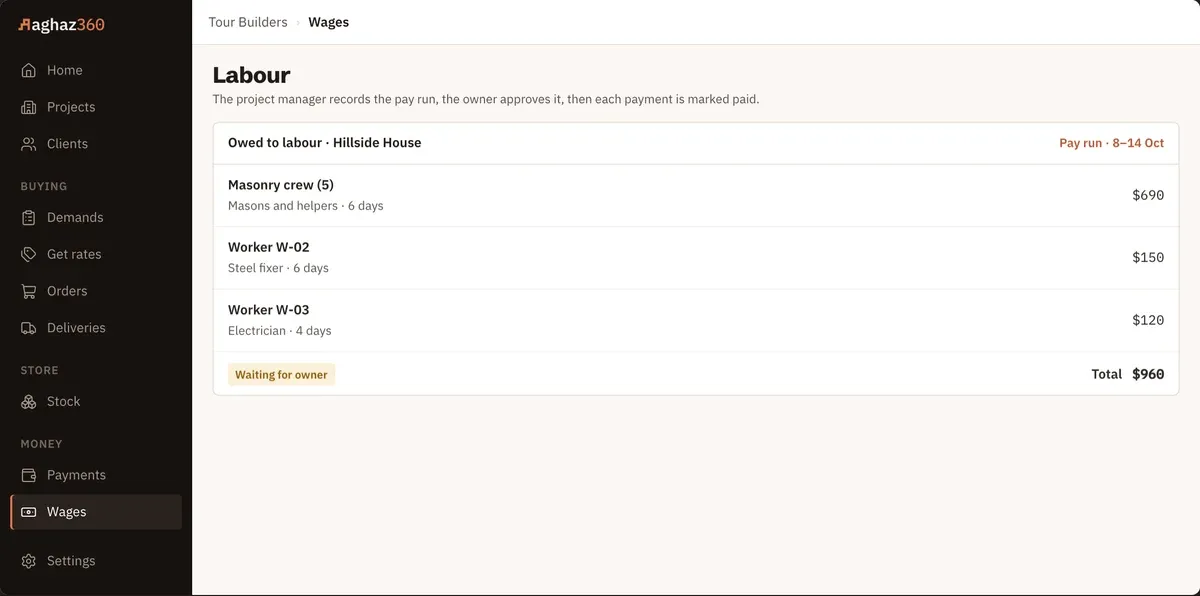
An app makes sense once attendance needs to come from the site the same day, groups and advances need a running balance per person, and approvals need a name and time. In Aaghaz360, workers have a day wage and an overtime rate, a group is recorded as a head with how many came that day, the days come from the daily site log, the project manager records the pay run and the owner approves it. Each person has a ledger showing days payable, days paid, days in approval and the balance. Labour cost then lands on the project and phase in project costing without being typed again. To see it with your own crews and rates, book a walkthrough.
Before you approve the weekly pay run
0 of 9 in placeTick what is already in place on your site.
Questions people ask
What is a muster roll in construction?
A muster roll is the attendance register for site labour: who worked each day, for how many days or hours, and, in many formats, the wages due and paid. In many countries it's both a site record and a legal record, so keep it in the format your local labour rules require.
How do you calculate labour cost per day on a construction site?
Add up the gross wages for the period, including overtime but before advances are deducted, and divide by the number of working days. For example, $788 gross over 6 working days is about $131 a day. For cost per unit of work, divide the labour cost of the crew that did the work by the quantity completed.
How should half days be recorded in a labour attendance register?
Mark them with their own code, such as H, counted as 0.5 day, and write down once what counts as a half day, for example arriving after 10 am or leaving before 1 pm. Do the same for days the site was stopped by rain or a lack of material, and decide in advance whether they're paid.
How do you pay a labour group through its head?
Agree the basis in writing (per person-day or per measured quantity), record the group's headcount every morning, and pay the head against the week's total, signed by the head. If you can, record the names in the group as well, so you know who actually worked.
How long should labour attendance and wage records be kept?
It depends on the country. In the United States, for example, payroll records must be kept for at least three years and the time cards and wage-rate records behind them for two years. Check the rule where you build, and keep signed sheets at least that long.
Should workers sign the attendance register?
Workers, or the group head, should sign or give a thumb impression on the wage sheet when they're paid, confirming the amount received. Daily signatures aren't usually needed if the register is marked on site every day and checked against the daily report.