Costs
Construction budget vs actual: how to track project costs phase by phase
A budget only helps if every dollar spent lands on the right phase in the week it is spent, and if open orders are counted before the bills arrive.
On this page · 7 sections
Key takeaways
- Split the budget by phase: one total hides an overrun until handover.
- Code every bill, wage sheet and material issue to the same phases as the budget.
- Count committed cost (approved orders and contracts not yet billed) next to actual spend.
- Compare spend with work done, not time passed: 60% spent is fine only if about 60% is built.
- When a phase runs over, separate price problems from quantity problems before acting.
What construction budget vs actual means
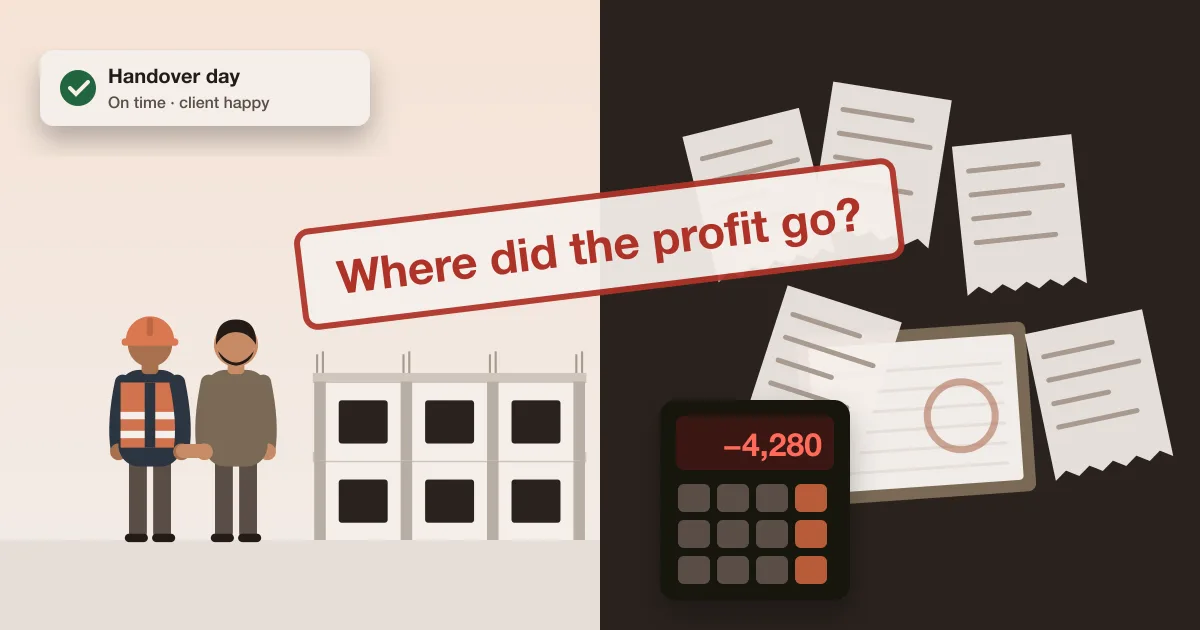
Construction budget vs actual is the running comparison between what each part of a project was planned to cost and what it has really cost so far. Done well, it tells you which phase is drifting while there is still time to act. Done badly, as one total checked at the end, it only explains why the project lost money.
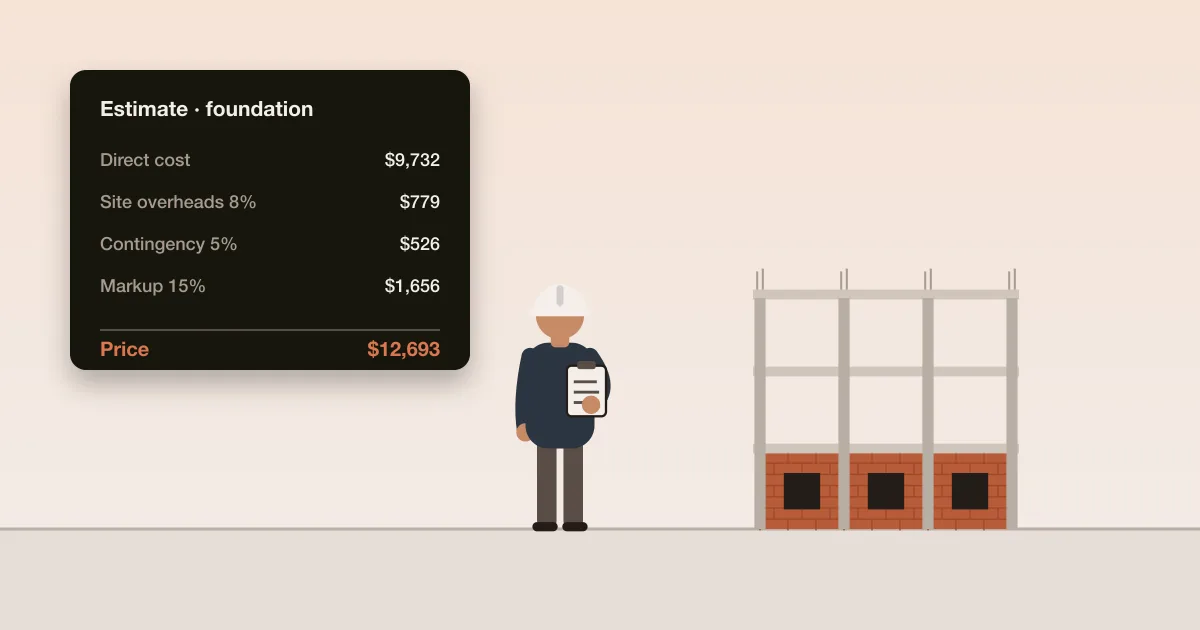
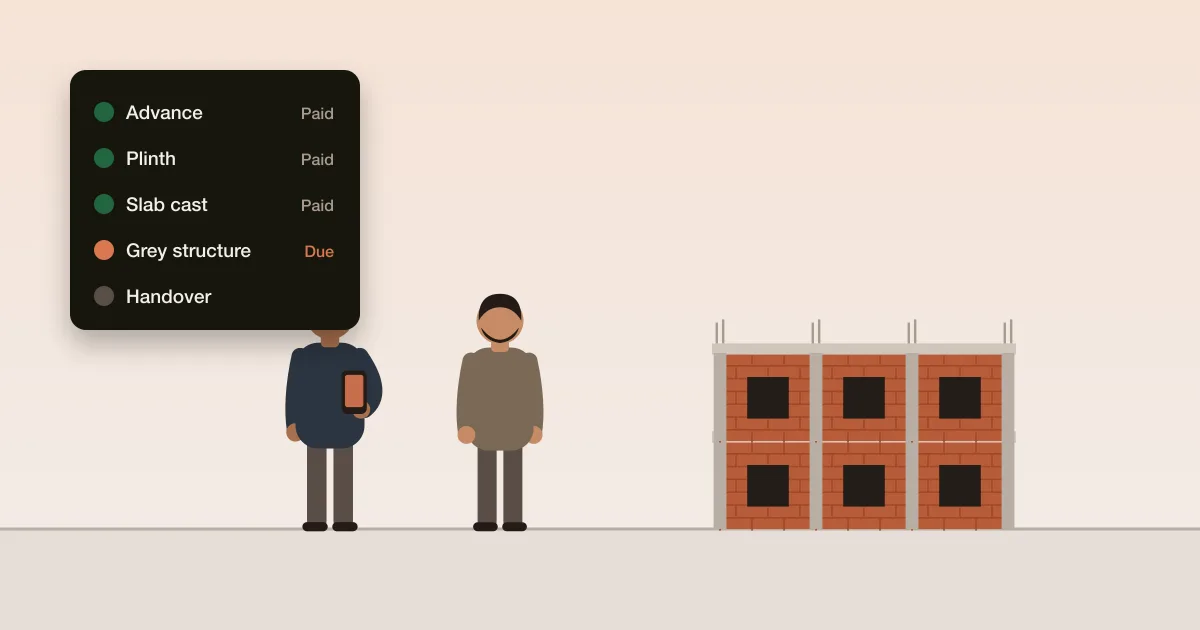
A house that finishes 10% over budget was usually 30% over on one phase months earlier. Split the budget by phase (excavation, foundation, grey structure, finishing) and the overrun shows while that phase is still running. The budget itself should come from an estimate split into the same phases (how to estimate construction costs); a free construction cost calculator gives you a first figure by category to start from.
Set up construction cost tracking once
- 1List the phases the way your team talks about the work, not the way an accountant would.
- 2Give each phase a budget for material, labour, subcontract work and other costs.
- 3Agree that every bill, wage sheet, expense and material issue must name a phase before it is paid or posted.
- 4Keep a small general bucket for costs that truly belong to the whole project, such as site security.
- 5Review every week, on the same day, with the same people.
The rule that makes it work is matching codes: actual costs must be recorded against the same phases as the budget, so the two can be compared line by line (Projul).
What is committed cost in construction?
Committed cost is money you have already promised but not yet paid: approved purchase orders and signed subcontracts. Leave it out and the budget looks healthier than it is. In one worked example, a phase with a 100,000 budget, 20,000 already paid and an 85,000 subcontract signed is really 5,000 over, even though actual spend alone suggests 80,000 left (Open Exam Prep). Add the work not yet ordered, at today's rates, and you have the cost to complete.
| Amount | What it tells you | |
|---|---|---|
| Budget | 34,000 | What the phase should cost |
| Actual spent | 24,000 | Bills, wages and issues posted |
| Committed | 7,000 | Approved orders not yet billed |
| Spent + committed | 31,000 | The real position: 3,000 left |
How to calculate cost variance against work done
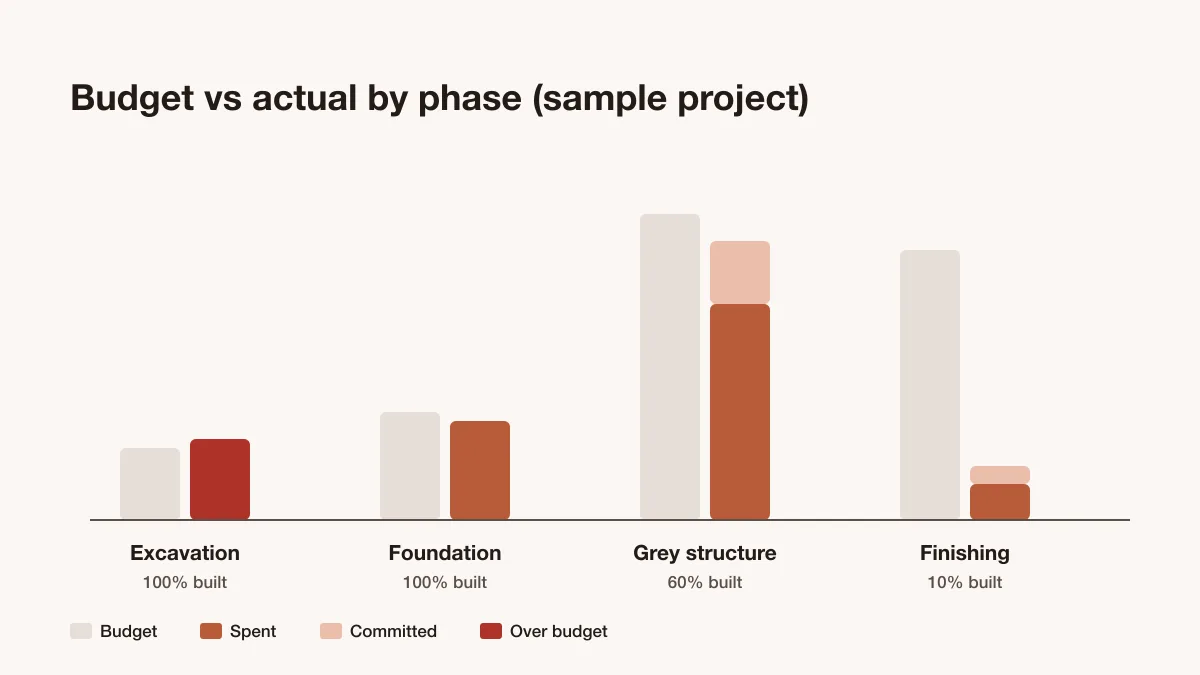
Spending 60% of a phase budget is fine if 60% of the work is done, and a warning if only 35% is. Earned value makes this precise: earned value is the budget of the work actually completed, and cost variance is earned value minus actual cost (OpenSpace). How to measure the work done, phase by phase, is covered in construction progress tracking.
- Earned value = phase budget × percentage of the phase complete.
- Cost variance = earned value − actual cost. Negative means you are paying more than the work done is worth.
- Example: a $34,000 structure phase that is 60% built has earned $20,400. If $24,000 has been spent, the variance is −$3,600.
How to control a construction cost overrun
- Check whether the overrun is price (rates went up) or quantity (more was used than planned).
- For quantity, compare store issues with progress: material may be going to the wrong work. The material tracking checkpoints show where.
- For price, re-quote the next orders and revise the budget openly rather than hiding it in another phase.
- If the client changed the scope, record it as a change with its own price, not as a cost, and bill it on the payment schedule.
Questions people ask
What is budget vs actual in construction?
It is the comparison, phase by phase, between what each part of the project was planned to cost and what it has cost so far, ideally including committed cost and judged against how much of the work is done.
What is committed cost in construction?
Committed cost is money already promised through approved purchase orders and signed subcontracts that has not yet been billed or paid. It belongs next to actual spend, or the remaining budget looks larger than it is.
How do you calculate cost variance in construction?
Multiply the phase budget by the percentage of work complete to get earned value, then subtract the actual cost. A negative result means the work done has cost more than it was budgeted to.
How often should construction costs be reviewed?
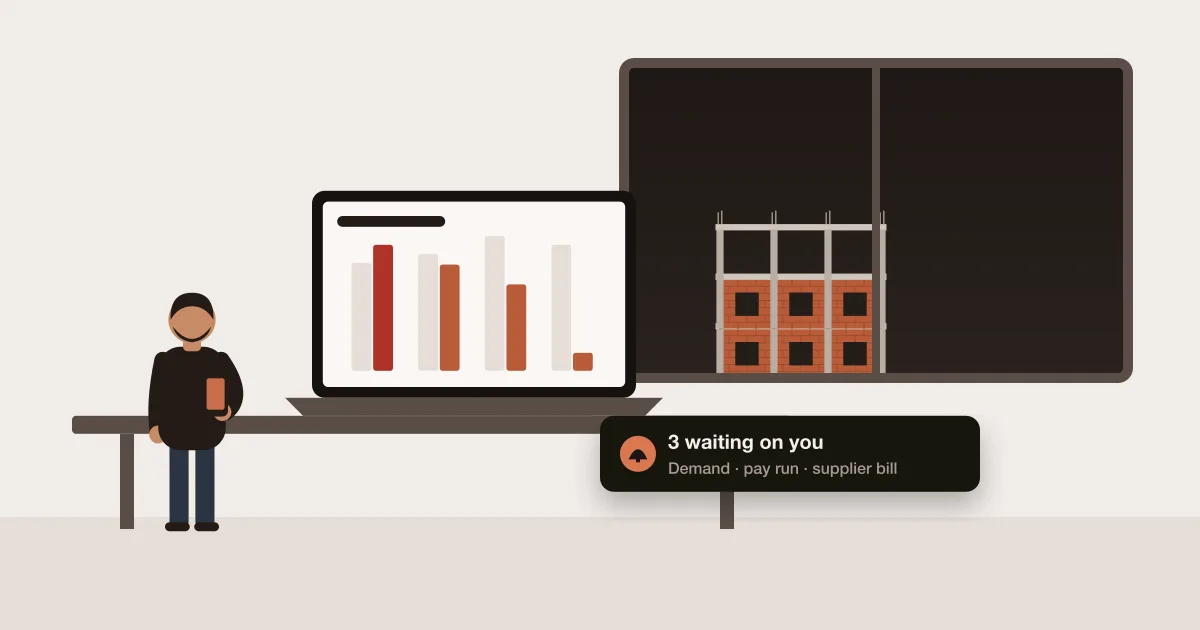
Weekly for running phases. A short review on the same day each week, looking at spent, committed and progress per phase, catches overruns while they can still be fixed.