Costs
Construction expense tracking: a step-by-step guide to real-time costs and profitability
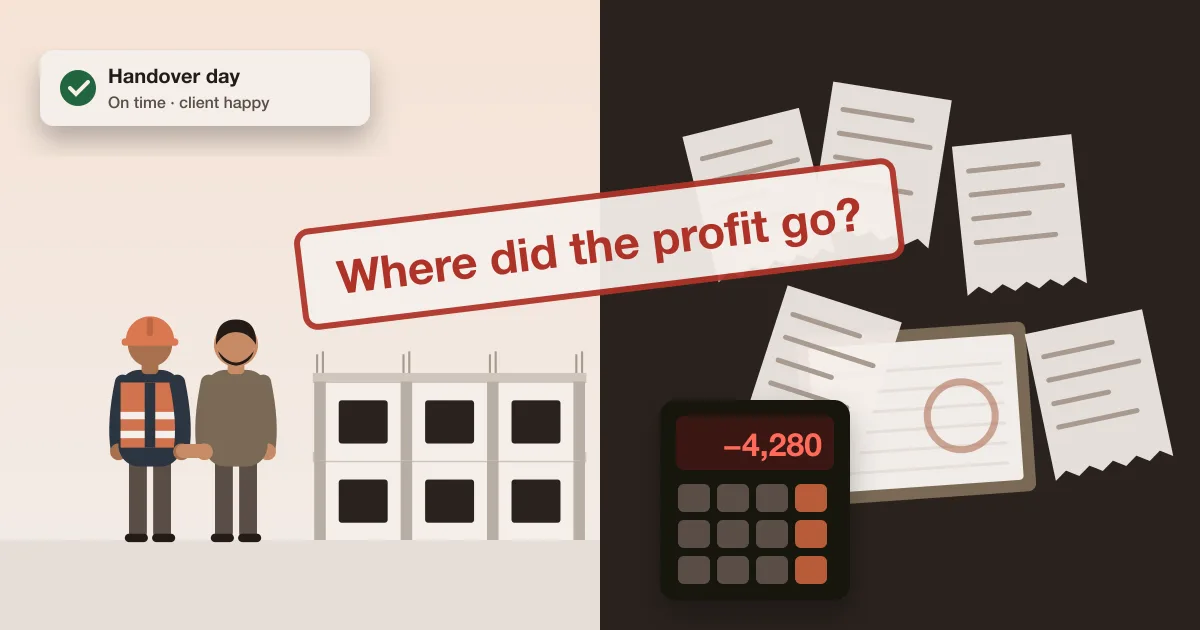
The job finished on time and the client is happy, yet the profit has gone. It rarely disappears at once: it leaks through price jumps, unrecorded site purchases and untracked labour hours, week after week. Here is how to see those leaks while you can still close them.
Part of the guide to construction budget vs actual
On this page · 9 sections
- What real-time construction expense tracking means
- Step 1: Set baseline budgets by cost bucket and phase
- Step 2: Capture every site expense the day it happens
- Step 3: Track committed cost, not just cash paid
- Step 4: Compare budget used with physical progress
- A 20-minute weekly profitability review
- Spreadsheet or software for construction expense tracking?
- Questions people ask
- Sources
Key takeaways
- Never run a job from one pool of money: split the budget into cost buckets (materials, labour and subcontractors, equipment, contingency) and then by phase.
- Record every site expense on the day it happens, with a photo of the receipt or delivery note, against a project, phase and category.
- Track committed cost (approved orders and signed subcontracts) next to cash paid; it shows overruns before the invoice arrives.
- Compare budget used with physical progress: 40% built with 65% of the budget spent is a red flag, whatever the bank balance says.
- Forecast margin = (contract value − forecast final cost) ÷ contract value; recalculate it every week, not at handover.
What real-time construction expense tracking means
Construction expense tracking is the practice of recording every cost on a project (material, labour, subcontract work, equipment and site expenses) against the budget line it belongs to, as it happens, so you can see the project's profit while the work is still running. Real-time means days, not months: a cost recorded on Tuesday shows in Tuesday evening's numbers, not in the month-end accounts.
It is the site-level side of job costing, where each project is its own cost centre. Annual accounts tell you whether the company made money; job costing tells you which project made it and which one lost it.
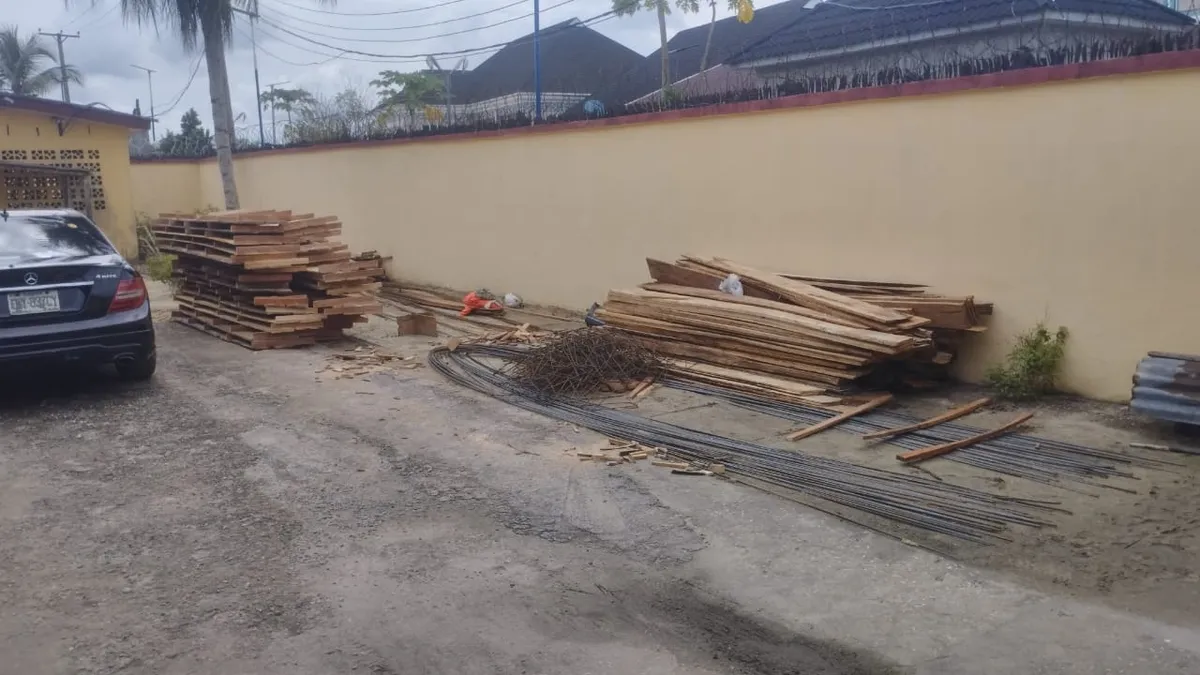
Margins rarely vanish in one event. They leak through small, repeated gaps:
- Price jumps: steel or cement bought at this week's rate while the budget used last quarter's.
- Unrecorded site purchases: cash buys for fittings, diesel or tools that sit in a supervisor's pocket for weeks.
- Untracked labour hours: overtime and extra workers that never reach the cost report until wages are paid.
- Duplicate or unmatched payments: a bill paid twice, or paid for material that was never fully delivered.
- Invisible commitments: purchase orders and subcontracts already signed but not yet billed.
The four steps below close each of these gaps. They work on a single house or across several sites at once, on paper or in construction management software such as Aaghaz360.
Step 1: Set baseline budgets by cost bucket and phase
Never treat the budget as one pool of cash. Start from your estimate (how to estimate construction costs, or build one with the free cost estimator and BOQ calculator) and split the cost into buckets, each with its own limit:
- Raw materials: cement, steel, blocks, aggregate, tiles, fittings.
- Direct labour and subcontractors: your own crews plus labour-only and supply-and-fix packages.
- Equipment and machinery: hire, fuel, transport, small tools.
- Contingency: a fixed safety buffer for known risks, managed as its own line and never spent on client changes.
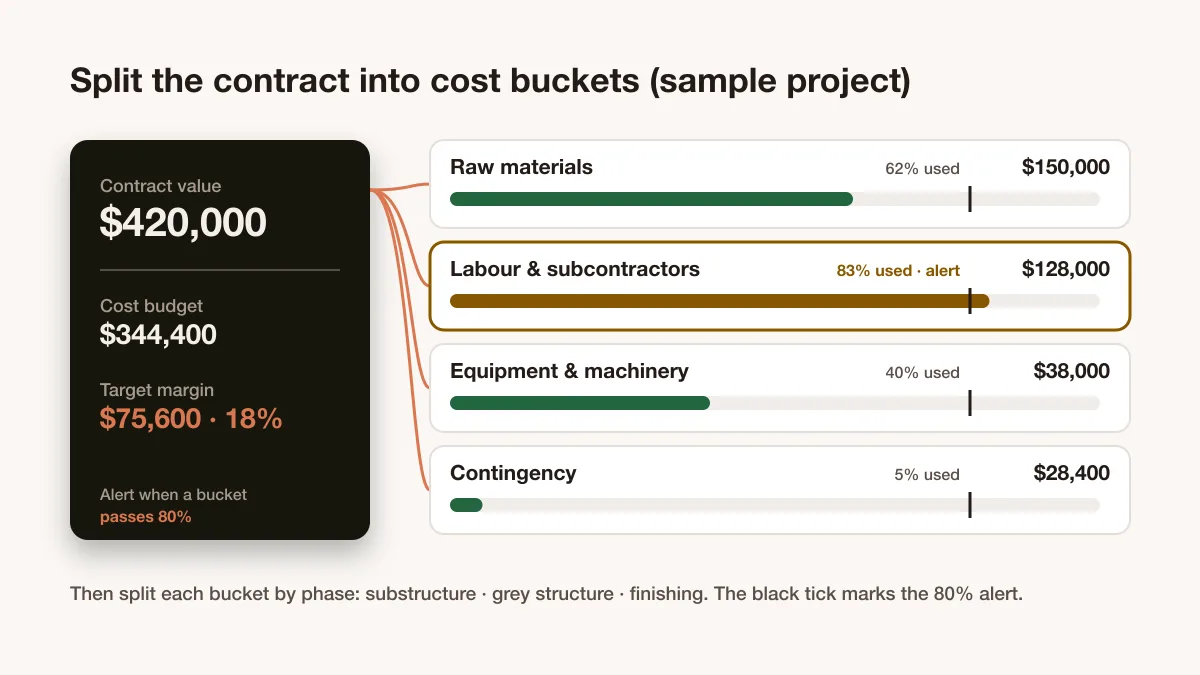
Then split each bucket by phase, such as substructure, grey structure and finishing. The phase split is what tells you which part of the job stayed within its limit and which one ran over.
| Phase | Materials | Labour & subcontract | Equipment | Phase total |
|---|---|---|---|---|
| Substructure | 30,000 | 22,000 | 14,000 | 66,000 |
| Grey structure | 70,000 | 54,000 | 18,000 | 142,000 |
| Finishing | 50,000 | 52,000 | 6,000 | 108,000 |
| Contingency (project level) | 28,400 | |||
| Cost budget | 150,000 | 128,000 | 38,000 | 344,400 |
Step 2: Capture every site expense the day it happens
Material purchases and daily labour payments that wait in paper registers, receipt books or a glove compartment for weeks leave you managing the budget blindfolded. By the time they are entered, the money is spent and the chance to react has passed.
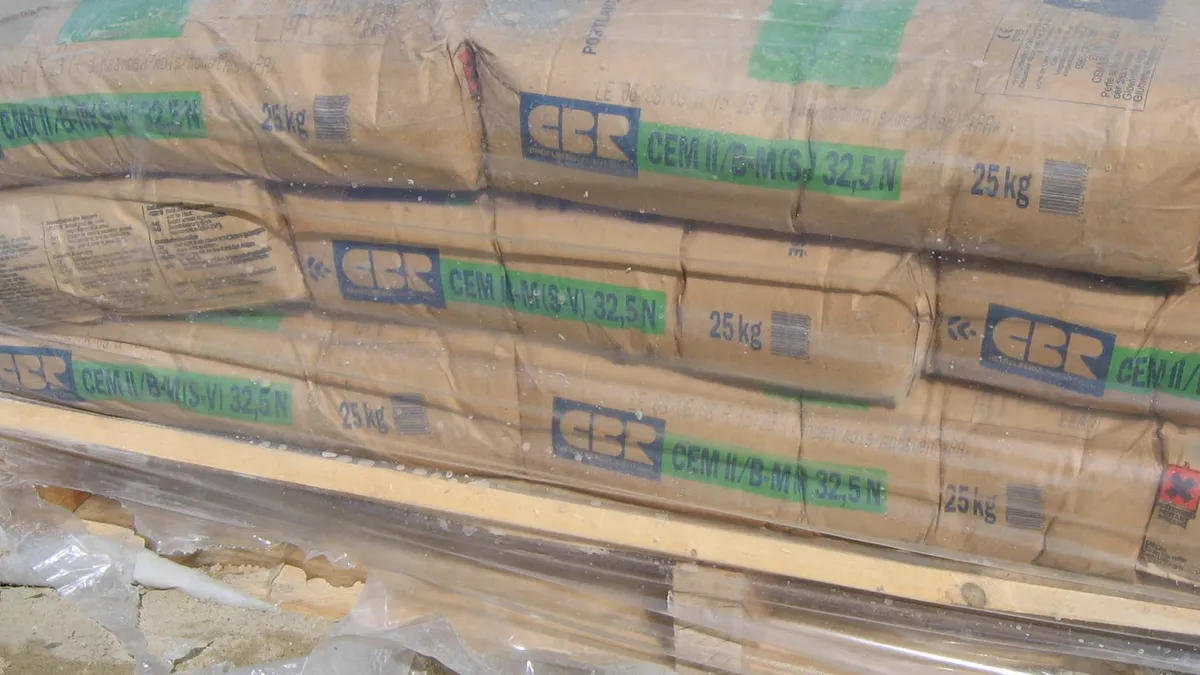
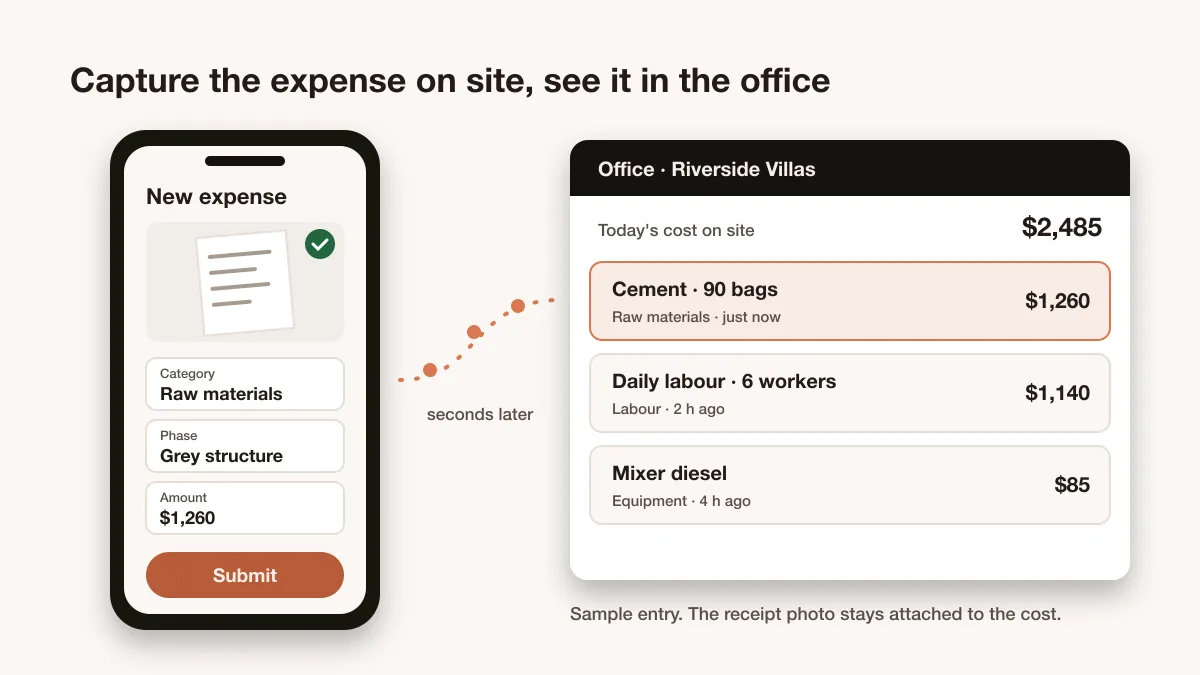
Record each expense from a phone, on site, at the moment it happens. Every entry needs the same few facts:
- 1Project and phase.
The cost must land on the same phase as its budget, or the comparison breaks. - 2Category.
Materials, labour, subcontract, equipment or other site expense: the same buckets as Step 1. - 3Amount and quantity.
$1,260 for 90 bags, not just $1,260, so you can check the rate later. - 4Supplier or payee.
Who was paid, or who is owed. - 5Photo of the receipt or delivery note.
The paper can be lost; the photo stays attached to the cost. - 6Who recorded it and when.
A name and a date make every entry traceable.
- No entry, no payment: accounts pay only bills and wage sheets that are already recorded against a phase.
- Match before you pay: the order, the delivery note and the supplier's bill should agree on quantity and price. This three-way match is what stops duplicate and over-payments.
- Give the site a fixed petty cash float and top it up only against recorded expenses.
- Record labour daily from the daily site report, so wages owed grow with the work, not after it.
- Record material as it is received and issued, with the material tracking checkpoints.
Step 3: Track committed cost, not just cash paid
If you only count money that has left the bank, the project will look comfortable right up to the moment the bills arrive. Committed cost is money you have already promised but not yet paid: approved purchase orders and signed subcontracts. Adding it to actual cost gives your true financial exposure (Open Exam Prep).
| Number | What it includes | What it answers |
|---|---|---|
| Budgeted cost | The baseline limit set in Step 1 | What may this phase cost? |
| Committed cost | Paid + billed but unpaid + open orders and subcontracts | How much have we promised? |
| Actual cash paid | Invoices cleared from the bank | How much has left the account? |
A worked example. The structure package of a project has a budget of $34,000. $18,500 has been paid. The supplier has billed another $4,600 that is not yet paid, and purchase orders for steel ($6,200) and ready-mix concrete ($3,800) are approved but not delivered.
| Amount | Left in budget | |
|---|---|---|
| Budget | 34,000 | |
| Paid | 18,500 | 15,500 (looks fine) |
| Billed, not yet paid | 4,600 | |
| Open orders: steel and concrete | 10,000 | |
| Committed (paid + billed + open) | 33,100 | 900 (97% used) |
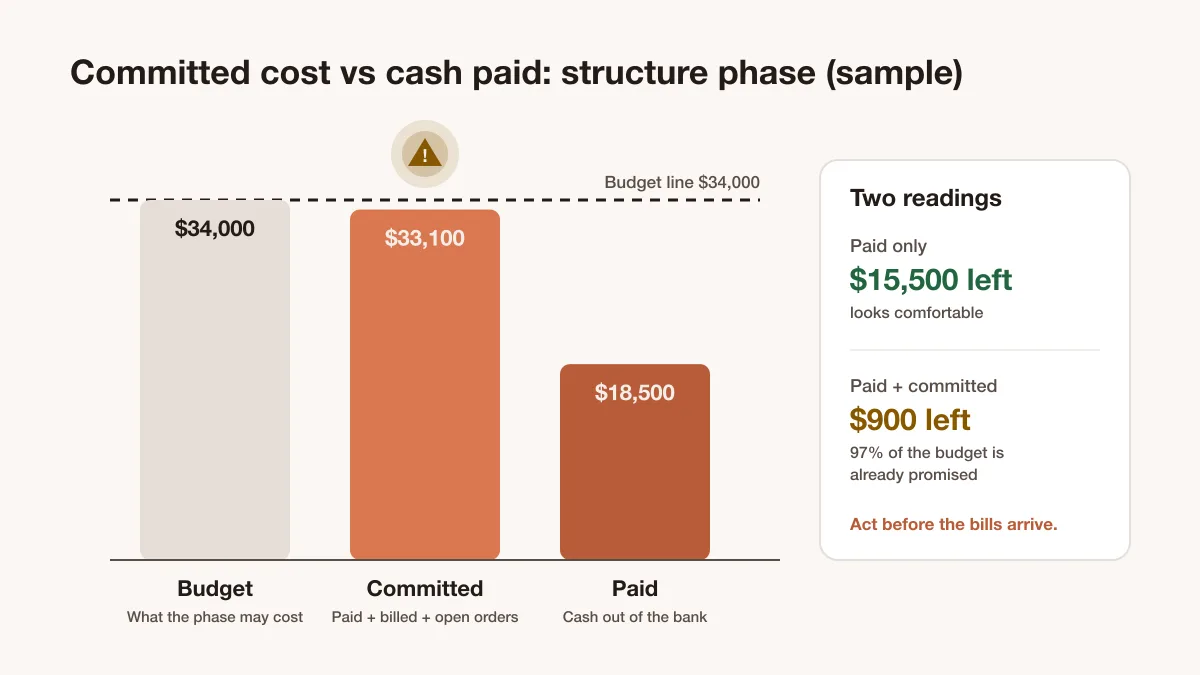
Because the alert fires on committed cost, it warns you before money leaves the account, while you can still re-quote the next order, change the specification with the client's agreement or move work to a cheaper method. Count commitments as soon as an order or subcontract is approved, and release them as bills arrive so nothing is counted twice (construction budget vs actual).
Step 4: Compare budget used with physical progress
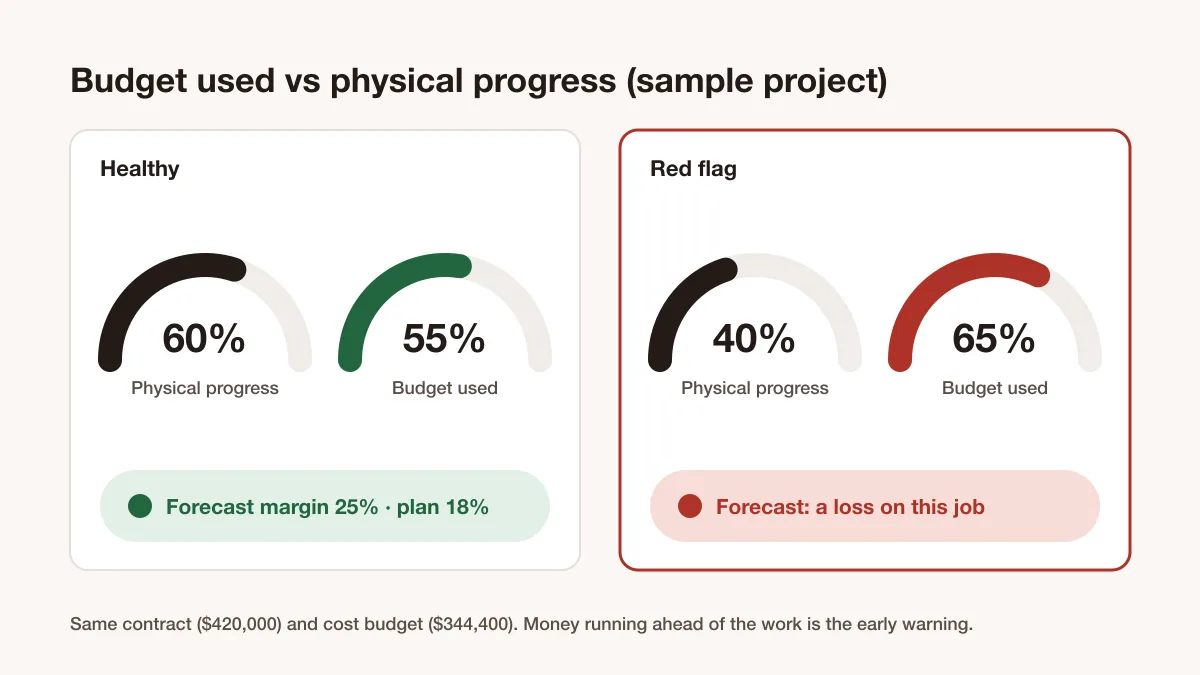
Spending money is not a problem; spending it faster than the work gets built is. Tie budget consumption to physical progress on site. If the project is 40% built but 65% of its cost budget is used, you have a red flag even if the bank balance looks healthy.
Three formulas from earned value management turn this into a margin you can read on any day:
- Earned value = cost budget × % physically complete. It is what the work done so far should have cost.
- Cost performance index (CPI) = earned value ÷ actual cost. Above 1.0 you are getting more work per dollar than planned; below 1.0, less.
- Forecast final cost = cost budget ÷ CPI, if the rest of the job runs at the same cost rate (a bottom-up cost to complete is the check on it). Forecast margin = (contract value − forecast final cost) ÷ contract value.
| Healthy | Red flag | |
|---|---|---|
| Physically complete | 60% | 40% |
| Budget used (actual cost) | 55% ($189,420) | 65% ($223,860) |
| Earned value | $206,640 | $137,760 |
| Cost performance index | 1.09 | 0.62 |
| Forecast final cost | $315,700 | $559,650 |
| Forecast margin | 24.8% | −33.3% (a loss) |
The weak point is the percentage complete. Measure it from installed quantities (cubic metres poured, square metres of blockwork laid) or from weighted milestones agreed in advance, never from the share of the programme that has passed. The same idea sits behind the percentage-of-completion method accountants use to recognise revenue on long contracts.
A 20-minute weekly profitability review
Real-time data only pays off if someone looks at it. Hold the same short review on the same day each week, project by project:
- 1Check last week's entries are complete.
Every delivery, wage sheet and site expense recorded, with photos. - 2Look at committed vs budget per phase.
Anything past 80% gets a name and an action. - 3Update physical progress.
Use measured quantities or agreed milestones. - 4Read the forecast margin.
Compare it with the margin in the estimate and with last week. - 5Decide and record actions.
Re-quote, re-plan, raise a variation or release contingency, with an owner and a date.
Cost tracking guides make the same point: variance is only useful if it is reviewed regularly against the same cost codes as the budget (Projul). Keep cash flow in the same review, so the payment schedule brings in money before the next big commitment.
Spreadsheet or software for construction expense tracking?
A spreadsheet (such as this construction project management Excel template) can hold the method above for one small job if one disciplined person keeps it. It struggles once several people record costs, several sites run at once, or you need committed cost and progress in the same view. That is the gap Aaghaz360, construction management software for builders and contractors, is built to close: site staff record labour, material and expenses from a phone, approved orders count as committed cost, and each phase shows spend against work done.
| Need | Paper and spreadsheet | Construction software |
|---|---|---|
| Recording from site | Typed in later, often days later | From a phone, the same day |
| Receipts and delivery notes | Paper files, easily lost | Photo attached to the cost |
| Committed cost | A separate list of open orders | Approved orders count automatically |
| Budget alerts | Someone has to notice | Raised when a phase will go over |
| Several sites | One file per job, merged by hand | One view across projects |
Whichever tool you use, the rules do not change: one budget split by bucket and phase, every cost recorded the day it happens, commitments counted, and spend judged against work done.
Is your expense tracking real-time?
0 of 8 in placeTick what is already in place on your site.
Questions people ask
How do you track construction expenses in real time?
Split the budget into cost buckets and phases, then have site staff record every purchase, wage payment and expense from a phone on the day it happens, with a photo of the receipt or delivery note and the project, phase and category. The office sees each cost the same day instead of at month end.
What is the difference between committed cost and actual cost?
Actual cost is money already spent or billed. Committed cost adds money already promised through approved purchase orders and signed subcontracts that have not been billed yet. Tracking committed cost shows an overrun before the invoice arrives.
How do you calculate the profit margin on a construction project while it is running?
Work out earned value (cost budget × % physically complete), divide it by actual cost to get the cost performance index, and divide the cost budget by that index to forecast the final cost. Forecast margin is contract value minus forecast final cost, divided by contract value.
What is a good cost performance index in construction?
A CPI of 1.0 means the work is costing exactly what was budgeted. Above 1.0 is under budget for the work done; below 1.0 is over. A CPI that stays below about 0.95 for more than a week or two deserves a cause and an action.
How often should construction costs be reviewed?
Record costs daily and review them weekly. A 20-minute review of committed cost, progress and forecast margin per phase catches overruns while there is still time to fix them.
What budget categories should a construction project have?
At minimum: raw materials, direct labour and subcontractors, equipment and machinery, and a contingency. Split each by phase, such as substructure, grey structure and finishing, using the same phases as your estimate.