Costs
Overhead and profit in construction: how to work out your rate and price it into a job
Every job has to pay for more than its own material and labour: the office, the owner's time, insurance, vehicles and the quotes you didn't win. If those costs aren't priced into each job, a builder can be busy all year and still lose money. This guide works through one small builder's overhead, turns it into a rate three different ways, reconciles them, and prices a job with it.
Part of the guide to construction budget vs actual
On this page · 12 sections
- What overhead and profit means in construction
- Job overhead vs company overhead (general conditions and preliminaries)
- Step 1: List a year of company overhead
- Step 2: Work out your overhead rate on cost, revenue or labour hours
- Converting between overhead on cost and overhead on revenue
- Step 3: Price overhead and profit into a job
- What overhead and profit percentages are typical
- When work slows down: under-recovered overhead
- Overhead and profit on changes and variations
- Recalculate twice a year, and check it against real jobs
- Questions people ask
- Sources
Key takeaways
- Overhead and profit in construction is what you add to a job's direct cost to pay for running the company (overhead) and to earn a return (profit).
- Job overhead, called general conditions in the US and preliminaries in the UK, belongs in the job's direct cost. Company overhead is spread across all jobs.
- Your overhead rate depends on the base: the same $180,000 is 20% of direct cost but 15% of revenue. Pick one base and use it everywhere.
- "10 and 10" (10% overhead, 10% profit) is a habit, not a standard. Applied on cost it is a 21% markup and a 17.4% margin.
- Overhead is fixed but recovery depends on volume. When turnover drops, the rate you priced at stops covering it, so recalculate at least twice a year.
What overhead and profit means in construction
Overhead and profit in construction, often written OH&P, is the amount a builder adds to the direct cost of a job. Overhead pays for the parts of the business no single job owns: the office, the owner's management time, accounts, insurance, vehicles, software, and the time spent pricing work you don't win. Profit is what remains after every cost is paid, and it is what funds the next slow month, new equipment and the owner's return on the risk taken.
The two are often quoted together as one percentage, but they behave differently. Overhead is a cost you will have whether or not you win the job. Profit is a choice you make in the price, and the first thing to shrink when overhead isn't covered. Keeping them separate is what lets you see which one went wrong.
Job overhead vs company overhead (general conditions and preliminaries)
The most common mistake is counting the same cost twice, or not at all, because "overhead" means two things. Job overhead is the cost of running one particular site; company overhead is the cost of running the business.
| Job overhead | Company overhead | |
|---|---|---|
| Also called | General conditions (US), preliminaries (UK and many Commonwealth countries), site overheads | General and administrative (G&A), head-office overheads, establishment costs |
| Examples | Site supervisor's time on that job, site cabin, temporary power and water, scaffolding hire, site security, skips, site insurance | Office rent, office staff, owner's salary for managing, accountant, business insurance, vehicles not charged to jobs, software, unpaid estimating time |
| Where it goes | In the job's direct cost, priced line by line | Spread across all jobs as a percentage or an hourly rate |
| Changes with | The job's length and size | The company's size, not any one job |
UK practice keeps the two apart for the same reason: the RICS New Rules of Measurement put preliminaries in their own section of a cost plan, separate from overheads and profit (Designing Buildings, RICS NRM). Whatever your country calls them, price job overhead in the estimate and recover company overhead with the rate below.
Step 1: List a year of company overhead
Start from last year's accounts and next year's plan, not from a percentage you heard. Here is a small builder that plans $1.2 million of work next year, with sample figures:
| Overhead line | Per year |
|---|---|
| Office rent and utilities | $18,000 |
| Office staff (accounts and estimating, part-time) | $54,000 |
| Owner's salary for managing, not site work | $60,000 |
| Vehicles and fuel not charged to jobs | $14,000 |
| Business insurance | $9,000 |
| Accountant, legal and licences | $7,000 |
| Tendering and marketing | $6,000 |
| Small tools and equipment not charged to jobs | $8,000 |
| Software, phones and IT | $4,000 |
| Total company overhead | $180,000 |
Step 2: Work out your overhead rate on cost, revenue or labour hours
An overhead rate is company overhead divided by a base. Three bases are common, and each gives a different number for the same overhead. The builder above plans $1,200,000 of revenue from $900,000 of direct job cost, and its crews will work about 30,000 hours.
| Base | Calculation | Rate | How it is used |
|---|---|---|---|
| Direct job cost | $180,000 ÷ $900,000 | 20% of direct cost | Add 20% to each job's estimated direct cost |
| Revenue | $180,000 ÷ $1,200,000 | 15% of revenue | Overhead takes 15% of each job's price |
| Labour hours | $180,000 ÷ 30,000 hours | $6.00 per hour | Add $6 to every crew hour in the estimate |
Direct cost is the usual base for builders who buy most of the material themselves. Labour hours suit trades whose cost is mostly their own crews. The base matters less than using one consistently: estimating with "15%" on direct cost when your 15% was worked out on revenue under-recovers a quarter of your overhead.
Converting between overhead on cost and overhead on revenue
Most published overhead percentages don't say which base they use, and most guides that show more than one base don't connect them. The conversion is simple once you know what share of revenue your direct cost is:
- Overhead % of revenue = overhead % of direct cost × (direct cost ÷ revenue).
- Overhead % of direct cost = overhead % of revenue ÷ (direct cost ÷ revenue).
- In the example, direct cost is 75% of revenue, so 20% of cost × 0.75 = 15% of revenue, and 15% of revenue ÷ 0.75 = 20% of cost.
Use this before comparing your rate with anyone else's. A builder who says "our overhead is 12%" on revenue may carry the same overhead as one who says 16% on cost.
Step 3: Price overhead and profit into a job
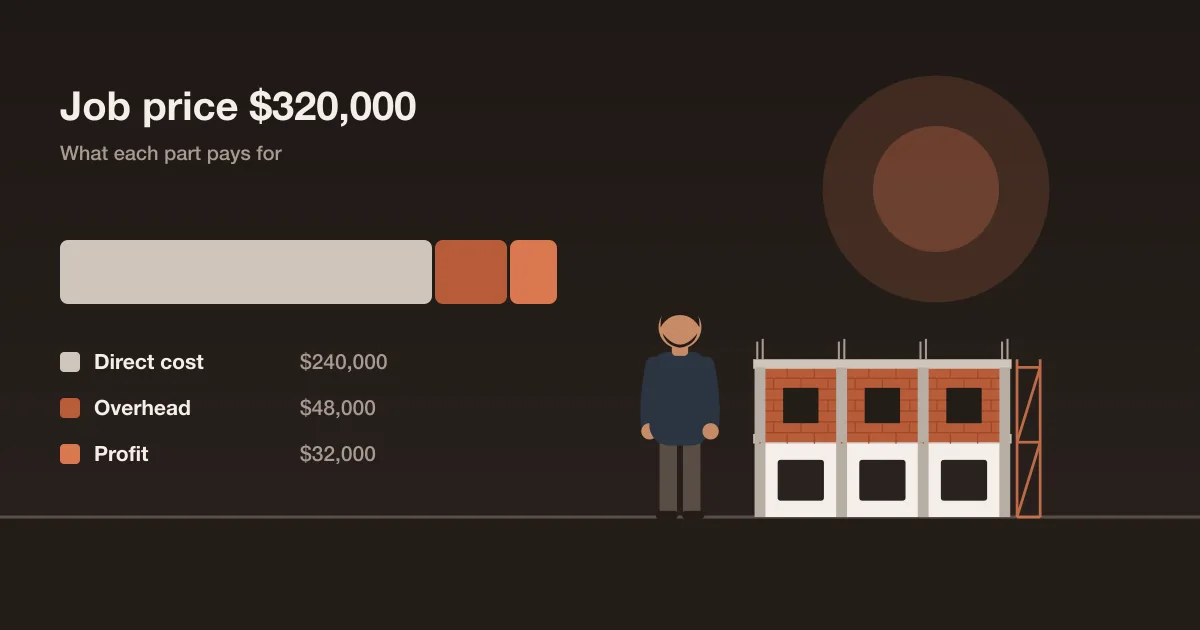
Take a house the builder above is pricing. The estimate's direct cost, including $18,000 of general conditions for that site, is $240,000. The target is 10% profit on the selling price.
- 1Direct cost.
Material, labour, subcontracts, plant and the job's own general conditions: $240,000. - 2Add company overhead at 20% of direct cost.
$240,000 × 20% = $48,000, so cost with overhead is $288,000. - 3Add profit as a margin on the price.
Price = $288,000 ÷ (1 − 10%) = $320,000. Profit is $32,000, which is 10% of $320,000. - 4Check.
Overhead of $48,000 is 15% of the $320,000 price, matching the revenue-based rate. The total markup on direct cost is $80,000 ÷ $240,000 = 33.3%.
Step 3 divides by (1 − margin) because profit was set as a share of the price. Adding 10% to cost instead would give a 9.1% margin. The markup vs margin section of the estimating guide covers the difference, and the same guide covers contingency, which is a separate allowance for risk, not overhead or profit.
What overhead and profit percentages are typical
Few overhead and profit benchmarks are published with a method. One that is: the US National Association of Home Builders' Cost of Doing Business Study, 2025 edition, which reports single-family builders' 2023 results.
| Measure | 2023 result |
|---|---|
| Gross profit margin (revenue minus cost of sales) | 20.7% (18.2% in 2020) |
| Operating expenses (finance, sales and marketing, G&A, owner's pay) | 12.0% of revenue |
| Net profit margin | 8.7% (7.0% in 2020) |
Sources: NAHB press release and NAHB Eye on Housing. These are averages for US single-family home builders, so treat them as a sense check, not a target. In the sample above, overhead of 15% of revenue and a 10% net margin would sit above the NAHB averages on both, which is a prompt to check the overhead list and the price, not proof that either is wrong.
The figure that matters is your own: last year's overhead divided by last year's base. A benchmark tells you which questions to ask; it can't tell you what your office costs.
When work slows down: under-recovered overhead
Overhead is mostly fixed, but you recover it as a percentage of jobs. If the work doesn't arrive, the percentage doesn't cover the cost. Using the same builder:
| Planned year | Slow year | |
|---|---|---|
| Revenue | $1,200,000 | $900,000 |
| Direct cost (75% of revenue) | $900,000 | $675,000 |
| Overhead recovered at 20% of direct cost | $180,000 | $135,000 |
| Actual company overhead | $180,000 | $180,000 |
| Profit priced into jobs (10% of revenue) | $120,000 | $90,000 |
| Profit actually made | $120,000 (10%) | $45,000 (5%) |
A quarter less work halved the profit, because $45,000 of overhead had no job to pay for it. The options are to cut overhead, win more work, or raise the rate for the jobs you do win, and each has a cost. Knowing the number early is what gives you the choice, which is why a mid-year check against plan matters.
Overhead and profit on changes and variations
Extra work ordered during the job also carries overhead and earns profit. Many contracts set the percentage allowed on changes, or say how it is worked out; read that clause before pricing a variation, and price it with the same base as the original estimate. Record every approved change against the contract so the job's budget and your payment schedule move with it, and so the margin on the finished job can be checked against the margin you priced.
Recalculate twice a year, and check it against real jobs
- 1Every six months, list overhead again from the accounts and divide by the base you use.
- 2Update the rate in your estimating sheet or quotation tool the same day.
- 3Set a minimum margin below which a quote needs the owner's approval.
- 4After each job, compare the margin you priced with the margin you made. A job that went over budget eats profit first; construction budget vs actual and cost to complete show where it went.
For a first estimate to price from, the construction cost estimator produces a bill of quantities with material and labour you can add your overhead and profit to.
Is your overhead and profit priced properly?
0 of 9 in placeTick what is already in place on your site.
Questions people ask
What is overhead and profit in construction?
It is what a builder adds to a job's direct cost. Overhead pays for running the company, such as the office, staff, insurance and vehicles, which no single job owns. Profit is the return left after every cost is paid. They are often quoted together as one percentage but should be worked out separately.
What is a typical overhead and profit percentage in construction?
It varies by company and market. NAHB's 2025 Cost of Doing Business Study reported US single-family builders' operating expenses at 12.0% of revenue and net profit at 8.7% in 2023. Your own rate, from your own overhead list, matters more than any average.
How do I calculate my overhead rate in construction?
Add up a year of company overhead and divide it by a base: direct job cost, revenue or labour hours. For example, $180,000 of overhead on $900,000 of direct cost is 20% of cost; on $1,200,000 of revenue it is 15%; over 30,000 crew hours it is $6 an hour. Use the same base in every estimate.
What is the difference between general conditions and overhead?
General conditions are the costs of running one particular site, such as supervision, the site cabin, temporary power and scaffolding. They go into that job's direct cost. Overhead, or general and administrative cost, is the cost of running the business and is spread across all jobs. In the UK, general conditions are called preliminaries.
Is 10% overhead and 10% profit standard?
It is a common habit, not a standard. Applied one after the other on cost, 10% and 10% is a 21% markup and a 17.4% margin. Whether that is enough depends on your own overhead, which you should work out from your accounts.
How often should I recalculate overhead?
At least twice a year, and whenever turnover, staff or premises change. Overhead is largely fixed, so a drop in work raises the rate you need to charge on the jobs you still win.