Costs
Cost to complete in construction: the formula, a worked example and a free Excel report
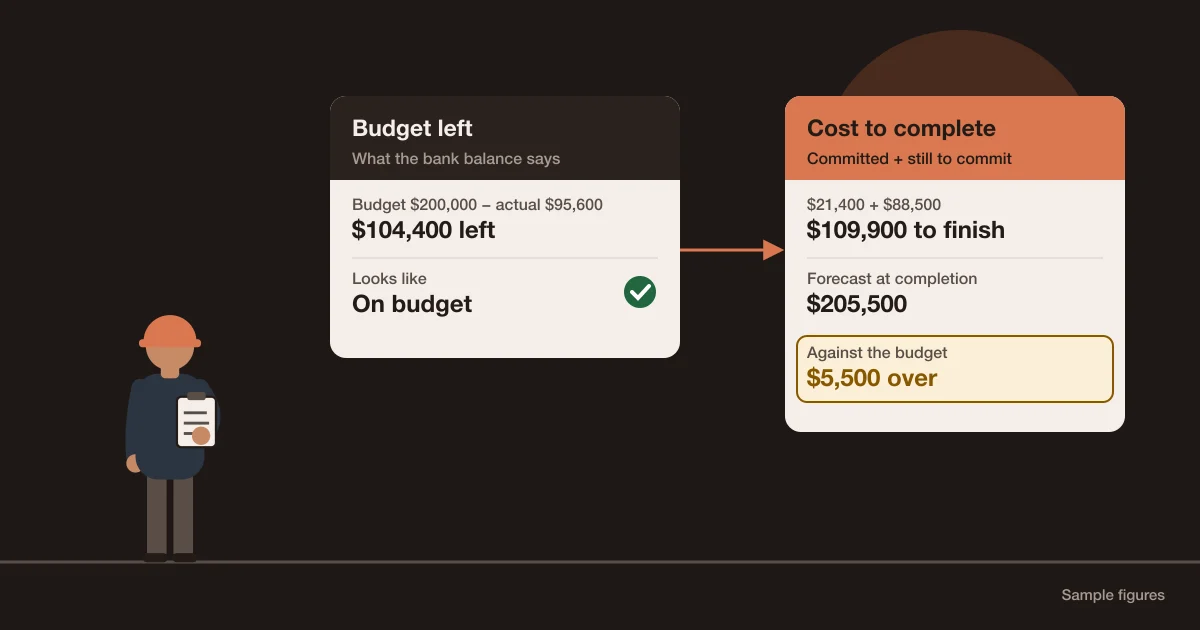
Budget left tells you how much money you haven't spent. Cost to complete tells you how much you still need. On a job that is drifting over budget, the two numbers can be thousands apart, and only one of them protects your margin.
Part of the guide to construction budget vs actual
On this page · 9 sections
Key takeaways
- Cost to complete is what you still expect to spend to finish the job: committed cost not yet billed, plus the cost of everything not yet ordered or let, priced at today's rates.
- Forecast at completion is actual cost to date plus cost to complete. Compare it with the budget, phase by phase, to see the overrun before it happens.
- Budget minus actual is not cost to complete. It assumes the rest of the job will cost exactly what is left, which is the one thing you don't know.
- Work it out bottom-up per phase: open orders and subcontracts from your records, and the rest from quantities left times current rates.
- Check it against a performance-based figure (budget ÷ cost performance index). If the two disagree badly, find out why.
What cost to complete means
Cost to complete (CTC), also called estimate to complete (ETC), is the amount you still expect to spend to finish a construction project or one of its phases, from today to handover. Add it to the cost already incurred and you get the forecast at completion: what the job, or the phase, will cost in the end.
| Term | What it is | Formula |
|---|---|---|
| Actual cost to date | Cost already paid or billed | From your bills, wage sheets and material issues |
| Committed cost, not yet billed | Approved orders and signed subcontracts you haven't been billed for | From open orders and subcontract balances |
| Cost to complete (estimate to complete) | What you still expect to spend | Committed not yet billed + still to commit |
| Forecast at completion (estimate at completion, forecast final cost) | What the job will cost in total | Actual to date + cost to complete |
| Variance at completion | How far over or under budget it will finish | Budget − forecast at completion |
| Budget left | Budget not yet spent | Budget − actual to date (not a forecast) |
The project-control definitions say the same thing in different words. AcqNotes, a reference for programme management, defines the estimate at completion as the forecast of what it will take to finish a project at a given point in time, and gives it as actual cost plus the estimate to complete (AcqNotes: Estimate at Completion).
Committed cost and cost variance are covered in more depth in construction budget vs actual. This guide is about the number that looks forward.
Three ways to calculate cost to complete
| Method | Formula | When it is right | When it misleads |
|---|---|---|---|
| Budget left | Budget − actual to date | Never as a forecast; only as a reminder of what is unspent | Whenever the job is running over or under its rates |
| Bottom-up | Committed not yet billed + quantities left × current rates | Small and mid-size builders with phases, orders and a BOQ | If open orders or remaining quantities are missed |
| Performance-based | (Budget − earned value) ÷ CPI, or budget ÷ CPI − actual | As a check on the bottom-up figure | Early in a phase, or when one bad week distorts the CPI |
The performance-based method uses the cost performance index (CPI): the value of work done (earned value) divided by its actual cost (Designing Buildings Wiki: Cost performance index). A CPI below 1 means each dollar spent is buying less than a dollar of budgeted work. Dividing the budget by the CPI assumes the rest of the job runs at the same efficiency. The construction expense tracking guide uses the same CPI to forecast margin.
For a builder, the bottom-up method is the one to run every month, because it is built from things you can check: the orders you have placed and the quantities still to build. The performance-based figure is the cross-check.
The bottom-up method, step by step
- 1Use the same phases as your budget, such as foundation, structure, services and finishes. A cost to complete only means something next to the budget it is compared with.
- 2Enter actual cost to date for each phase: bills received (paid or not), wage sheets and material issued from the store.
- 3List committed cost not yet billed: approved purchase orders and signed subcontracts, minus what has already been billed against them. Include deliveries received but not yet billed.
- 4List what is still to commit: work and material not yet ordered or let. Take the quantity left from the drawings or BOQ, minus what is built or ordered, and price it at today's quotes, not at the estimate's rates.
- 5Cost to complete = committed not yet billed + still to commit.
Forecast at completion = actual + cost to complete. Variance = budget − forecast. - 6Compare with last month.
A forecast that moves without a reason is usually a missing order or a wrong quantity.
A worked example: a $200,000 house job
Hillside House is a sample house job with a cost budget of $200,000 and a contract price with the client of $230,000. It is now about halfway through. All figures are sample figures.
| Phase | Budget | Actual to date | Committed, not billed | Still to commit | Cost to complete | Forecast at completion | Variance |
|---|---|---|---|---|---|---|---|
| Foundation | $38,000 | $39,200 | $0 | $0 | $0 | $39,200 | −$1,200 |
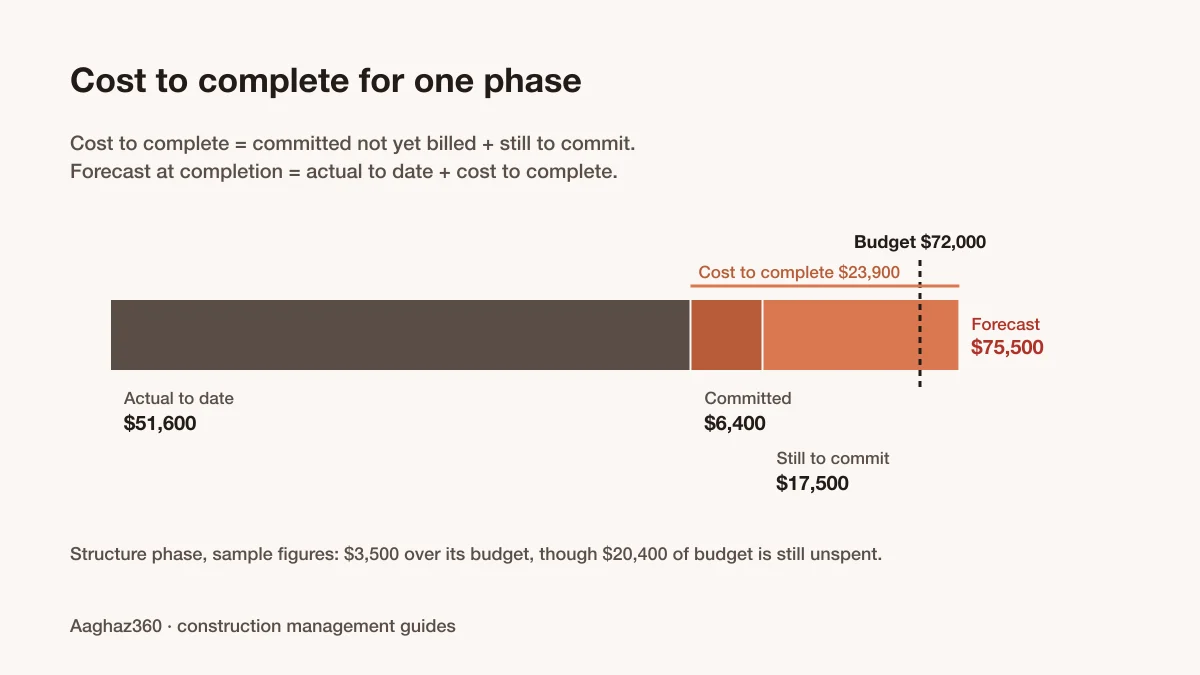
| Structure | $72,000 | $51,600 | $6,400 | $17,500 | $23,900 | $75,500 | −$3,500 |
| Services | $34,000 | $4,800 | $12,000 | $16,500 | $28,500 | $33,300 | +$700 |
| Finishes | $56,000 | $0 | $3,000 | $54,500 | $57,500 | $57,500 | −$1,500 |
| Total | $200,000 | $95,600 | $21,400 | $88,500 | $109,900 | $205,500 | −$5,500 |
Where the structure numbers come from. Committed: an order for blocks, delivered but not yet billed ($4,100), and the unbilled balance of the steel fixing subcontract ($2,300), so $6,400. Still to commit: roof slab concrete, 40 m³ × $145 = $5,800; steel bar, 5 t × $780 = $3,900; formwork hire, $2,300; labour, 110 worker-days × $50 = $5,500. That is $17,500.
What the owner learns. The bank balance says $104,400 of budget is left ($200,000 − $95,600), and the job looks on track. The cost to complete says $109,900 is still needed, so the job will finish at $205,500, $5,500 over budget. The margin on the $230,000 contract falls from the planned $30,000 (13.0%) to $24,500 (10.7%). Structure is the phase to act on: re-quote the roof slab concrete and check the labour estimate before the slab is ordered.
The cross-check. By measured work, foundation is 100% done, structure 70%, services 10% and finishes 0%. Earned value is $38,000 + $50,400 + $3,400 + $0 = $91,800, or 45.9% of the budget. CPI = $91,800 ÷ $95,600 = 0.960. The performance-based forecast at completion is budget ÷ CPI: $200,000 × $95,600 ÷ $91,800 = $208,279 (dividing by the rounded 0.960 gives $208,333), so the performance-based cost to complete is $208,279 − $95,600 = $112,679. The phase percentages come from measured work; measuring % complete explains the methods.
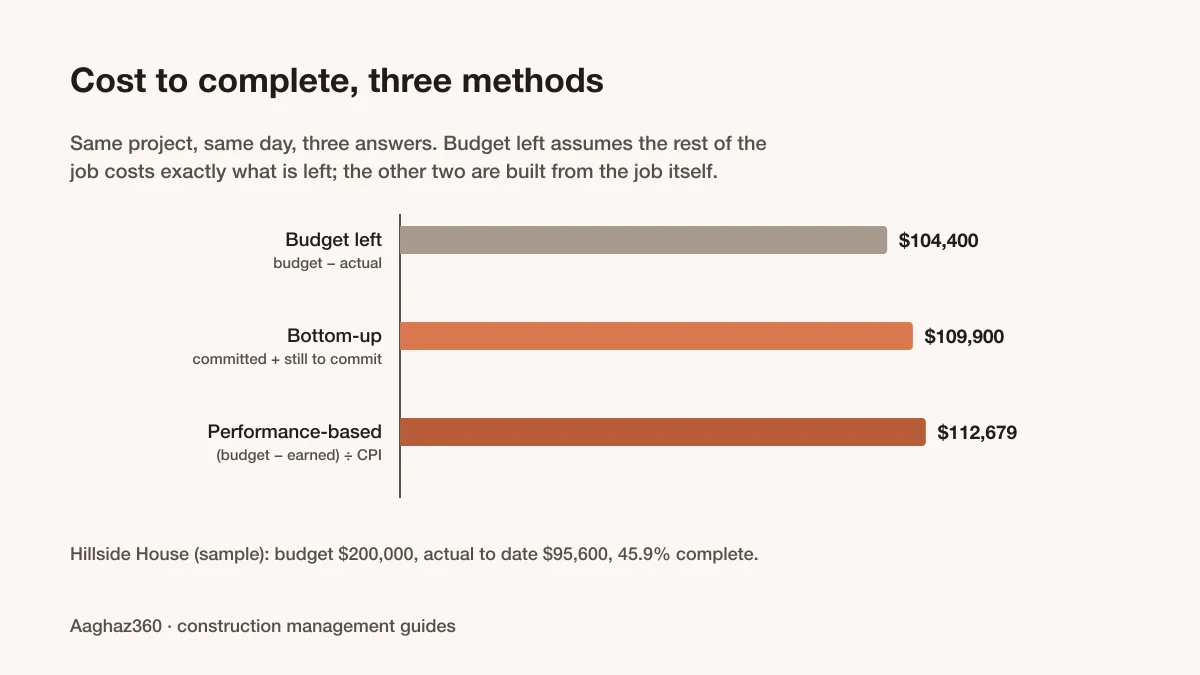
The bottom-up and performance-based figures are $2,779 apart, which is close enough: both say the job is over budget by roughly $5,500 to $8,300. If they were far apart, the first thing to look for is an open order or a remaining quantity missing from the bottom-up list.
Download the free cost to complete report (Excel). It holds this example: a report sheet per phase with forecast, variance, earned value and the three methods; an Open commitments sheet; and a Still to commit sheet that totals by phase. Replace the sample rows with your own; blank rows stay blank.
What goes in a monthly cost to complete report
- One row per phase: budget, actual to date, committed not billed, still to commit, cost to complete, forecast at completion, variance.
- The contract value and the forecast margin, in dollars and percent, against last month's.
- The three phases with the largest movement since last month, each with the reason (price rise, re-measured quantity, extra work, missing order found).
- Budget revisions approved since the last report, with who approved them, so the budget the forecast is compared with is the current one.
- Actions: what will be re-quoted, re-measured or raised with the client as extra work.
Monthly is a sensible default for a house or a small building. Run it every two weeks on a fast job or one that is already over budget. Whoever prepares it, the owner or the person responsible for the margin should read it and sign off the actions.
Common cost to complete mistakes
- Using budget left as the cost to complete. It shows the job on budget right up to the moment it isn't.
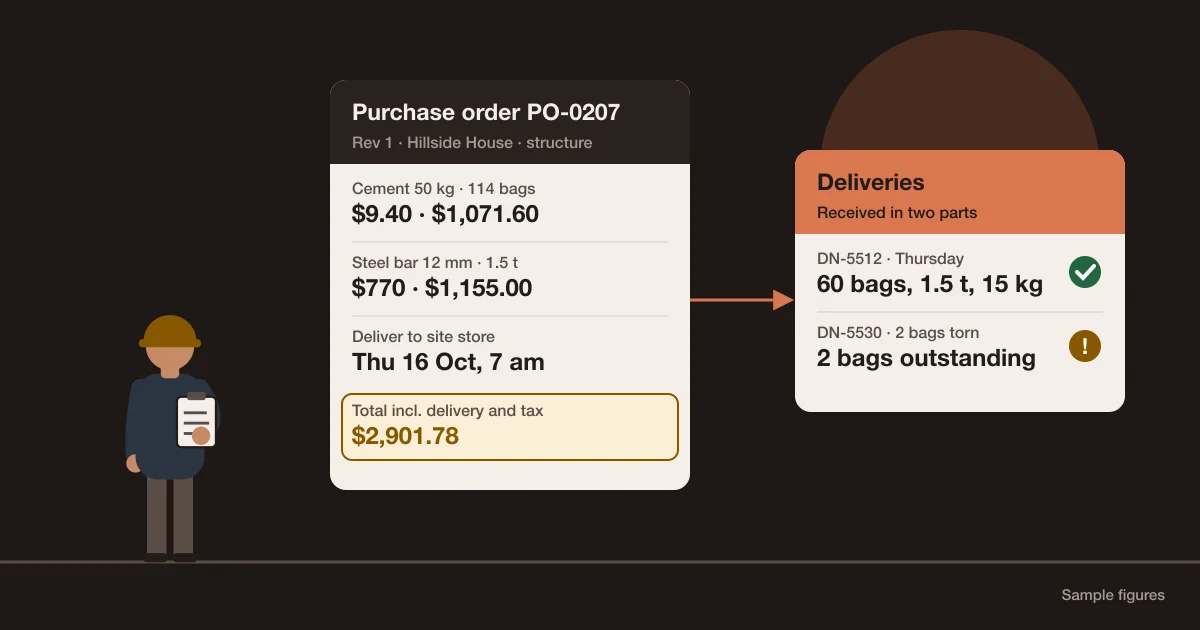
- Leaving out deliveries received but not yet billed. The material is on site and the bill is coming.
- Pricing what is left at the estimate's rates instead of today's quotes.
- Counting the whole value of an open order as committed even after part of it has been billed, which counts that part twice.
- Forgetting work that isn't in any order yet: snagging, cleaning, temporary works removal, final connections.
- Updating the forecast only when someone asks. A cost to complete is useful when it is regular, so the movement is visible.
- Treating a lender's cost-to-complete review as the same thing. A bank's independent review checks whether the remaining loan covers the work; your own forecast is for running the job.
In a spreadsheet or in software
The free report does the arithmetic once the inputs are in. The hard part is the inputs: actual cost and open commitments have to be collected from bills, wage sheets and orders spread across sites, every month, by someone who knows what is missing. On one job that is a few hours. On five it is a part-time role.
In Aaghaz360, bills, wage sheets, material issues and expenses post to the project and phase they belong to, and open orders count as committed cost on the phase. Each project shows where it will finish against its contract, budgets are revised openly with their history kept, and you get an alert when a phase will go over. To see it on one of your own jobs, book a walkthrough.
Before you sign off a cost to complete report
0 of 9 in placeTick what is already in place on your site.
Questions people ask
What is the formula for cost to complete?
Bottom-up: cost to complete = committed cost not yet billed + cost of the work still to commit, priced at current rates. Forecast at completion = actual cost to date + cost to complete. A performance-based check is (budget − earned value) ÷ CPI.
What is the difference between estimate to complete and estimate at completion?
Estimate to complete is what is still to be spent from today. Estimate at completion is the total the job will cost: actual cost to date plus the estimate to complete.
Is cost to complete the same as budget remaining?
No. Budget remaining is budget minus actual, the money not yet spent. Cost to complete is what you still expect to spend. If the job is running over its rates, cost to complete will be higher than the budget remaining.
Does cost to complete include committed costs?
Yes. Approved orders and signed subcontracts that haven't been billed yet are money you will spend, so they are part of the cost to complete. Count only the unbilled part, so nothing is counted twice.
How often should a contractor update cost to complete?
At least monthly on each running job, and every two weeks on a fast or troubled one. The value is in the movement from one report to the next, so keep the dates regular.