Costs
Construction payment schedule: how contractors get paid on time
Most contractors don't run out of work. They run out of cash, because they pay suppliers and labour every week and the client pays when it suits them.
Part of the guide to construction budget vs actual
On this page · 8 sections
Key takeaways
- Tie each instalment to a stage the client can see, such as plinth, slab or plaster, not to dates alone.
- Take an advance before starting so you are not funding the first phase yourself.
- Invoice the day a stage is reached; late invoices are the main reason for late payment.
- Agree retention, if any, and when it is released, in writing.
- Price client changes separately and add them to the schedule before doing the work.
Why contractors run short of cash
A construction payment schedule is the agreement on how much the client pays and when, stage by stage. Without one, money comes in when the client feels progress, while cement, steel and wages go out every week. Finance and payment problems are among the most frequently cited causes of project delays in research studies (Transportation Research Record, via KFUPM), and on private houses the same gap stops work just as surely.
A stage-based payment plan for house construction
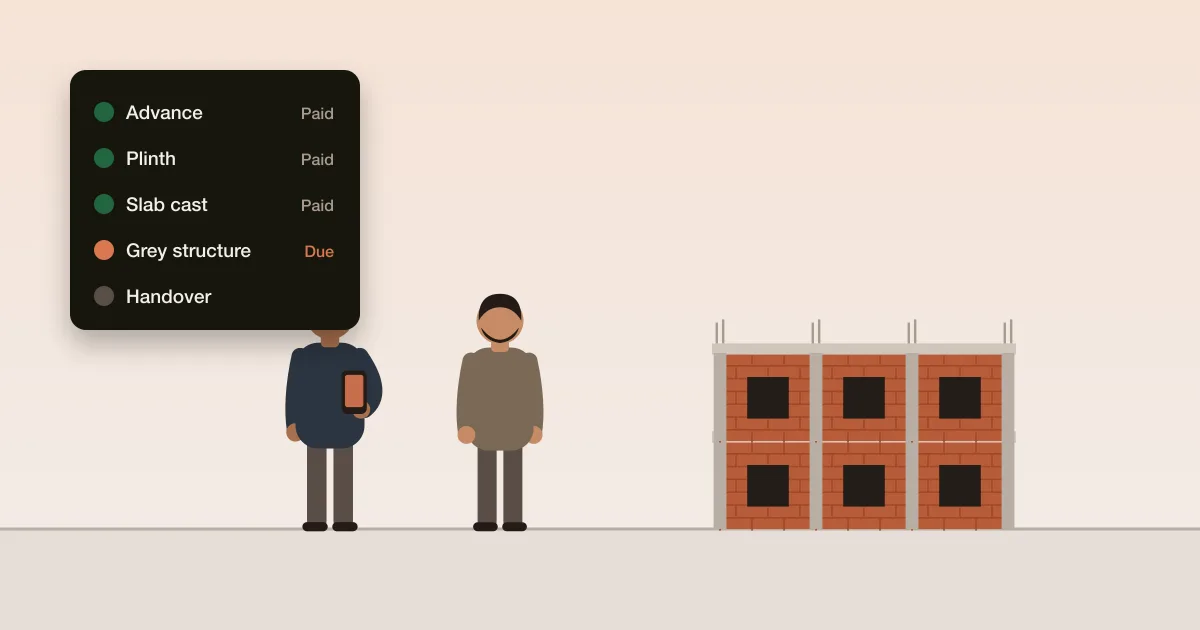
Link each instalment to a stage both sides can see on site. The percentages below are an example to adapt, not a standard: set them so each payment arrives before the next phase's spending starts. If you don't have a phase-by-phase price yet, a construction cost estimator can split the total into categories to base the stages on.
| Stage reached | Example share | Why here |
|---|---|---|
| Contract signed (advance) | 15–20% | Funds excavation and the first material |
| Plinth complete | 15% | Before columns and walls start |
| Ground-floor slab cast | 20% | Steel and cement for the next floor |
| Grey structure complete | 20% | Before finishing material is ordered |
| Plaster and services done | 15% | Before tiles, fixtures and paint |
| Handover | 10–15% | Balance, with any agreed retention |
Advance payment in a construction contract
An advance lets you start without funding the first phase from your own pocket. Agree how it is recovered: either as the first instalment in its own right, or deducted proportionally from later bills. Write it down either way, so neither side is surprised at the last payment.
Retention money in construction
Retention is a share of each payment the client holds back as security for defects, commonly around 5% in standard contracts, often released half at practical completion and half after a defects period of 6 to 12 months (Mastt). If you agree to retention, put the percentage and both release triggers in the contract, and don't count retained money as cash you have. When you hold retention from your own subcontractors, subcontractor management software keeps what is held on each contract.
How to get paid on time as a contractor
- 1Invoice the day a stage is reached.
Late invoices are the most common reason for late payment (Projul). - 2Attach proof: a photo of the stage and a short note of what was done.
- 3Send a statement showing billed, received and still due, so the client sees the whole account.
- 4Follow up on a fixed rhythm: a reminder on the due date, another a week later, then a call.
- 5Agree in the contract what happens if payment is late, such as pausing work after a set number of days.
Keep your own supplier payments in step: if you know a client instalment is two weeks away, compare supplier quotations with credit terms in mind.
Price client changes before doing them
A changed staircase or an extra room is new work. Price it, get the client's agreement in writing, and add it to the schedule as its own instalment. Changes absorbed into the original price are the quietest way contractors lose money, and they make budget vs actual meaningless.
Questions people ask
What is a construction payment schedule?
An agreement on how much the client pays and when, usually an advance followed by instalments tied to stages such as plinth, slab, grey structure, plaster and handover.
How much advance should a contractor take?
Enough to fund the first phase without using your own money, often in the range of 15 to 20% on a house build, agreed in writing along with how it is recovered from later bills.
What is retention money in construction?
A share of each payment, commonly around 5%, held back by the client as security for defects and usually released half at completion and half after a defects period.
How can I get clients to pay on time?
Tie payments to visible stages, invoice the day a stage is reached with a photo as proof, send a running statement, and follow up on a fixed rhythm starting on the due date.