Purchasing
Construction purchase order template: fields, terms, part deliveries and a worked example
The purchase order is the only document between the site's request and the supplier's bill that commits money. Write it so the person signing for a delivery at 7 am and the person paying the bill a month later can both check against it, line by line.
Part of the guide to construction material procurement process
On this page · 11 sections
- What a construction purchase order is
- Where the purchase order sits in site buying
- What to include on a construction purchase order
- A worked example: one order, one revision, two deliveries
- Terms and conditions to print on the order
- Revisions and part deliveries: the two things most templates leave out
- Purchase order or subcontract?
- Common purchase order mistakes
- PO book, spreadsheet or software
- Questions people ask
- Sources
Key takeaways
- A construction purchase order is the buyer's written order to one supplier: items, quantities, units, agreed rates, where and when to deliver, and the terms. It becomes a contract once the supplier accepts it.
- Put the delivery site, the receiver and the date needed on site on the order. Most delivery disputes start with an order that didn't say them.
- Number every order and make the supplier quote that number on every delivery note and bill. It is what lets the bill be matched later.
- Never change an order by phone. Issue a revision with a new number (Rev 1, Rev 2) and keep the earlier version.
- Allow part deliveries in writing, and track the quantity still outstanding on each line until it arrives or the order is revised.
What a construction purchase order is
A construction purchase order template is the fixed layout you fill in each time you order material or plant hire from a supplier: who is buying, from whom, which items, how many, at what rate, delivered where and when, and on what terms. Designing Buildings Wiki defines a purchase order as a document issued by a buyer to a seller to show the intention to buy, and notes that it becomes a legal contract only when the supplier accepts it (Designing Buildings Wiki: Purchase order).
On a building site the order does three jobs at once. It tells the supplier exactly what to send. It tells the storekeeper what to expect and what to count. And it gives accounts the agreed rates to check the bill against. If any of the three can't be done from the order alone, the order is missing something.
It goes by other names. Many contractors in the Gulf and East Africa call it a local purchase order (LPO). Some firms say material order or supply order. The fields below are the same whatever you call it.
Where the purchase order sits in site buying
The order comes after the request and the price, and before the delivery and the bill:
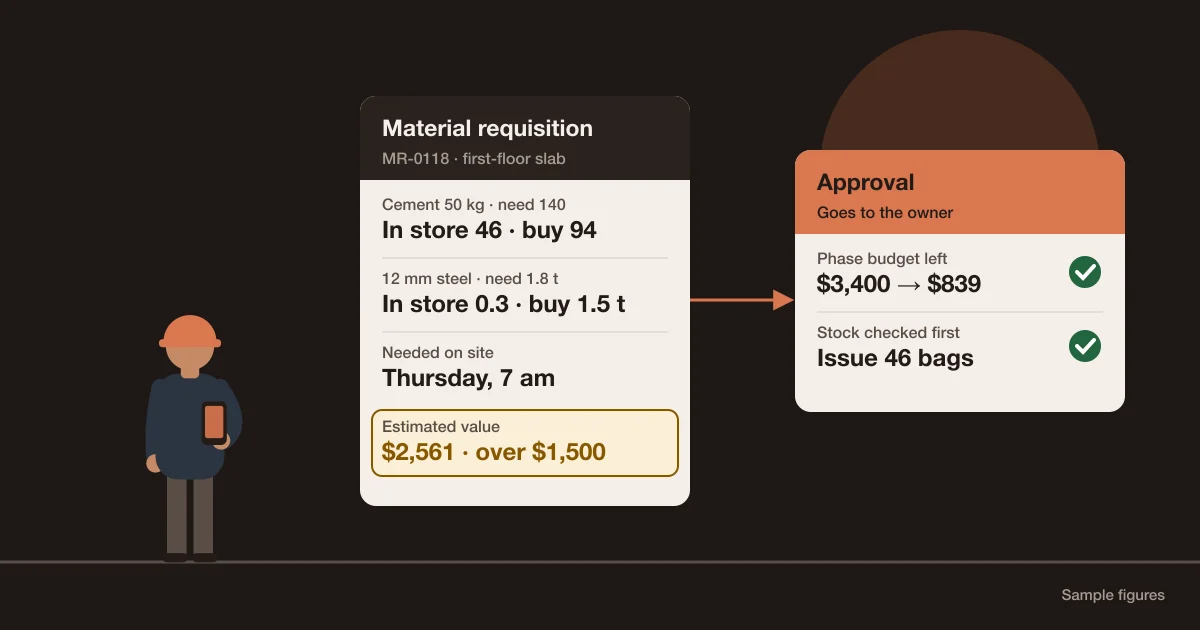
- 1The site raises a material requisition, the store is checked and the shortfall is approved.
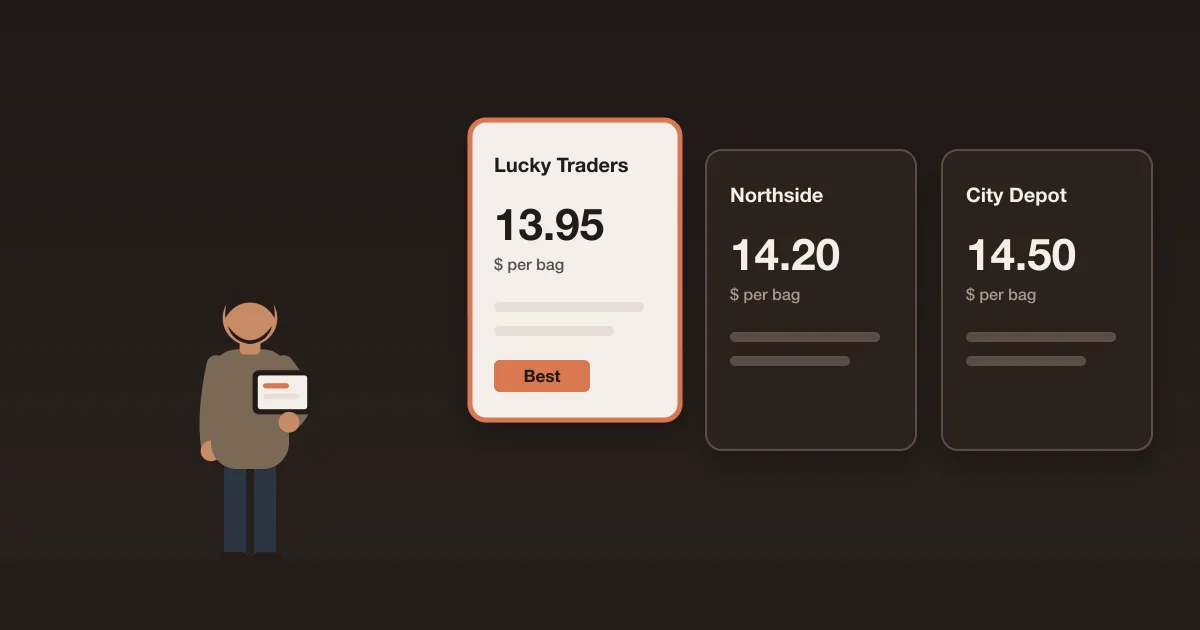
- 2The buyer collects quotes and picks a supplier (how to compare supplier quotations).
- 3The purchase order goes to that supplier, with the agreed rates and terms.
- 4Deliveries arrive, often in parts, and the receiver counts them against the order.
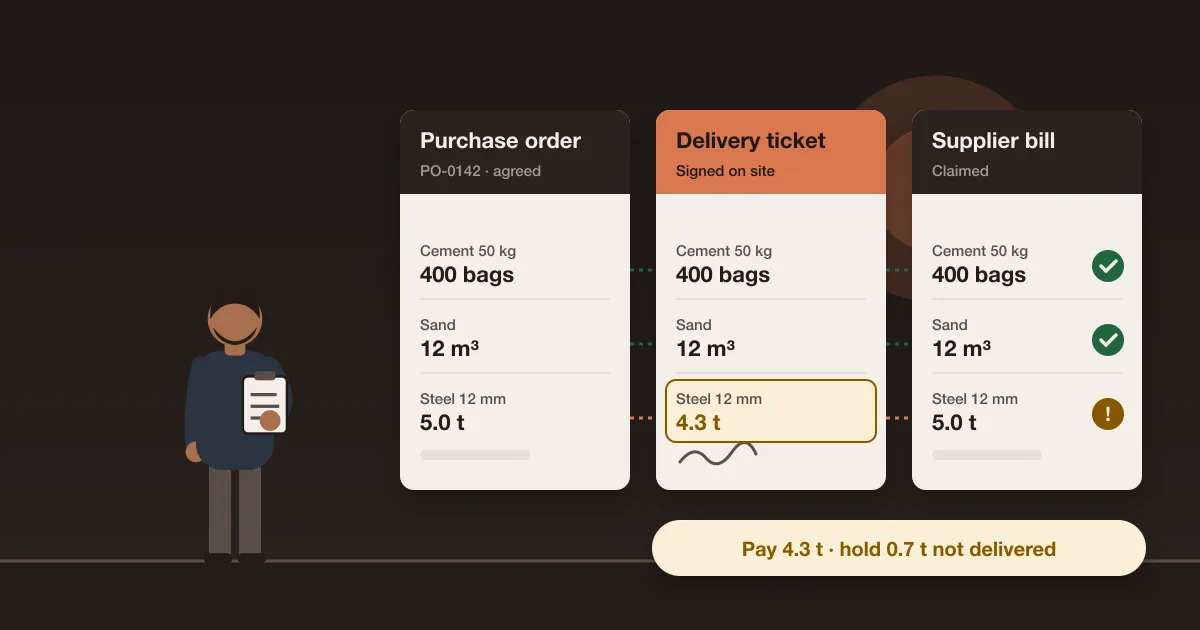
- 5The supplier's bill is matched against the order and what was accepted on site, then paid (three-way match).
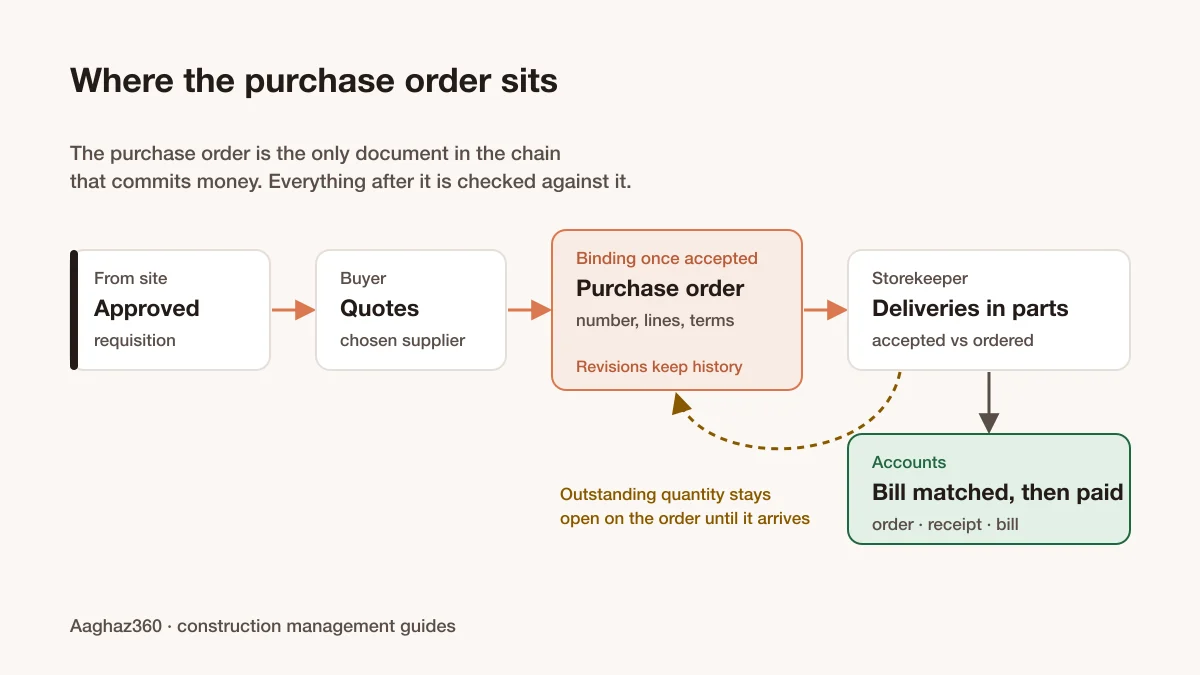
The requisition is internal and costs nothing to change. The order is external. Once the supplier accepts it, changing it means agreeing the change with someone outside your company, which is why the order needs to be right the first time.
What to include on a construction purchase order
Designing Buildings Wiki lists the usual contents of a purchase order as the PO number, a description of what is bought, technical details, quantities, discounts, agreed prices, payment terms and shipment dates. A building site needs a few more:
| Field | Example | Why it matters on site |
|---|---|---|
| PO number and revision | PO-0207, Rev 0 | Delivery notes and bills quote it, so each one can be traced to an order |
| Date issued | Tue 14 Oct | Shows which version of the price the supplier agreed to |
| Project and phase | Hillside House, structure | The cost lands on the right job and phase when the bill is entered |
| Requisition number | MR-0118 | Links the order back to the approved request |
| Supplier and quote reference | Supplier A, quote Q-311 | Ties the rates to a written quote with a validity date |
| Deliver to and receiver | Site store, storekeeper | A named receiver means someone is there to count and sign |
| Needed on site by, delivery hours | Thu 16 Oct, 7 am; 7 am to 4 pm | Stops a delivery arriving after the site has closed, or the day after the pour |
| Lines: item and specification | Steel bar 12 mm, grade per drawing S-04 | Size, grade and standard; a vague line invites a cheaper substitute |
| Unit, quantity, rate, amount | t, 1.5, $770.00, $1,155.00 | The unit must be the one the supplier bills in, or the bill can't be matched |
| Delivery charge and tax | $45.00; tax at your rate | Delivery and tax shown separately, so the total can be checked |
| Part deliveries | Allowed, balance within 3 working days | Says what happens if not everything arrives at once |
| Payment terms | 30 days from a correct, matched bill | When the clock for payment starts, and that it starts from a correct bill |
| Authorised by | Project manager, date | Who committed the money, within their approval limit |
If you only have room for six fields, keep the PO number, the delivery site and date, the item lines with unit and rate, the total, the payment terms and who authorised it.
A worked example: one order, one revision, two deliveries
This order follows the approved requisition from the material requisition form guide: buy 94 bags of cement, 1.5 t of 12 mm steel, 0.6 t of 10 mm steel and 15 kg of binding wire for a first-floor slab. All rates, quantities and the tax rate are sample figures, not market prices.
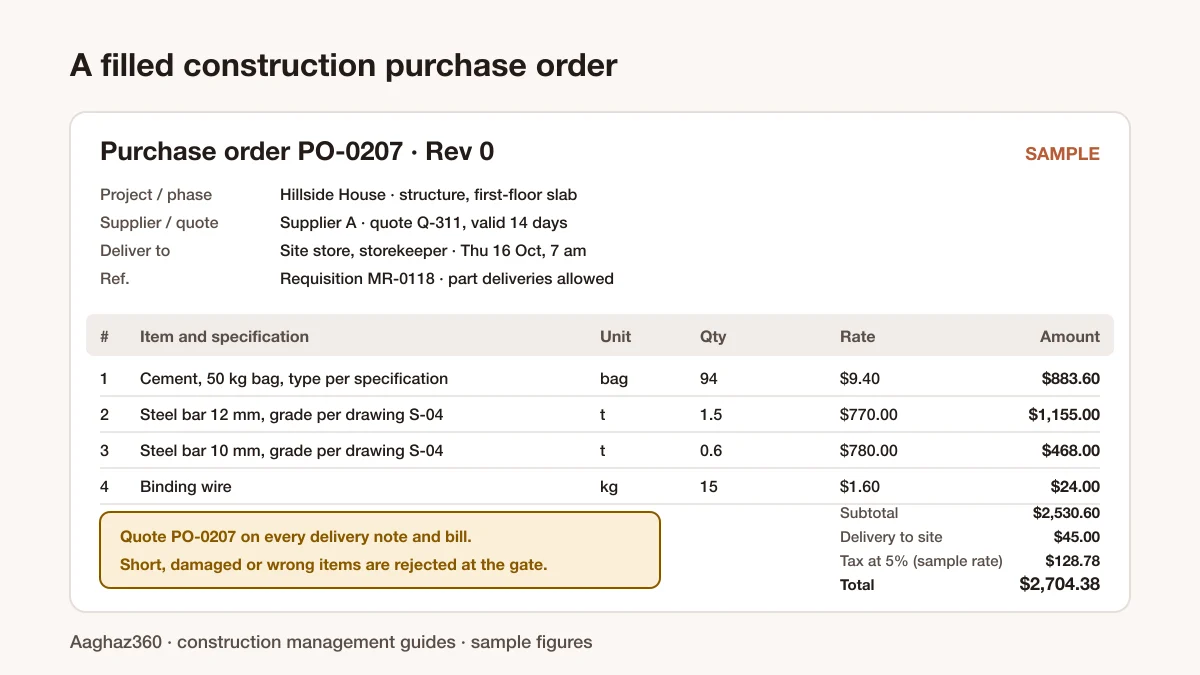
| Line | Item and specification | Unit | Qty | Rate | Amount |
|---|---|---|---|---|---|
| 1 | Cement, 50 kg bag, type per specification | bag | 94 | $9.40 | $883.60 |
| 2 | Steel bar 12 mm, grade per drawing S-04 | t | 1.5 | $770.00 | $1,155.00 |
| 3 | Steel bar 10 mm, grade per drawing S-04 | t | 0.6 | $780.00 | $468.00 |
| 4 | Binding wire | kg | 15 | $1.60 | $24.00 |
| Subtotal | $2,530.60 | ||||
| Delivery to site | $45.00 | ||||
| Tax at 5% (sample rate) on $2,575.60 | $128.78 | ||||
| Total | $2,704.38 |
The requisition estimated $2,561 for these items before delivery and tax. The quoted rates came in at $2,530.60, $30.40 lower, so the order stays within what was approved.
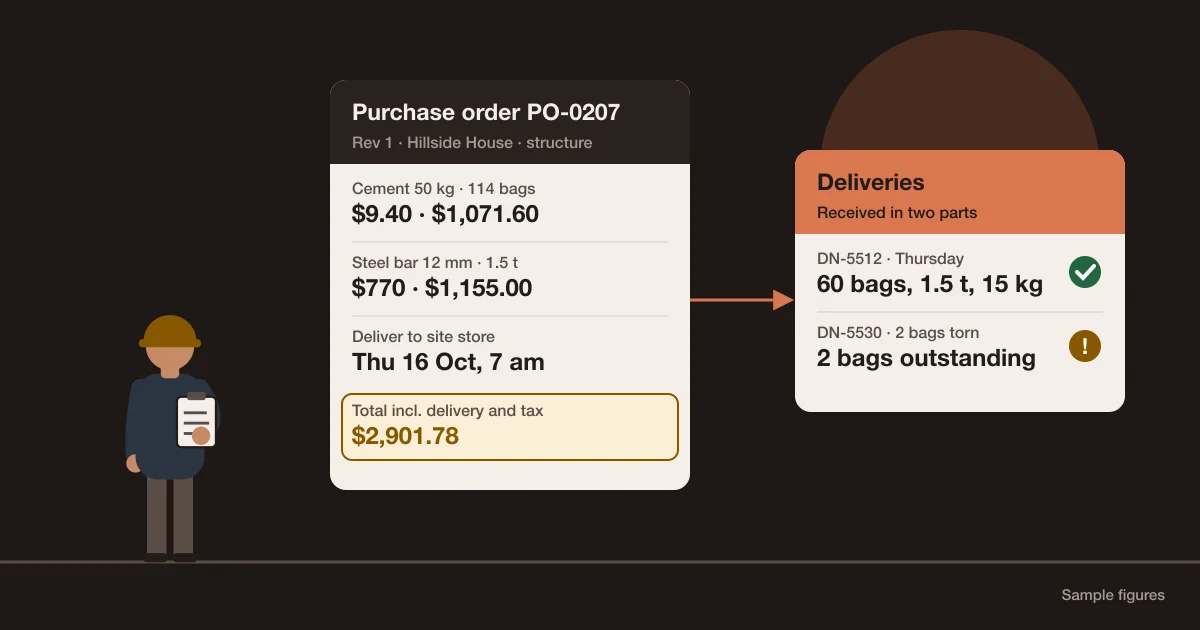
Revision 1. On Wednesday the engineer adds the stair flight to the same pour and needs 20 more bags. Instead of a phone call, the buyer issues PO-0207 Rev 1 with line 1 changed from 94 to 114 bags. Line 1 becomes 114 × $9.40 = $1,071.60, the subtotal $2,718.60, the total before tax $2,763.60, tax $138.18 and the total $2,901.78. That is $197.40 more than Rev 0: 20 bags at $9.40 plus 5% tax. Rev 0 is kept, marked as replaced.
Two deliveries. Delivery note DN-5512 on Thursday brings 60 bags, the 12 mm steel and the wire; all are counted and accepted. DN-5530 on Friday brings 54 bags and the 10 mm steel. Two bags are torn, so the storekeeper photographs them and rejects them at the gate.
| Line | Item | Ordered | Accepted | Outstanding | Accepted value |
|---|---|---|---|---|---|
| 1 | Cement, 50 kg bag | 114 | 60 + 52 = 112 | 2 | $1,052.80 |
| 2 | Steel bar 12 mm | 1.5 t | 1.5 t | 0 | $1,155.00 |
| 3 | Steel bar 10 mm | 0.6 t | 0.6 t | 0 | $468.00 |
| 4 | Binding wire | 15 kg | 15 kg | 0 | $24.00 |
| Total accepted, before delivery and tax | $2,699.80 |
What the order now tells everyone: the supplier owes 2 bags, worth $18.80 before tax. If the bill arrives for 114 bags, accounts pays for 112 and holds the rest until the replacements are signed for. The order stays open until those 2 bags arrive, or until a Rev 2 reduces line 1 to 112. Check: $2,699.80 accepted plus $18.80 outstanding is $2,718.60, the Rev 1 subtotal.
Download the free construction purchase order template (Excel). It has three sheets: the purchase order with this example (amounts, subtotal, tax and total calculate), a Deliveries sheet that works out the accepted and outstanding quantity per line, and a PO log for every order and revision. Blank rows stay blank until you fill them.
Terms and conditions to print on the order
Most small builders print a short set of terms on every order and keep their full conditions in a separate document the supplier has agreed to. The list below is what site-level terms usually need to cover. It isn't legal advice: contract law differs by country, so have your full conditions checked locally.
- Quote the PO number and line on every delivery note and bill. Bills without it are returned.
- Deliver to the address and in the hours on the order. The receiver signs for quantities counted, not for what the delivery note says.
- Part deliveries are allowed, or not; if they are, say by when the balance must follow.
- Short, damaged or wrong items can be rejected at delivery and are not paid for.
- No substitutions, and no change of rate or quantity, without a written revision of the order.
- Documents that must come with the goods, such as the test or mill certificate the specification asks for on steel.
- Payment terms, counted from the date of a correct bill that matches the order and the signed delivery notes.
- How either side can cancel, and what happens to material already delivered.
Revisions and part deliveries: the two things most templates leave out
Orders change. A pour moves, a quantity is re-measured, a supplier runs short. The danger isn't the change, it's a change that only exists in a phone call. When the bill comes, nobody can show which quantity or rate was agreed.
- Issue a revision for any change of item, quantity, rate, date or delivery site. Keep the same PO number with a revision number, and send the whole order again, not just the changed line.
- Keep every earlier revision, marked as replaced. The bill is checked against the latest revision the supplier accepted.
- If the revision raises the total above the buyer's approval limit, it goes for approval again, like a new order.
- Track outstanding quantity per line, not per order. 'Part delivered' doesn't tell anyone that it's 2 bags of cement and not 2 t of steel.
- Close an order deliberately: either everything has arrived, or a final revision reduces the quantity to what was accepted.
Receiving is where the order earns its keep. The storekeeper counts against the order, not against the delivery note, and records what was rejected and why. The construction material tracking guide covers the delivery check in more detail.
Purchase order or subcontract?
A purchase order suits goods with a clear quantity and rate: cement, steel, blocks, tiles, plant hire by the day. Work done by another firm on your site, such as steel fixing, electrical installation or plastering, usually needs a subcontract instead.
| Purchase order | Subcontract | |
|---|---|---|
| Used for | Material, plant hire, goods with a unit rate | Work carried out on site by another firm |
| Measured by | Quantity delivered and accepted | Work done and measured, often in stages |
| Paid | Against matched bills for what was received | Against measured work, often less retention and advance recovery |
| Changes | Revision of the order | Variation to the subcontract |
Some contractors call a labour-only subcontract a work order. Whatever the name, if the payment depends on measured work rather than delivered goods, it belongs on a contract with a value, an advance, a retention rate and its own terms, not on a purchase order.
Common purchase order mistakes
- No delivery site or receiver. The truck arrives at the office, or at a site where nobody is there to count.
- Units that don't match the bill. Steel ordered by the bar, billed by the tonne.
- Verbal changes. The quantity on the bill matches a phone call, not the order.
- One order number reused for several deliveries with no line-level record of what is still to come.
- Rates without a quote reference, so a price rise on the bill can't be challenged.
- Orders raised after the delivery to cover it. The order is meant to control the purchase, not record it.
- Payment terms that start from delivery, not from a correct bill. You end up paying for short deliveries before anyone has checked.
PO book, spreadsheet or software
A numbered carbon PO book works for one buyer and one site, as long as a copy goes to the site and a copy to accounts, and every revision is a new page.
A spreadsheet adds the arithmetic and a log of every order. The free template does the line amounts and totals, and works out what is still outstanding from the deliveries you enter. It still relies on one person typing in the delivery notes, and nobody on site sees the order unless it is printed or sent.
Software makes the order the shared record. In Aaghaz360, the purchase order is created from the approved demand and the chosen quotation, and carries the delivery site, receiver and terms. Change it and the earlier version is kept. The storekeeper receives against it in parts, records short, damaged or rejected items with a photo of the delivery note, and the supplier's bill is matched against the order and what was received before it is paid. Open orders also count as committed cost on the phase budget. To see the whole path with your own materials, book a walkthrough.
Before you send a purchase order
0 of 9 in placeTick what is already in place on your site.
Questions people ask
What is a purchase order in construction?
It is the buyer's written order to a supplier for material, plant or goods: the items and specification, quantities, units, agreed rates, where and when to deliver, and the payment terms. It becomes a contract once the supplier accepts it, and the bill is later checked against it.
Is a purchase order legally binding?
Generally it becomes binding once the supplier accepts it, for example by confirming it in writing or delivering against it. Before that it is an offer to buy. The exact rules depend on your country's contract law, so have your standard terms checked locally.
What is the difference between a purchase order and a subcontract?
A purchase order buys goods with a quantity and rate, paid for what is delivered and accepted. A subcontract buys work done on site by another firm, usually paid against measured work, often with an advance and retention. Use a subcontract when payment depends on work done rather than goods delivered.
What is an LPO in construction?
LPO stands for local purchase order, the name many contractors in the Gulf and East Africa use for a purchase order to a supplier. It has the same fields: number, supplier, items, quantities, rates, delivery details and terms.
Can a purchase order be changed after it is sent?
Yes, by issuing a revision with the same PO number and a new revision number, sent to the supplier in full. Keep the earlier version. If the change raises the total above the buyer's approval limit, approve it again.
How do you handle a part delivery against a purchase order?
Count and accept what arrived, record any rejected items, and keep the outstanding quantity open on each line. Pay the bill for what was accepted. The order is closed when the balance arrives or a revision reduces the quantity.