Purchasing
Construction material procurement process: every step from site request to paid bill
Material is usually the largest share of what a builder spends, and almost every step of buying it can leak money or time: an order placed too late, a rate nobody approved, a short delivery paid in full. This guide follows one steel order through the whole process, with the dates, amounts and documents at each step, and links to the detailed guide for each stage.
On this page · 12 sections
- What material procurement means in construction
- The procurement process at a glance, and who does what
- Step 1: Plan purchases from the BOQ and the programme
- Steps 2 and 3: Raise the material request and approve it by amount
- Step 4: Get quotations and choose the supplier
- Step 5: Issue the purchase order (and what buyout means)
- Step 6: Receive the delivery and record what arrived
- Step 7: Match the supplier's bill and pay
- Procurement measures and common mistakes for small builders
- Running procurement in a spreadsheet or in software
- Questions people ask
- Sources
Key takeaways
- The construction material procurement process has seven steps: plan, request, approve, quote, order, receive, and match and pay. Each one produces a record the next step checks.
- Work back from the date material is needed on site: order-by date = needed date − supplier lead time − a buffer, and the request must come earlier still to allow for quotes and approval.
- Set approval limits by amount in writing, so small requests move fast and large ones reach the owner.
- An issued purchase order is a commitment. Count it against the phase budget the day it goes out, not when the bill arrives.
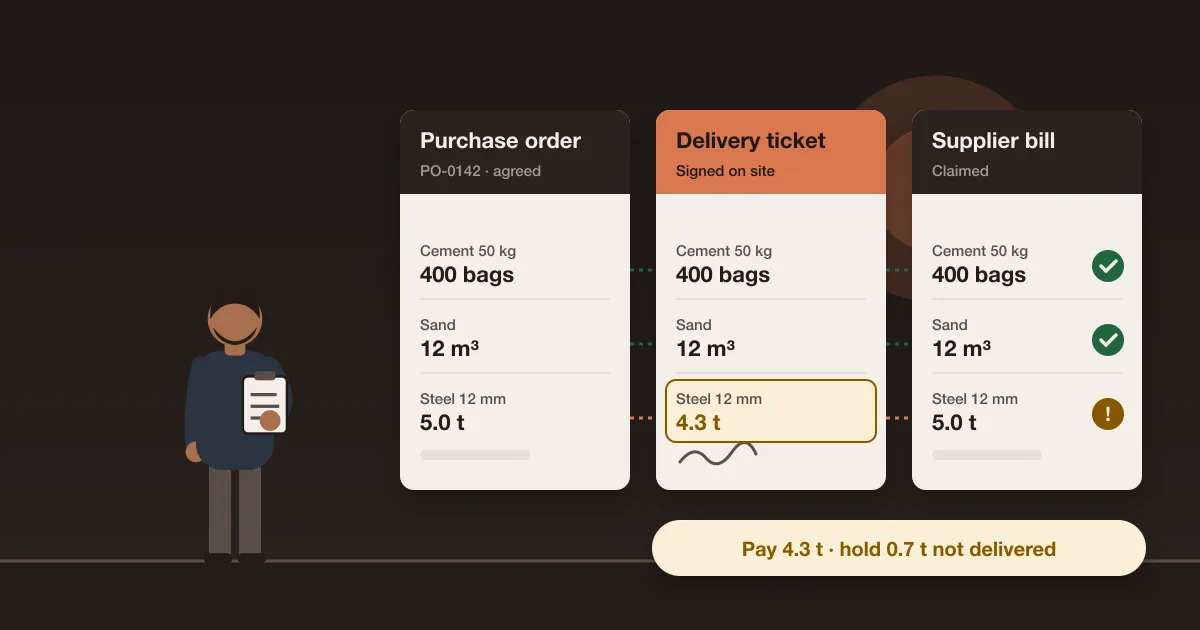
- Pay only what the order, the signed delivery and the bill agree on, and hold the difference.
What material procurement means in construction
The construction material procurement process is how a builder or contractor gets the right material to site on time, at an agreed price, and pays only for what arrived. It runs from planning what is needed, through the site's request, approval, supplier quotations and the purchase order, to receiving the delivery, checking the supplier's bill and paying it. A Penn State construction management text notes that procurement is "sometimes referred to as purchasing" (Messner, Penn State); on a building site the two words mean the same work.
It matters because material is a large share of cost. The Construction Industry Institute's materials management handbook put materials and equipment at 50 to 60% of project cost and named lack of materials as the most common cause of construction delays (CII). The handbook dates from 1987, but the point hasn't changed: a late or short delivery stops the work it was meant for.
| Procurement route (client side) | Material procurement (builder side) | |
|---|---|---|
| Who does it | The client or owner, with advisers | The builder or contractor |
| What is bought | Design and construction of the whole project | Material, and often plant hire and subcontract packages |
| Choices | Traditional (design, then bid, then build), design and build, management contracting, partnering | Which supplier, at what rate, delivered when, paid how |
| Documents | Tender documents, bids, the main contract | Material request, quotations, purchase order, delivery note, bill |
| Covered here | No: see construction bidding or the UK government's Construction Playbook | Yes |
The procurement process at a glance, and who does what
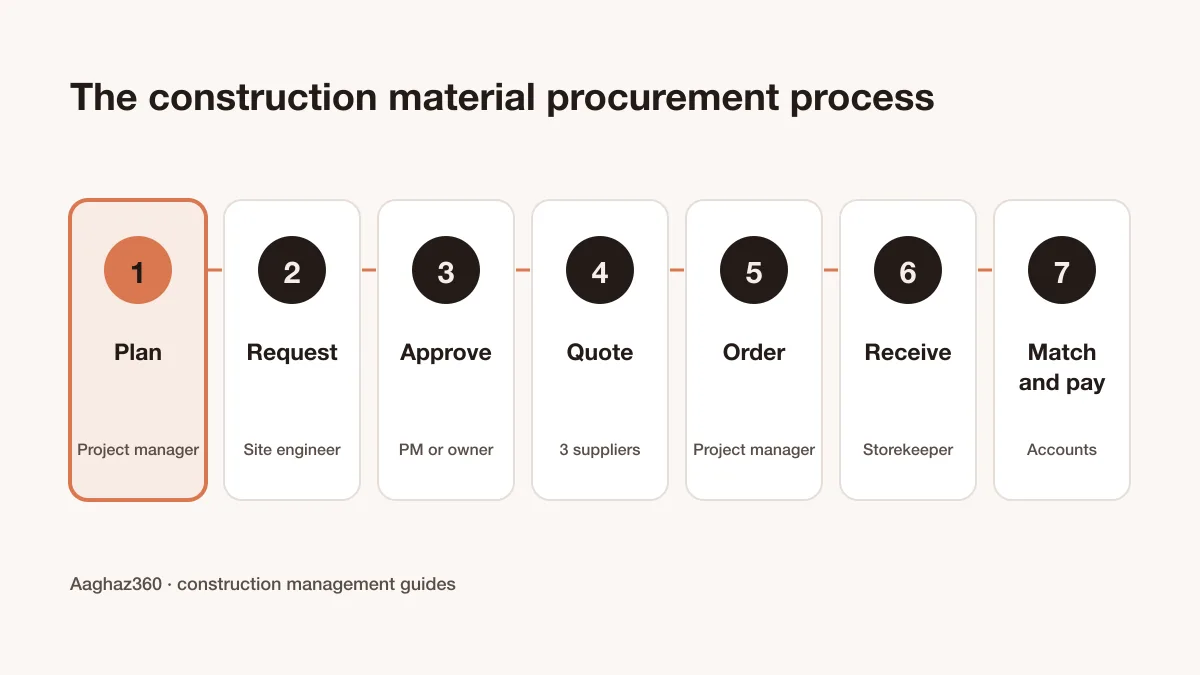
| Step | Owner on a small builder's team | Record it produces |
|---|---|---|
| 1. Plan | Project manager | Procurement schedule: item, quantity, needed-on-site date, order-by date |
| 2. Request | Site engineer | Material request (requisition or indent) with project, phase and date needed |
| 3. Approve | Project manager or owner, by amount | Approval with name, amount and time |
| 4. Quote | Project manager or buyer | Supplier quotations side by side |
| 5. Order | Project manager | Purchase order (PO) with rate, delivery site, receiver and terms |
| 6. Receive | Storekeeper or site engineer | Delivery note signed with the quantity accepted (goods received note) |
| 7. Match and pay | Accounts, owner approves | Bill matched to order and delivery; payment |
The rule that makes it work is that no step starts without the record from the one before. No order without an approved request, no payment without a signed delivery. The construction material tracking guide shows where material is lost on site once it has arrived; this guide is about getting it there.
Step 1: Plan purchases from the BOQ and the programme
Planning is the step most small builders skip, and it causes most emergency purchases. Take the quantities from the bill of quantities or estimate, and the dates from the programme, and list each material with the date it must be on site. Then work backwards.
Worked example (sample numbers, counted in days before the pour): a first-floor slab is poured on day 0. Fixing its steel takes 3 working days, so 12 tonnes of rebar must be on site by day −4. The supplier needs 7 days, and you allow 1 day in case a truck is late, so the order must go out by day −12. Getting three quotes and the owner's approval takes 3 days, so the site must request the steel by day −15.
| Item | Quantity | Needed on site | Lead time | Order by | Request by |
|---|---|---|---|---|---|
| Rebar 16 mm, first-floor slab | 12 t | Day −4 | 7 days + 1 buffer | Day −12 | Day −15 |
| Cement for the pour | 380 bags | Day −2 | 2 days + 1 buffer | Day −5 | Day −7 |
| Ready-mix concrete | 48 m³ | Day 0 | Booked 3 days ahead | Day −3 | Day −5 |
Keep the schedule next to the programme and review it weekly. When the programme moves, the order-by dates move with it. The construction progress tracking guide shows how to keep the programme honest, and the cost estimator gives a first bill of quantities if you don't have one yet.
Steps 2 and 3: Raise the material request and approve it by amount
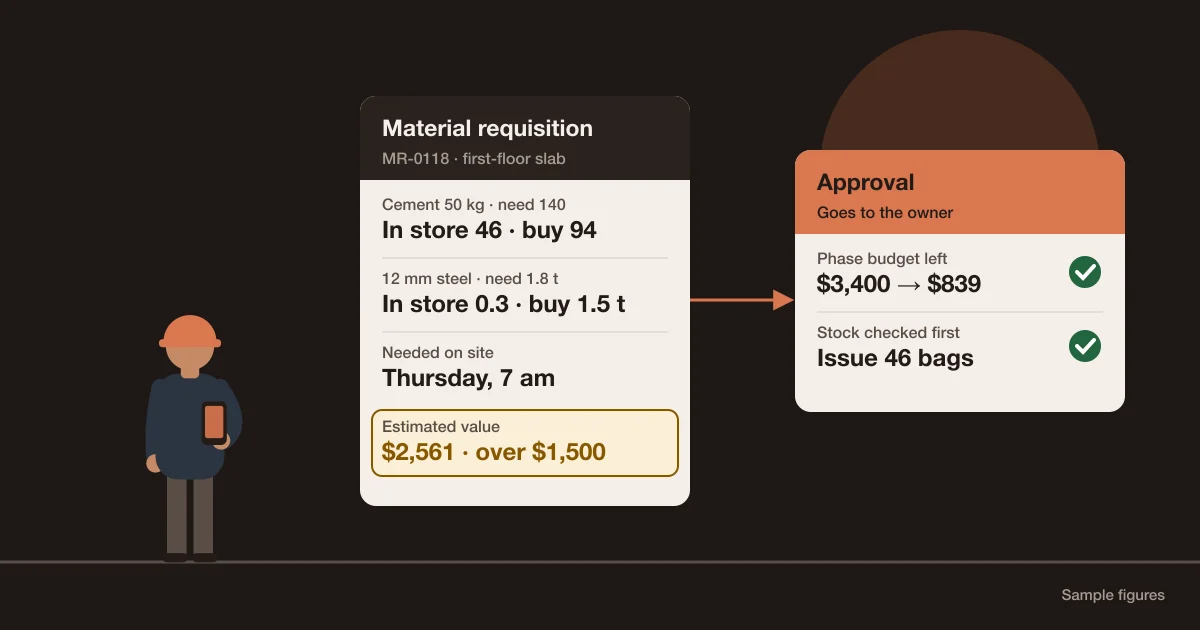
The site engineer raises a material request (also called a requisition or indent) for the steel on day −15: item, size, quantity, project, phase and the date needed, plus what is already in the site store. A phone call isn't a request; it can't be checked against anything later. The material requisition form guide lists the fields and the difference between a requisition and a purchase order.
Approval limits decide who signs. A common pattern is that the project manager approves up to a set amount and the owner approves anything above it. In the example, the company's written limit is $2,000 for the project manager, so a steel request worth about $9,000 goes to the owner, who approves it from a phone the same day. The name, amount and time of the approval are recorded.
Step 4: Get quotations and choose the supplier
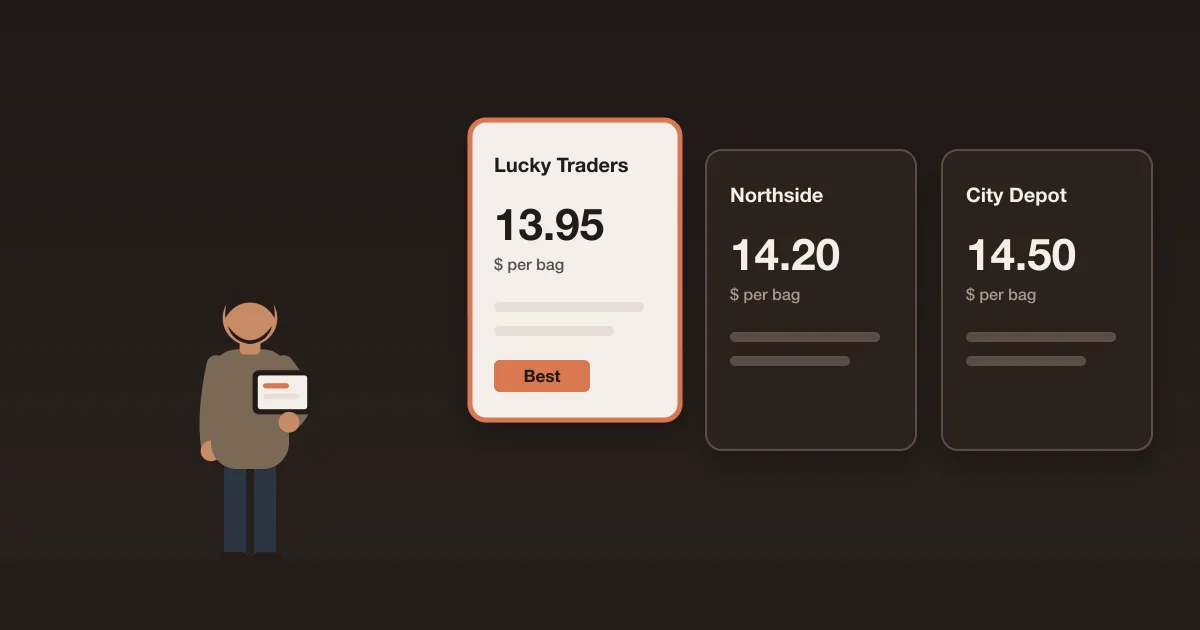
Ask at least three suppliers for the same item, quantity, specification and delivery date. Messner's text recommends at least three bids per scope of work for the same reason (Messner, Penn State). Compare the landed cost, not the headline rate: delivery, unloading, payment terms and whether they can meet the order-by date.
| Supplier | Rate | Delivery | Lead time | Landed cost for 12 t | Verdict |
|---|---|---|---|---|---|
| A | $795/t | Included | 5 days | $9,540 | Fast but dearest |
| B | $760/t | $25/t extra | 10 days | $9,420 | Misses the order-by date |
| C | $772/t | Included | 7 days | $9,264 | Chosen |
Supplier B looked cheapest on rate, but with delivery added it is $156 dearer than C, and its 10-day lead time would land the steel after fixing should start. The guide to comparing supplier quotations covers splitting an order between suppliers and what to do when quotes aren't like-for-like.
Step 5: Issue the purchase order (and what buyout means)
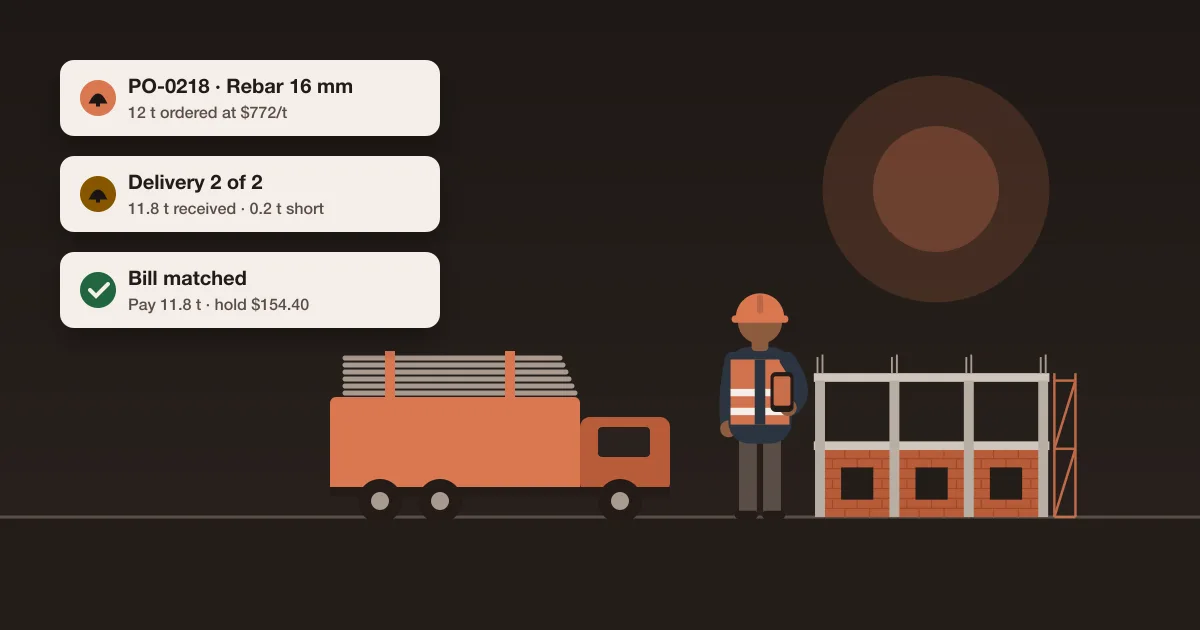
The purchase order goes to supplier C on day −12: 12 t of 16 mm rebar at $772 per tonne, delivered, $9,264 in total, with the delivery site, the receiver's name, the date needed, the basis of measurement (weighbridge or theoretical weight) and the payment terms. The supplier is asked to quote the PO number on every delivery note and bill. If anything changes later, issue a revision of the same PO rather than a new one, so the history stays together. The construction purchase order template has every field, with a free Excel download.
"Buyout" is the US name for the stage, early in a job, when a contractor places the main purchase orders and subcontracts at agreed prices. On a large project it is a phase of its own; on a small one it is simply placing orders against the procurement schedule.
The moment the PO is issued, $9,264 is committed. The phase budget for slab steel was $9,500, so only $236 is left before a single bill has arrived. That is what makes committed cost useful: a builder who waits for bills to see spending sees this overrun weeks later. See step 7 below and construction budget vs actual.
Step 6: Receive the delivery and record what arrived
The steel arrives in two loads: 7.2 t on day −6 and 4.6 t on day −5. The storekeeper checks each load against the PO before signing, writes the accepted quantity on the delivery note and photographs it. Together the loads come to 11.8 t, so 0.2 t (about one bundle) is short. The shortfall is recorded on the delivery and flagged to the project manager the same day, while the driver is still a phone call away.
- Count or weigh before signing. A delivery note signed "received in good order" without a count proves the truck came, not what was on it.
- Record damaged or rejected material on the note, and return it against the same order.
- Get the signed note to the office the same day. A delivery the office can't see doesn't count as received.
- Put the material into the site store, so what is issued to the work later can be checked against what came in.
The construction material tracking guide covers receiving in detail, and construction site inventory covers stock counts.
Step 7: Match the supplier's bill and pay
Supplier C bills 12 t at $772: $9,264. Before paying, accounts compares the bill with the order and the two signed delivery notes, line by line. This is the three-way match. The order and the bill agree on rate, but the site accepted 11.8 t, not 12. So $9,109.60 (11.8 × $772) is approved and $154.40 is held until the missing bundle arrives or the supplier sends a credit note.
Paying the matching part and holding only the difference keeps the supplier relationship intact and the records right. The payment is recorded against the supplier's ledger, so the balance owed is clear before the next order, and the person who approves the payment shouldn't be the one who raised the order or signed for the delivery.
| Day | Step | Record | Money |
|---|---|---|---|
| −15 | Request | 12 t requested for the first-floor slab | About $9,000 expected |
| −15 | Approval | Owner approves (above the $2,000 limit) | None yet |
| −14 to −13 | Quotes | Three quotes; supplier C chosen | None yet |
| −12 | Purchase order | PO for 12 t at $772/t | $9,264 committed |
| −6 and −5 | Deliveries | 11.8 t accepted, 0.2 t short | Cost of 11.8 t received |
| After billing | Bill matched | Bill for 12 t checked against PO and 2 notes | $9,109.60 approved, $154.40 held |
Procurement measures and common mistakes for small builders
You don't need a procurement department to measure procurement. Five numbers, checked monthly, show where the process is breaking:
| Measure | How to work it out | What a bad number tells you |
|---|---|---|
| Orders on time | Orders placed on or before their order-by date ÷ all orders | Planning is being skipped |
| Emergency purchases | Purchases made without a request raised in advance, per month | The schedule isn't reviewed weekly |
| Short or damaged deliveries | Deliveries with a shortfall or rejection ÷ all deliveries | A supplier or a receiving problem |
| Rate drift | Billed rate − ordered rate, summed over the month | Bills are being paid without a match |
| Request to order time | Days from request to purchase order, on average | Approvals or quotes are slow |
- Ordering by phone or voice note, with no written request or order to check the bill against.
- Choosing on rate alone and missing the delivery date.
- One person ordering, receiving and paying.
- Paying the bill total when the delivery was short.
- Seeing the cost only when bills arrive, after the budget is already gone.
Running procurement in a spreadsheet or in software
With one site and a handful of orders a month, a procurement schedule and an order register in a spreadsheet work, alongside a construction project management Excel template. The spreadsheet breaks when several sites buy from the same suppliers, delivery notes stay in site engineers' pockets and the register is updated after the bill is paid.
At that point every step needs to happen where the previous one was recorded. Construction procurement software keeps the request, approval, quotes, order, deliveries and bill on one trail, and deliveries feed the site store and the job's cost tracking. For how it fits with the rest of a builder's records, see what construction management software is.
Your procurement process, step by step
0 of 10 in placeTick what is already in place on your site.
Questions people ask
What is the material procurement process in construction?
It is how a builder gets material to site on time and at an agreed price, and pays only for what arrived. The usual steps are: plan from the bill of quantities and programme, the site requests, a manager approves by amount, suppliers quote, a purchase order is issued, the delivery is received and checked, and the bill is matched to the order and delivery before payment.
What is the difference between procurement and purchasing in construction?
On a building site they are used for the same work. Where people do separate them, procurement is the whole process from planning and choosing suppliers to payment, and purchasing is the narrower act of placing and paying orders. "Construction procurement" can also mean the client's procurement route, such as design and build.
How do I calculate when to order material?
Work back from the date it must be on site. Subtract the supplier's lead time and a buffer for a late delivery to get the order-by date. Subtract the time it takes to get quotes and approval to get the date the site must request it. Review the dates weekly as the programme moves.
Who is responsible for procurement on a small construction project?
Usually the project manager plans and orders, the site engineer requests, the owner approves large amounts, the storekeeper receives and accounts matches and pays. The important rule is that the person who orders, the person who receives and the person who pays are not all the same person.
What is buyout in construction?
Buyout is the US term for the stage, early in a job, when the contractor places its main purchase orders and subcontracts at agreed prices. Tracking buyout shows how much of the budget is already committed before the work starts.
How many quotations should I get for construction material?
Three is the common standard for anything above a small amount, for the same item, quantity, specification and delivery date. Compare the landed cost, including delivery and payment terms, and whether the supplier can meet your order-by date.