Purchasing
Three-way match in construction: check every supplier bill before you pay
A supplier bill is a claim, not a fact. Before it is paid, check it against what you ordered and what the site actually signed for. In construction that check takes more than a glance, because one order can arrive in five deliveries, in units the bill doesn't use.
Part of the guide to construction material procurement process
On this page · 11 sections
- What a three-way match in construction checks
- Why matching is harder on a construction site
- How to do a three-way match, step by step
- Worked example: a steel and cement bill
- Matching when the units don't agree
- What to do with each kind of mismatch
- Who should order, receive and approve
- Subcontractors and services: what replaces the delivery ticket
- Run it in a spreadsheet or in software
- Questions people ask
- Sources
Key takeaways
- A three-way match checks the purchase order, the delivery ticket signed on site and the supplier's bill. Pay only what all three agree on.
- Match line by line: item, quantity, unit and rate. A matching total can hide a short delivery paid for at a higher rate.
- When they don't agree, pay the part that matches and hold the difference. Don't hold the whole bill.
- Agree in the order how quantity is measured (counted, weighed or calculated) so the units can be converted.
- The person who orders, the person who receives and the person who pays should not be the same person.
What a three-way match in construction checks
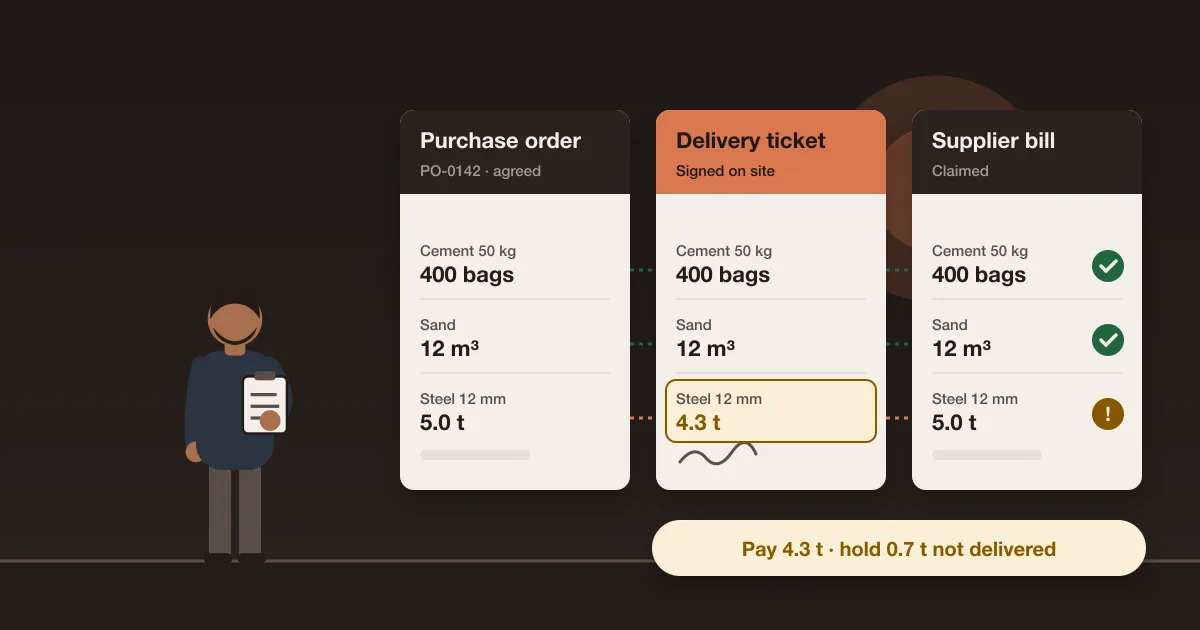
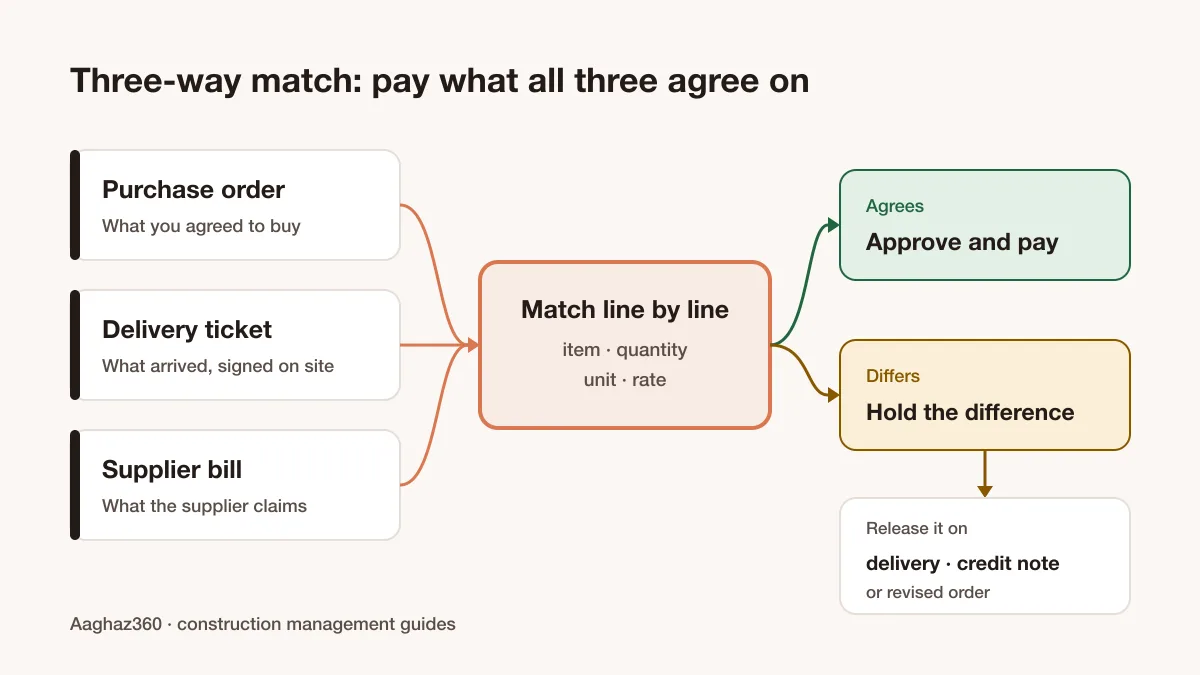
A three-way match in construction is the check accounts makes before paying a supplier. Three documents should agree: the purchase order (what you agreed to buy, at what rate), the delivery ticket signed on site (what actually arrived) and the supplier's bill (what you are being asked to pay). If they agree, the bill is paid. If they don't, only the part they agree on is paid and the rest waits for an answer.
Each document answers a different question, and each comes from a different person. That is what makes the check work. A supplier can't invent a delivery the site never signed for, and a site can't sign for something nobody ordered.
| Document | Who creates it | What it proves | Compare |
|---|---|---|---|
| Purchase order (PO) | Your office, after approval | You agreed to buy this, at this rate, on these terms | PO number, item, quantity, unit, rate, delivery terms |
| Delivery ticket or goods received note | Supplier's driver, signed by your receiver | This much arrived on site, in this condition, on this date | PO number, item, quantity accepted, short or damaged |
| Supplier bill (invoice) | Supplier's accounts | This is what the supplier claims you owe | PO number, ticket numbers, quantity, rate, extras, tax |
Government buyers follow the same logic. US federal rules base payment on a proper invoice backed by a receiving report that records the contract number and the quantities received and accepted (FAR 32.905). A builder doesn't need the paperwork of a federal agency, but the principle carries over: pay against evidence of receipt, not against the bill alone.
Why matching is harder on a construction site
The textbook three-way match assumes one order, one delivery and one bill. A site breaks that assumption almost every week:
- Partial deliveries. One steel order arrives in three trucks over ten days, but the supplier sends one bill for the full order, sometimes before the last truck.
- Tickets signed far from the office. The proof of receipt is a paper slip in a site engineer's pocket. If it never reaches accounts, the bill gets paid in full by default.
- Different units. Steel is ordered by the tonne, counted on site as bars and billed on weighbridge weight. Concrete is ordered and billed by volume and arrives as truckloads.
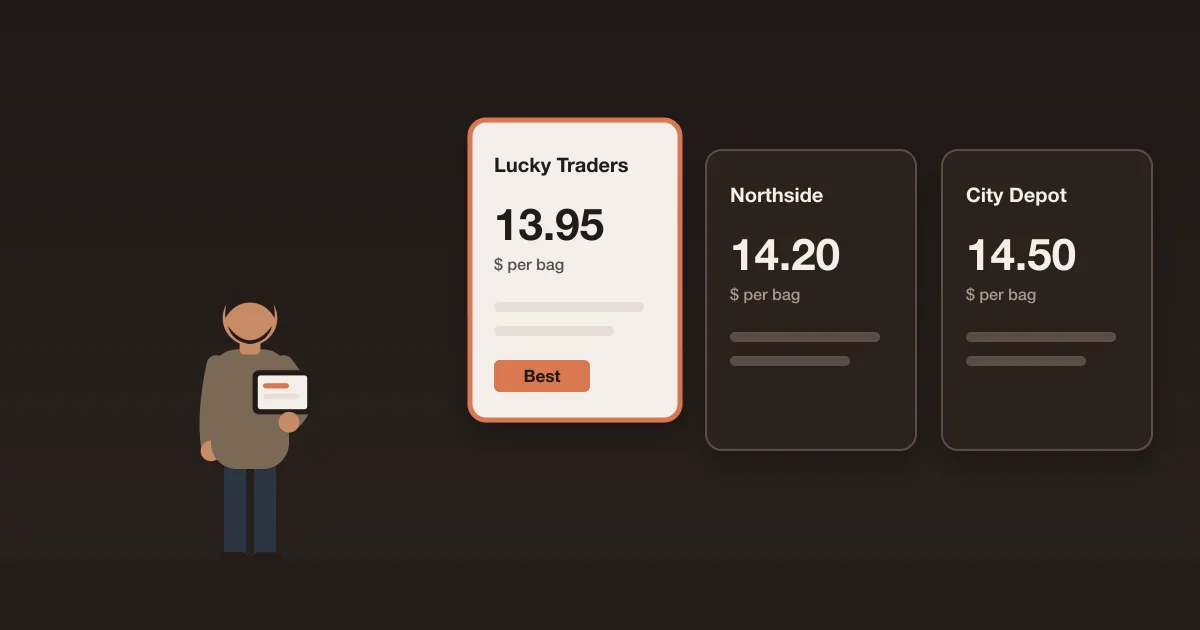
- Prices that move. Steel and cement rates change between the quotation and the bill. The bill quietly shows today's rate instead of the agreed one.
- Extras that were never ordered. Delivery charges, unloading, pump hire, fuel surcharges or a substituted brand appear on the bill but not on the order.
- Rejected material. Broken bags, bent bars or a load of concrete sent back still show up on the bill unless someone raises it.
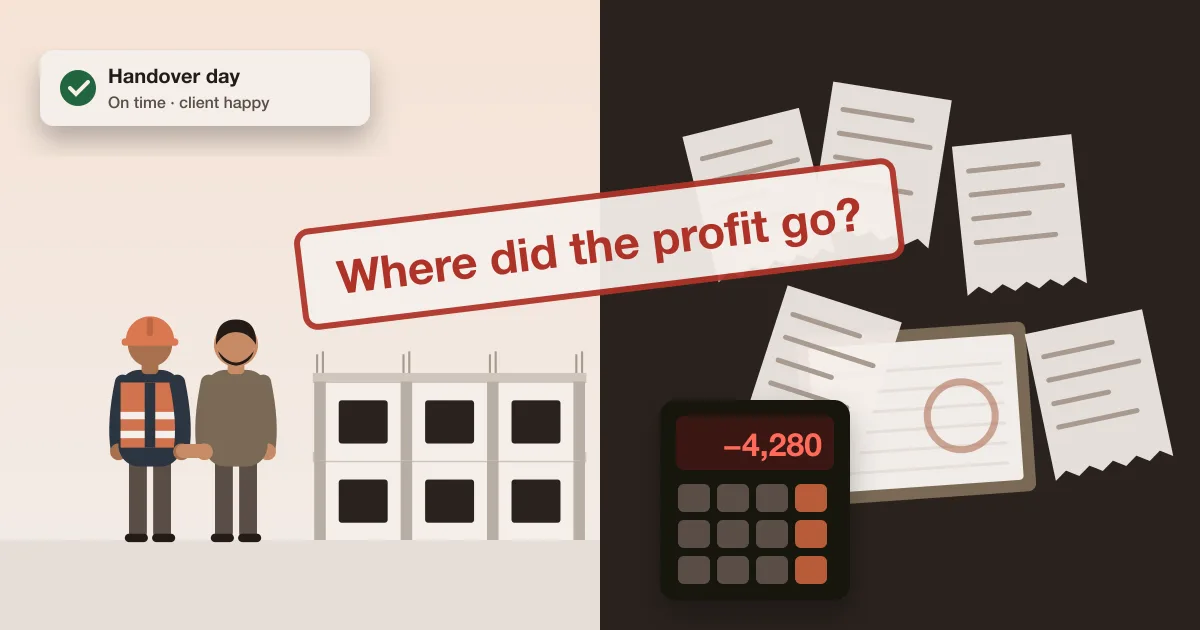
None of these mean the supplier is dishonest. Most mismatches are timing and paperwork. But each one pays out money for something you didn't receive or didn't agree to, and on a job running at a thin margin, that comes straight out of profit. It also distorts your construction budget vs actual report, because the cost lands before the material does.
How to do a three-way match, step by step
- 1Give every order a number.
The purchase order lists each item, quantity, unit, rate, the delivery site, who receives and what is included in the rate (delivery, unloading). Ask the supplier to quote the PO number on every ticket and bill. - 2Receive against the order on site.
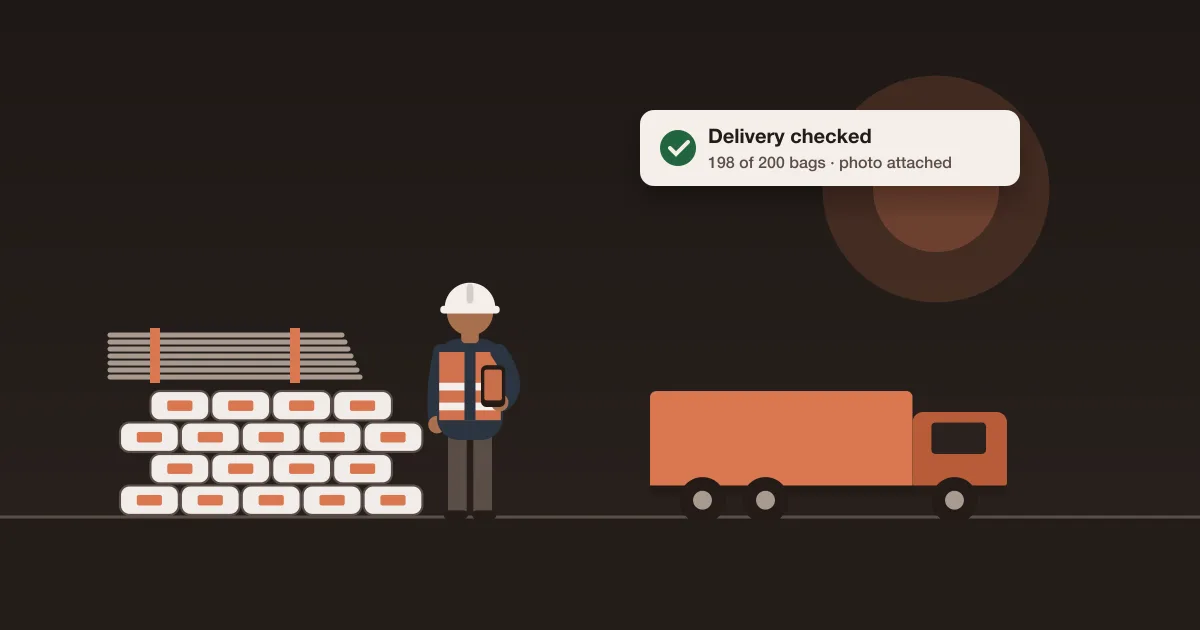
The receiver counts or measures before signing, writes the actual quantity on the ticket, notes anything short, damaged or rejected, and photographs the signed ticket. Never sign a blank or 'received in good order' ticket you haven't checked. - 3Get the ticket to the office the same day.
A photo on a shared channel or in your system is enough. The rule is simple: a delivery the office can't see doesn't count as received. - 4Match line by line when the bill arrives.
For each line, compare item, quantity, unit and rate across the three documents. Add up the accepted quantity from every ticket that belongs to that order, not only the latest one. - 5Split the bill into 'matches' and 'held'.
Approve what matches. Put each difference on hold with a reason: not yet delivered, rate above order, not on order, rejected on site. - 6Resolve the held part in writing.
A later delivery, a credit note from the supplier or a revised purchase order approved by whoever approved the original order. Then release it. - 7Pay, and charge the cost to the job.
Record the payment against the project and phase the material was bought for, so job costing stays right. See construction expense tracking for how to tag costs.
Worked example: a steel and cement bill
Here is a realistic bill with three common problems in it. The figures are sample numbers, not market rates.
The order (PO-0142): 5.0 tonnes of 12 mm steel bar at $780 per tonne, and 400 bags of 50 kg cement at $9.50 per bag, delivery included in both rates. Steel arrived in two loads: ticket 5521 for 2.5 t and ticket 5538 for 1.8 t, so 0.7 t is still to come. Cement arrived on one ticket: 400 bags delivered, 4 torn bags rejected and sent back, 396 accepted. The supplier's bill asks for 5.0 t of steel at $795, 400 bags of cement at $9.50, and $60 delivery.
| Line | Ordered | Accepted on site | Billed | Approve now | Hold |
|---|---|---|---|---|---|
| 12 mm steel | 5.0 t @ $780 | 4.3 t (2 tickets) | 5.0 t @ $795 = $3,975 | 4.3 t × $780 = $3,354 | $621: 0.7 t not delivered, rate $15/t above order |
| Cement 50 kg | 400 bags @ $9.50 | 396 bags (4 rejected) | 400 bags = $3,800 | 396 × $9.50 = $3,762 | $38: 4 bags rejected on site |
| Delivery | Included in rate | n/a | $60 | $0 | $60: not on order |
| Total | $7,835 | $7,116 | $719 |
The bill total is $7,835. The amount that matches is $7,116, and $719 (about 9% of the bill) waits for answers. Notice that two problems overlap on the steel line: paying 5.0 t at the agreed $780 would still overpay for 0.7 t that never arrived, and paying 4.3 t at the billed $795 would accept a rate nobody approved. Checking only the bill total against the order total ($7,700 ordered against $7,835 billed) would have flagged $135 and missed most of it.
What happens next: the supplier delivers the last 0.7 t and that quantity is released at $780 ($546). The rate difference and the delivery charge are either withdrawn with a credit note or, if the price rise was genuine and agreed, approved as a revised order. The rejected cement is credited or replaced.
Matching when the units don't agree
Most construction mismatches that look like fraud are really unit problems. Settle the basis of measurement in the purchase order, before the first truck arrives:
- Steel bar by weight. Say whether you pay on weighbridge weight or theoretical weight. Theoretical weight per metre in kg is the bar diameter in mm squared, divided by 162 (from steel's density of about 7,850 kg/m³). A 12 mm bar weighs about 0.888 kg/m, so a 12 m length is about 10.7 kg and 4.3 t is roughly 400 bars. If the site counts bars, the office can convert the count to tonnes. Real bars vary a little from the theoretical figure, so agree which number governs.
- Cement and bagged material by count. Pay per bag accepted. 20 bags of 50 kg make a tonne, if the supplier bills by the tonne.
- Ready-mixed concrete by volume. Each truck should come with a batch ticket showing the plant, ticket number, date, truck, mix class, volume and batching time. Building departments such as Miami-Dade County list these items for ready-mix tickets. Add up the tickets per pour and match the bill to that sum, not to the volume on the order.
- Aggregates and sand by load or weight. A truck 'load' means different things to different suppliers. Specify cubic metres or tonnes, and record the vehicle number on every ticket.
- Pieces, lengths and packs. Tiles by box or square metre, pipe by length, cable by drum or metre. Write both the order unit and the billing unit on the PO if they differ.
What to do with each kind of mismatch
| What you see | Likely cause | What to do |
|---|---|---|
| Billed more than was accepted | Partial delivery, back order or rejected items | Pay what was accepted. Hold the rest until it is delivered or credited. |
| Rate on bill above the order | Price rise, wrong price list, old quotation | Hold the difference. Release it only with a revised order approved by whoever approved the original. |
| Charge not on the order | Delivery, unloading, pump hire, surcharge | Hold it. If it is genuine, add it to the order and approve it; next time, put it on the order up front. |
| Different brand or grade | Substitution at the yard | Check with the engineer before accepting. Pay the ordered rate only if the substitute is accepted as equal. |
| Received more than ordered | Over-delivery or rounding | Accept only what an approver agrees to keep. Return or refuse the rest. |
| Same bill seen twice | Resent bill, copy from another channel | Check bill number, date and amount against paid bills. Pay once. |
| No ticket for a billed delivery | Ticket lost on site, or no delivery | Ask the site before paying. If no one signed for it, it wasn't received. |
Decide your tolerances in writing, so accounts isn't making judgement calls on every bill. A tolerance is the difference you accept without querying. Sensible starting points, which you should adjust to your own work, are: no tolerance on counted items such as bags, pieces and boxes; a small, written tolerance on weighed or measured bulk material, where scales and loads genuinely vary; and no tolerance on rate unless the order says the price is fixed on the day of delivery.
Who should order, receive and approve
The match only protects you if three different people produce the three documents. Splitting key duties among different people to reduce the risk of error or fraud is called segregation of duties, and it is a core principle of internal control (GAO Green Book). If one person can order, sign for the delivery and approve the bill, the match is that person checking their own work.
- Orders: the project manager or purchaser raises the purchase order after the demand is approved.
- Receiving: the storekeeper or site engineer signs the ticket and records the accepted quantity.
- Matching and payment: accounts matches and the owner or a named manager approves payment above a set amount.
A small builder with three people in the office can still do this. The owner approves orders and payments, the site signs for deliveries, and whoever does the books does the match. What matters is that no single person controls all three steps. The construction material tracking guide shows where this fits in the full path from site demand to payment, and a regular site stock count catches what slips past receiving.
Subcontractors and services: what replaces the delivery ticket
Work, unlike material, doesn't arrive on a truck. For subcontractors and labour, the 'receipt' is evidence of work done:
- Subcontract work: a measurement or progress record agreed on site, matched against the contract rates and the stage reached. Retention and advances are deducted as the contract says.
- Daily-wage labour: days and hours from the daily site report, matched against the agreed day rate before the pay run.
- Equipment hire: hours or days from the site log, matched against the hire rate and the dates the machine was actually on site.
- Fixed fees and services: a two-way match of the bill against the agreed fee is usually enough.
The same rule applies: pay for what was agreed and what was received, and hold the rest until it is explained.
Run it in a spreadsheet or in software
With a handful of orders a month, a match register in a spreadsheet works, alongside a construction project management Excel template. Use one row per order line with these columns: PO number, item, unit, quantity ordered, rate ordered, ticket numbers, quantity accepted, bill number, quantity billed, rate billed, approved amount, held amount, reason held, date resolved. Filter on 'held' every week and chase each one.
The spreadsheet breaks down when tickets stay on site, several projects buy from the same supplier and nobody updates the register before the bill is paid. At that point the match needs to happen where the order and the receipt are already recorded. In construction procurement software, the order, each partial receipt with its photo and the bill sit on one record, so the match is a comparison, not a hunt for paper. Received material also lands in the site store, and paid bills flow into project costing.
Before you approve a supplier bill
0 of 9 in placeTick what is already in place on your site.
Questions people ask
What is a three-way match in construction?
It is the check before paying a supplier: the purchase order, the delivery ticket signed on site and the supplier's bill must agree on item, quantity, unit and rate. Only the part all three agree on is paid; any difference is held until it is explained.
What is the difference between a two-way and a three-way match?
A two-way match compares the order with the bill. A three-way match adds proof of receipt, the signed delivery ticket or goods received note, so you also confirm the goods arrived. Use two-way for services and fixed fees, and three-way for material delivered to site.
What should I do if a supplier bills for more than was delivered?
Pay for the quantity accepted on site at the agreed rate and hold the rest. Tell the supplier which tickets you matched and ask for the remaining delivery or a credit note. Don't hold the whole bill over part of it.
Is a signed delivery ticket enough proof of receipt?
Only if the receiver counted or measured before signing and wrote the accepted quantity on it. A ticket signed 'received' without a count proves the truck came, not what was on it. Photograph it and get it to the office the same day.
Does a small construction company need three-way matching?
Yes, in a simple form. Number your orders, make the site write the accepted quantity on every ticket, and check bills line by line before paying. That takes minutes per bill and catches short deliveries, rate changes and charges you never agreed to.
What tolerance should I allow in a three-way match?
Set it yourself, in writing. A common approach is no tolerance on counted items and on rates, and a small agreed tolerance on weighed or measured bulk material such as steel, sand or aggregate.