Costs
Estimating site work costs: clearing, earthwork, utilities and paving, step by step
Site work is the part of an estimate priced before anyone has seen what is under the ground. Measured carefully, with the soil's swell and every truckload counted, it stops being the line that eats the profit.
Part of the guide to construction budget vs actual
On this page · 10 sections
- What site work covers
- Why site work is the riskiest part of an estimate
- How to estimate site work costs step by step
- Bank, loose and compacted volume: swell and shrinkage
- Worked example: earthwork for a house plot
- Trenches, utilities and the items people forget
- Why a site work cost per square foot misleads
- Turn the site work estimate into a budget you can track
- Questions people ask
- Sources
Key takeaways
- Site work covers everything outside the building's walls: clearing, earthwork, trenches, utilities, drainage, paving and temporary works.
- Measure earthwork in bank (in-place) volume, then convert: loose volume for haulage, compacted volume for fill.
- Price plant by the hour from a productivity you can prove, and haulage and disposal by the load.
- Trenches 1.5 m (5 ft) or deeper need a protective system, so shoring or a trench box belongs in the price.
- Write down what you assumed about the ground, and exclude or price rock, groundwater and contaminated soil separately.
What site work covers
Estimating site work costs means pricing everything that happens to the plot outside the building itself: clearing it, cutting and filling the ground to level, digging for foundations and services, connecting water, sewer, storm drainage and power, and finishing the outside with paving, kerbs and fencing. MasterFormat, the system most specifications in North America are organised by, groups this work in three divisions: 31 Earthwork, 32 Exterior Improvements and 33 Utilities (MasterFormat).
Each item is measured in its own unit and has its own cost drivers. List them all before pricing anything, so nothing is left for the site team to discover:
| Item | Measured in | What drives the cost |
|---|---|---|
| Clearing and demolition | m² of plot, or a lump sum per structure | Trees and roots, old foundations, disposal of debris |
| Topsoil strip | m² × depth, as m³ | Depth to strip, whether topsoil is kept on site or carted away |
| Bulk excavation, cut and fill | m³ bank volume | Soil type, rock, groundwater, machine size, working space |
| Trench excavation and backfill | m of trench, by width and depth band | Depth (shoring above 1.5 m), existing services, reinstatement |
| Haulage and disposal | Truckloads (loose m³ or tonnes) | Swell, distance to tip, tipping fees, contaminated soil |
| Imported fill and sub-base | m³ compacted | Shrinkage, material spec, layer thickness, compaction tests |
| Utilities and connections | m of pipe or cable, plus each connection | Distance to the mains, authority fees, road crossings |
| Drainage | m of pipe, number of manholes or pits | Falls, depth, soakaways, pumping |
| Paving, kerbs and footpaths | m², m of kerb | Sub-base depth, surface type, access for plant |
| Temporary works | Lump sum or per week | Site access, hoarding, dewatering, plant mobilisation |
Why site work is the riskiest part of an estimate
Most of a building can be measured from the drawings. Site work depends on ground nobody has dug yet. The same 300 m³ of excavation costs very different amounts in dry sandy soil, in clay after rain, in rock, or below the water table, and the drawings rarely say which.
- Ground conditions: rock, soft spots, old fill and groundwater change the machine, the speed and the temporary works needed.
- Volume changes: soil bulks up when dug and settles when compacted, so a takeoff in drawing volume alone under-counts truckloads and fill.
- Haul distance and disposal: a tip twice as far away roughly doubles the truck time per load, and tipping fees are charged on what leaves site.
- Distance to utilities: a water or sewer connection 40 m away is a different job from one at the boundary.
- Access and working space: a tight urban plot may need a smaller machine, more hand digging and more loads.
- Weather and season: wet ground slows excavation and compaction, and may need pumping.
How to estimate site work costs step by step
- 1Walk the site.
Note slopes, trees, old structures, access for trucks, overhead lines, the nearest water, sewer and power, and where spoil could be stockpiled. - 2Read the drawings and soil report, and list every site work item from the table above that applies to this job.
- 3Take off quantities.
Use survey levels and the foundation and drainage drawings to measure each item. Measure earthwork as bank volume: the ground as it sits now. - 4Convert volumes.
Multiply by the swell for loose volume to haul, and by the shrinkage for the bank volume needed to make each cubic metre of compacted fill. - 5Work out plant and crew time.
Divide each quantity by a productivity you trust, preferably from your own past jobs, to get excavator, truck, roller and labour hours. - 6Price each item: plant hours × hire rate, labour hours × wage rate, material from current quotes, plus haulage and tipping by the load and any test fees.
- 7Add the items that belong to no single quantity: mobilisation, site access, dewatering, trench support, setting out and reinstatement.
- 8Add a contingency for ground risk and write down the exclusions, such as rock, contaminated soil or work below the water table.
Steps 6 to 8 follow the same rules as any other part of an estimate. The full method for unit rates, contingency and markup is in how to estimate construction costs, and rate analysis shows how to build a rate per m³ from material, labour and plant.
Bank, loose and compacted volume: swell and shrinkage
Soil exists in three states that an estimator has to keep apart. Bank volume is the ground in place, before it is dug. Loose volume is the same soil after digging, when air fills the gaps between the grains and it takes up more room. Compacted volume is soil rolled into place as fill, usually smaller than the bank volume it came from. Both swell and shrinkage are measured from the bank state (KSU, CE419).
| You know | You need | Calculation |
|---|---|---|
| Bank m³ to dig | Loose m³ to haul | Bank × (1 + swell) |
| Loose m³ in trucks | Bank m³ dug | Loose ÷ (1 + swell) |
| Compacted m³ of fill | Bank m³ to dig or buy | Compacted ÷ (1 − shrinkage) |
| Bank m³ | Compacted m³ it will make | Bank × (1 − shrinkage) |
Swell and shrinkage come from densities. In the King Saud University course notes, a soil weighing 1,661 kg/m³ in the bank and 1,186 kg/m³ loose swells by 40%, so one bank cubic metre fills 1.4 m³ of truck. Compacted to 2,077 kg/m³, the same soil shrinks by 20%, so one bank cubic metre makes 0.8 m³ of fill (KSU, CE419).
Published tables of typical swell and shrinkage vary between sources and editions, so use the figures from the soil report, the material supplier or your own past jobs on similar ground. Whatever figure you use, write it in the estimate so it can be checked.
Balance cut and fill before you price haulage
Soil dug on one part of the plot can often become fill on another. Work out how much of the cut is suitable for fill, convert it to compacted volume, and only haul away the rest. Every cubic metre reused is one you don't pay to cart off and another you don't pay to buy in.
Worked example: earthwork for a house plot
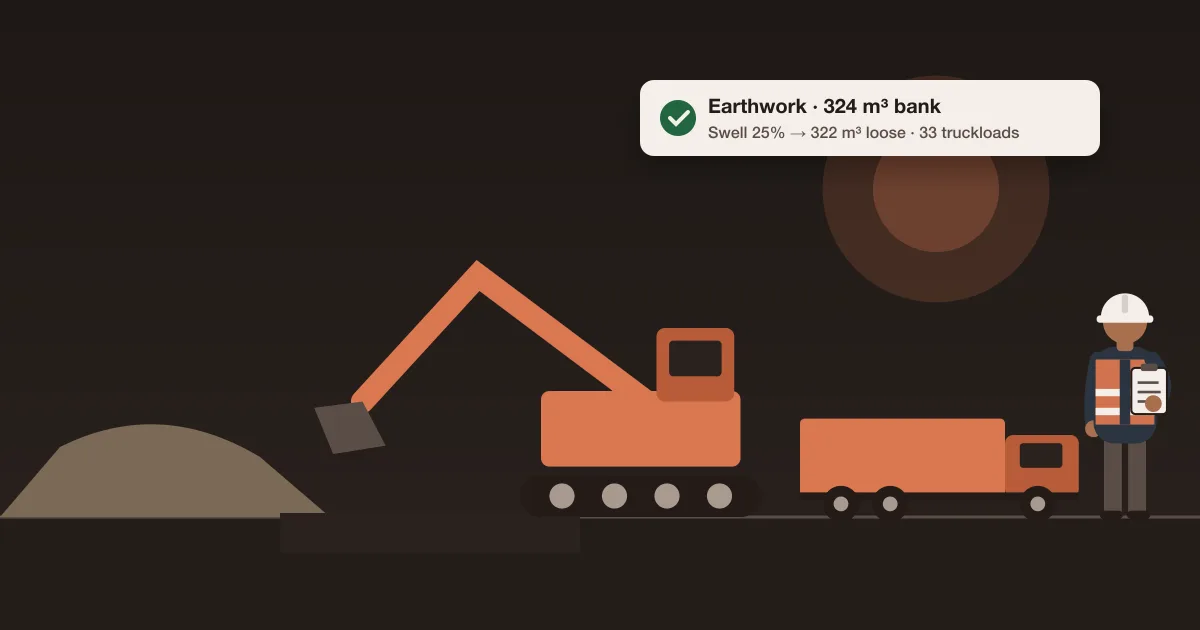
A house with a basement needs an excavation 18 m × 12 m × 1.5 m deep: 324 m³ bank. After the walls are built, 60 m³ of compacted backfill goes back around them, using the dug soil. The soil report gives 25% swell and 10% shrinkage for this ground. All rates below are sample figures, not market prices.
- 1Backfill: 60 m³ compacted ÷ (1 − 0.10) = 66.7 m³ bank of the dug soil is kept on site.
- 2Spoil to remove: 324 − 66.7 = 257.3 m³ bank, × 1.25 swell = 321.7 m³ loose.
- 3Truckloads: 321.7 m³ ÷ 10 m³ per truck = 32.2, so 33 loads.
- 4Excavator time: 324 m³ bank ÷ 25 m³ per hour (from past jobs on this soil) = 13 hours.
- 5Backfill and compaction: 60 m³ ÷ 8 m³ per hour = 7.5 hours for a plate compactor and two labourers.
| Item | Quantity | Rate | Amount |
|---|---|---|---|
| Excavator mobilisation | 1 | $350 | $350.00 |
| Excavator | 13 h | $95/h | $1,235.00 |
| Haulage | 33 loads | $85/load | $2,805.00 |
| Tipping fees | 33 loads | $40/load | $1,320.00 |
| Labour, backfill | 2 × 7.5 h | $30/h | $450.00 |
| Plate compactor | 7.5 h | $25/h | $187.50 |
| Compaction tests | 2 | $150 | $300.00 |
| Subtotal | $6,647.50 | ||
| Ground-risk contingency | 10% | $664.75 | |
| Earthwork total | $7,312.25 |
Leave out the swell and the spoil looks like 257.3 m³, or 26 loads. That's 7 loads short, $875 of haulage and tipping missing from a $6,647.50 subtotal, about 13% of it, before the ground has done anything unexpected.
Trenches, utilities and the items people forget
Trenches for footings, pipes and cables are priced per metre, but depth changes the method. In the United States, OSHA requires a protective system (sloping, benching, shoring or a shield) for anyone working in an excavation 5 ft (1.52 m) or deeper, unless it is entirely in stable rock (29 CFR 1926.652). Many other countries set similar rules. Either way, price the trench box or shoring, or the wider cut needed for sloped sides, and the extra spoil it creates.
- Dewatering: pumps, fuel and someone to run them if the dig goes below the water table.
- Existing services: locating them, hand digging near them and the cost of a strike.
- Connection fees charged by the water, sewer or power authority, which are often more than the pipe work.
- Road or footpath reinstatement where a service crosses a public way.
- Testing: compaction tests on fill, pressure tests on pipes, CCTV surveys of drains where specified.
- Setting out and surveys before and after earthwork.
- Removing temporary roads and hardstanding at the end of the job.
Why a site work cost per square foot misleads
Rates per m² or per square foot of floor area price the building, not the plot. Two identical houses can need very different site work: one on a flat plot with services at the gate, one on a slope 60 m from the sewer. Many published building rates leave site work out entirely. The Rider Levett Bucknall rates on our Australia construction cost estimator, for example, exclude site works and drainage.
Use a floor-area rate from the construction cost estimator for an early budget of the building, then add site work as its own estimate, item by item, as soon as the plot and the drawings allow. Quantities measured from the plot beat any average (RSMeans).
Turn the site work estimate into a budget you can track
Site work is also where actual cost runs away fastest, because every extra truckload or pump-hour is small on its own. Keep the same items in the budget as in the estimate (excavation, haulage, backfill, utilities, paving) and record plant hours, loads and material against them as the work happens, not at month end. A phase that has used 80% of its loads with half the digging done is a warning you can still act on. Construction budget vs actual explains how to read it.
Before you send a site work estimate
0 of 7 in placeTick what is already in place on your site.
Questions people ask
What is included in site work?
Site clearing and demolition, topsoil strip, excavation, cut and fill, trenches and backfill, haulage and disposal, imported fill, utilities and their connections, drainage, paving, kerbs, fencing and temporary works such as site access and dewatering.
How do you estimate excavation cost?
Measure the bank volume from the drawings and levels, convert it to loose volume for haulage using the soil's swell, divide by the machine's productivity for plant hours, then price plant hours, truckloads, tipping fees and any shoring or pumping.
What is the swell factor in earthwork?
Swell is how much soil grows when it is dug, measured against its bank (in-place) volume. With 25% swell, 100 m³ of bank soil fills 125 m³ of trucks. Take the figure from the soil report or past jobs on similar ground.
Is site work included in construction cost per square foot?
Often not. Many published building rates exclude site works, drainage and external works, so check the source's notes and add site work as a separate estimate based on the plot.
How much contingency should site work carry?
More than the building, because the ground is unknown. Size it to what you know: little with a soil report and trial pits, more without them. List rock, groundwater and contaminated soil as exclusions or separate prices rather than burying them in the contingency.