Costs
Rate analysis in construction: build up a unit rate from material, labour and plant
A unit rate is a promise: this is what one cubic metre, one square metre or one tonne will cost you to put in place. Rate analysis is how you check that promise before you sign it, by building the rate up from what actually goes into the work.
Part of the guide to construction budget vs actual
On this page · 7 sections
Key takeaways
- Rate analysis builds the cost of one unit of work from its parts: material plus wastage, labour, plant, then overheads and profit.
- Labour and plant come from a gang's output per day. Get the output wrong and the whole rate is wrong.
- Price each item exactly as the bill of quantities measures it. Formwork and steel are usually separate items, not part of the concrete rate.
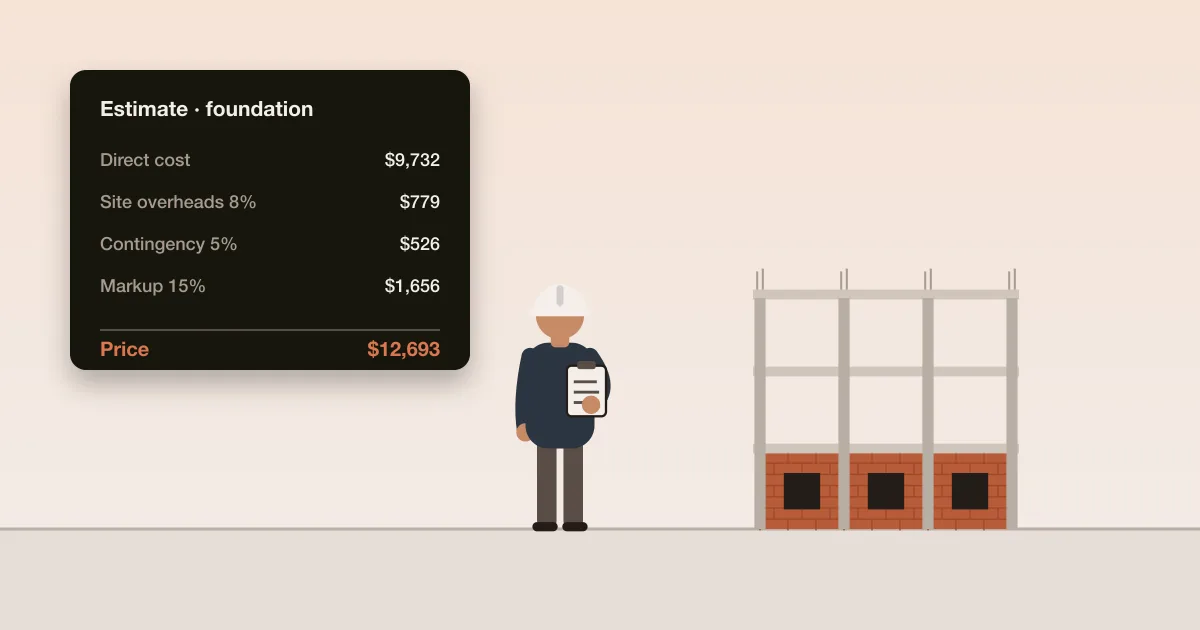
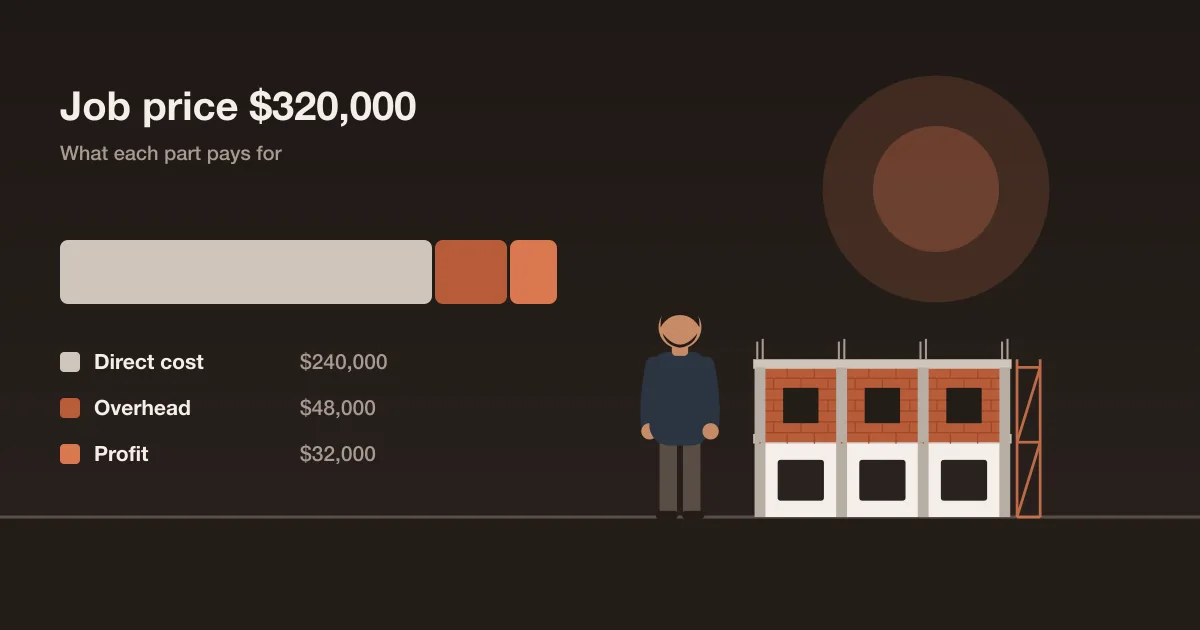
- Overheads and profit are percentages you choose. Government schedules fix them; a private tender is your own decision.
- Keep the analysis. When the job runs, compare it with what the work really used, and fix the next rate.
What rate analysis in construction means
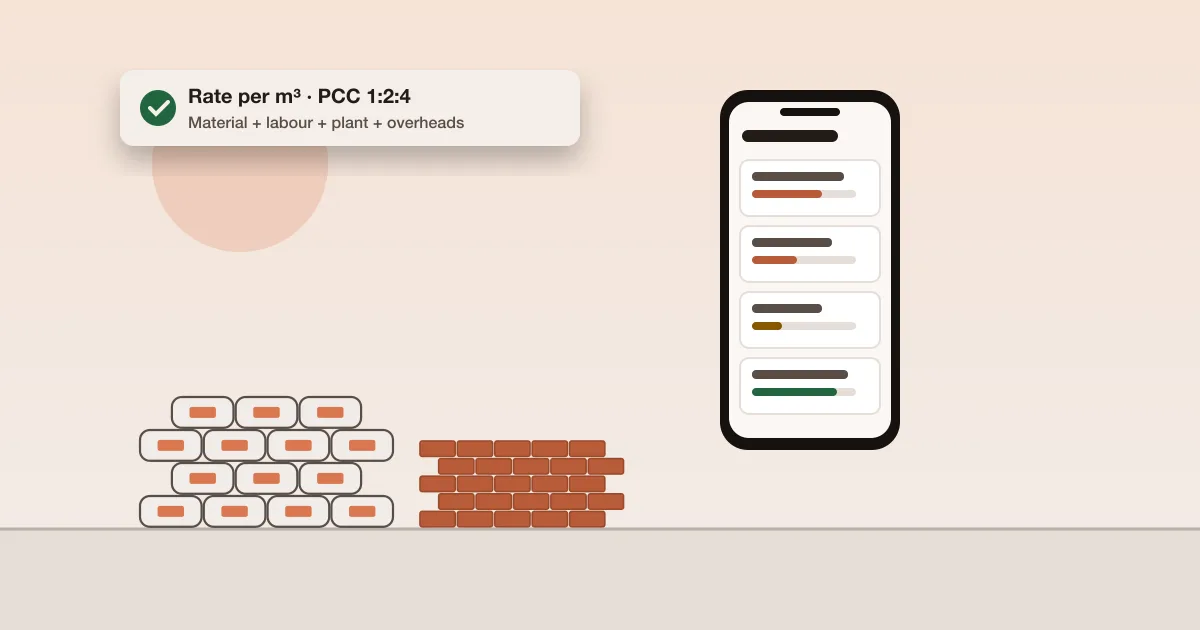
Rate analysis in construction is the working that turns one item of a bill of quantities into a price per unit. You take one unit of work, say a cubic metre of concrete, list every material, worker and machine it needs, price each one, and add your overheads and profit. The result is the rate you enter against that item.
The same working goes by two names. In Pakistan and India it is called rate analysis, and government departments publish their own analyses alongside a schedule of rates. In the Gulf and the UK it is usually called a rate build-up, and a tender may ask for one: a breakdown of each rate into labour, material, plant and on-costs, so the client can see the rate is realistic.
| Part | What it covers | How it is worked out |
|---|---|---|
| Material | Everything that ends up in the work | Quantity per unit × delivered price |
| Wastage | Spillage, offcuts, breakage, over-ordering | A percentage of material, by item |
| Labour | The gang that does the work | Gang cost per day ÷ units the gang completes per day |
| Plant | Mixers, pumps, vibrators, hoists, fuel | Hire per day ÷ units per day |
| Overheads | Office, staff, insurance, finance costs | A percentage of direct cost |
| Profit | Your margin and the risk you carry | A percentage of cost plus overheads |
How to build up a unit rate, step by step
- 1Read the item exactly as the bill describes it: the unit, what is included and what is measured separately. A concrete item usually excludes formwork and reinforcement, which have items of their own.
- 2List the materials for one unit and their quantities.
For site-mixed concrete, the dry volume of the mix is more than the wet volume it makes; South Asian practice uses about 1.54 m³ of dry material per m³ of concrete. The cement, sand and aggregate calculator works this out. - 3Price materials delivered to site, not at the yard gate.
Add transport and unloading if the supplier's price leaves them out. - 4Add wastage item by item.
Two to five percent is typical for concrete materials; tiles, blocks and timber can run higher. - 5Price labour from output, not from guesses per unit.
Decide the gang (for example one mason and six labourers), its daily cost and how many units it really completes in a day. - 6Price plant the same way: daily hire and fuel divided by the units it serves that day.
- 7Add overheads, then profit.
Keep them as separate lines so you can see what you are adding. - 8Round the final rate, and write down the date and the prices you used.
A rate without a date can't be checked later.
Worked example: 1 m³ of 1:2:4 concrete, mixed on site
Sample figures in Pakistani rupees, not market rates. Cement is taken at 1,440 kg per m³ and 50 kg per bag, which gives 0.22 m³ of cement, 0.44 m³ of sand and 0.88 m³ of crush from 1.54 m³ of dry material.
| Item | Working | Amount (Rs) |
|---|---|---|
| Cement | 6.34 bags × 1,450 | 9,193 |
| Sand | 0.44 m³ × 3,500 | 1,540 |
| Crush (aggregate) | 0.88 m³ × 6,500 | 5,720 |
| Wastage | 2.5% of 16,453 | 411 |
| Labour | Mason 2,500 + 6 labourers × 1,500 = 11,500 a day ÷ 5 m³ | 2,300 |
| Plant | Mixer and vibrator with fuel 7,500 a day ÷ 5 m³ | 1,500 |
| Direct cost | 20,664 | |
| Overheads | 7.5% of 20,664 | 1,550 |
| Profit | 10% of 22,214 | 2,221 |
| Rate per m³ | 24,435 |
Pakistani schedules often quote concrete per 100 cft. One m³ is 35.31 cft, so this rate is about Rs 69,192 per 100 cft. Government work is priced from the department's own schedule: Khyber Pakhtunkhwa's Finance Department, for example, issues a Market Rate System twice a year built from market prices of material, labour and equipment collected in Peshawar (KP Finance Department, MRS-2025). Use the schedule your client uses, and your own analysis to check you can build at that rate.
Rate build-up in the UAE: ready-mix, preliminaries and OH&P
On a UAE site the same item looks different. Concrete arrives as ready-mix and is pumped, labour is priced per hour all-in (wages, accommodation, transport and visa costs), and preliminaries are often priced as a percentage on top of the measured work. Turner & Townsend's 2025 benchmarks put preliminaries at 12% and overheads and profit at 12% for a 2,500 m² building in Dubai, and 15% and 15% in Abu Dhabi; on 50,000 m² projects overheads and profit drop to 10% in both (Turner & Townsend, 2025).
| Item | Working | Amount (AED) |
|---|---|---|
| Ready-mix concrete | 290 per m³ + 3% wastage | 298.70 |
| Concrete pump | 1,800 a day ÷ 60 m³ poured | 30.00 |
| Labour | 7 workers × 22 an hour × 8 hours ÷ 60 m³ | 20.53 |
| Vibrators and small plant | Allowance | 4.00 |
| Direct cost | 353.23 | |
| Preliminaries | 12% of 353.23 | 42.39 |
| Overheads and profit | 12% of 395.62 | 47.47 |
| Rate per m³ | 443.09 |
VAT at 5% goes on the bill, not into the rate. If the tender prices preliminaries in a section of their own, leave them out of each rate, or they are charged twice. To see what a whole villa comes to per square foot, use the UAE construction cost calculator.
Check the rate against what the job really used
A rate analysis is a forecast. Once work starts, the site tells you whether it was right: bags of cement issued per m³ poured, the gang's real output from the daily log, the pump's real hours. If cement per m³ runs at 7 bags instead of 6.34, either wastage is higher than you allowed or material is leaving the site.
Compare at least the three biggest items on every job, then update the analysis you price the next one with. How overheads and profit are set, and how the rates roll up into a full estimate, are covered in how to estimate construction costs.
Before you enter a rate
0 of 6 in placeTick what is already in place on your site.
Questions people ask
What is rate analysis in construction?
Working out the cost of one unit of an item of work, such as a cubic metre of concrete, from the material, wastage, labour and plant it needs, then adding overheads and profit.
What is the difference between rate analysis and rate build-up?
None in method. Rate analysis is the usual term in Pakistan and India; rate build-up is used in the Gulf and the UK, where tenders often ask for a breakdown of each rate into labour, material, plant and on-costs.
What percentage should I add for overheads and profit?
It is your decision on a private job. As a benchmark, Turner & Townsend put overheads and profit at 10–15% in Dubai and Abu Dhabi in 2025, depending on project size. Government schedules fix their own percentage, so use theirs on government work.
Is formwork included in the concrete rate?
Usually not. Most bills of quantities measure formwork and reinforcement as separate items, so the concrete rate covers only the concrete, its placing and the plant for it. Read the item description to be sure.
Is VAT included in a unit rate in the UAE?
No. Rates are entered without VAT, and 5% VAT is added to the bill or invoice total.